
Source of funds is where the money for this particular transaction came from. Source of wealth is how the customer built their overall wealth and assets over time. For a real estate agency, a deposit from a prior sale is a source of funds, while a career of salary, a business sale or an inheritance is a source of wealth. Since Tranche 2 obligations commenced on 1 July 2026, agencies are in the AML/CTF regime and are expected to know which question they are asking, when, and what evidence answers it.
TL;DR
- Source of funds (SoF) answers: how and where was the money for this transaction obtained? A bank account is only where the money sat, not necessarily its origin.
- Source of wealth (SoW) answers: how did this customer accumulate their entire wealth? It is broader and looks further back.
- Required under the Rules: your AML/CTF policies must say when you collect, or collect and verify, each (Rules 5-2). Foreign PEPs and some other PEPs require both, and enhanced CDD applies where relevant to the risk.
- Match evidence to risk. A lower-risk buyer needs less. A high-risk buyer, or one whose activity does not fit what you know, needs deeper, independently verified evidence.
- Record the reasoning, not just the documents, in one case record an auditor can follow.
Table of Contents
- The difference in plain terms
- Examples you will meet in property transactions
- When each one is required
- What evidence supports each claim
- How to verify, step by step
- When the evidence does not fit
- Putting it in your policies and risk assessment
- Recording the check for an audit
- Our perspective
- Where AML Guard fits
- FAQ
- Sources
The difference in plain terms
The two terms are often used as if they were interchangeable, and in practice they are asked together on many onboarding forms. They are different questions, and they protect you in different ways.
AUSTRAC describes source of funds as how and where money was obtained for a specific transaction, and source of wealth as how the customer accumulated their entire wealth and assets. Its guidance also makes a point that agencies often miss: the account the money is transferred from is the transfer location, and not necessarily the underlying source. Saying “the funds come from the customer’s Commonwealth Bank account” tells you where the money was held. It does not tell you how it got there.
A useful way to hold the difference: funds are the water in this transaction, and wealth is the catchment that fed it. One shows you the specific flow. The other tells you whether a flow of that size is plausible for this person at all.
| Source of funds | Source of wealth | |
|---|---|---|
| Question | Where did the money for this deal come from? | How did this person build their overall wealth? |
| Scope | One transaction or deposit | The customer’s whole financial position |
| Time horizon | Recent, tied to the deal | Years or decades |
| Property example | Proceeds of a prior sale, a loan, a gift from a parent | Salary over a career, sale of a business, an inheritance |
| Typical evidence | Settlement statement, loan approval, signed gift letter | Tax returns, business accounts, probated will, share-registry extract |
Examples you will meet in property transactions
AUSTRAC’s guidance lists the kinds of explanations that commonly sit behind the money. For a property purchase, the realistic source-of-funds explanations are:
- salary or wages saved over time
- business income or distributions from a trust
- dividends and investment income
- the sale of real estate or other personal property
- a gift from a family member
- an inheritance
- a loan
- compensation or an insurance payout
- royalties or gambling winnings
The AUSTRAC guidance on source of funds and source of wealth gives the first six as examples, and its list of evidence covers loans, compensation or insurance payouts, royalties and gambling winnings. The wealth explanations overlap, but they describe the whole picture: employment over a career, running or selling a business, investment returns, inheritance, and other economic, business or commercial activity that generated or significantly contributed to net worth.
Three property scenarios show how the two questions separate:
- A first home buyer with a parental gift. The source of funds for the deposit is the gift. The source of wealth is the buyer’s own salary history, and perhaps the parents’ circumstances if the gift is large.
- A downsizer buying with sale proceeds. The source of funds is the sale of the family home, which a settlement statement or title record supports. The source of wealth is decades of property ownership and employment.
- An investor buying through a company. The source of funds may be a distribution or a loan from a related party. The source of wealth is the business that generated the profit, which is where audited accounts and professional confirmations come in.
In each case the second question is what tells you whether the first answer is credible.
When each one is required
Neither is a blanket requirement for every customer at the same depth. The law ties them to risk, and your program has to say how.
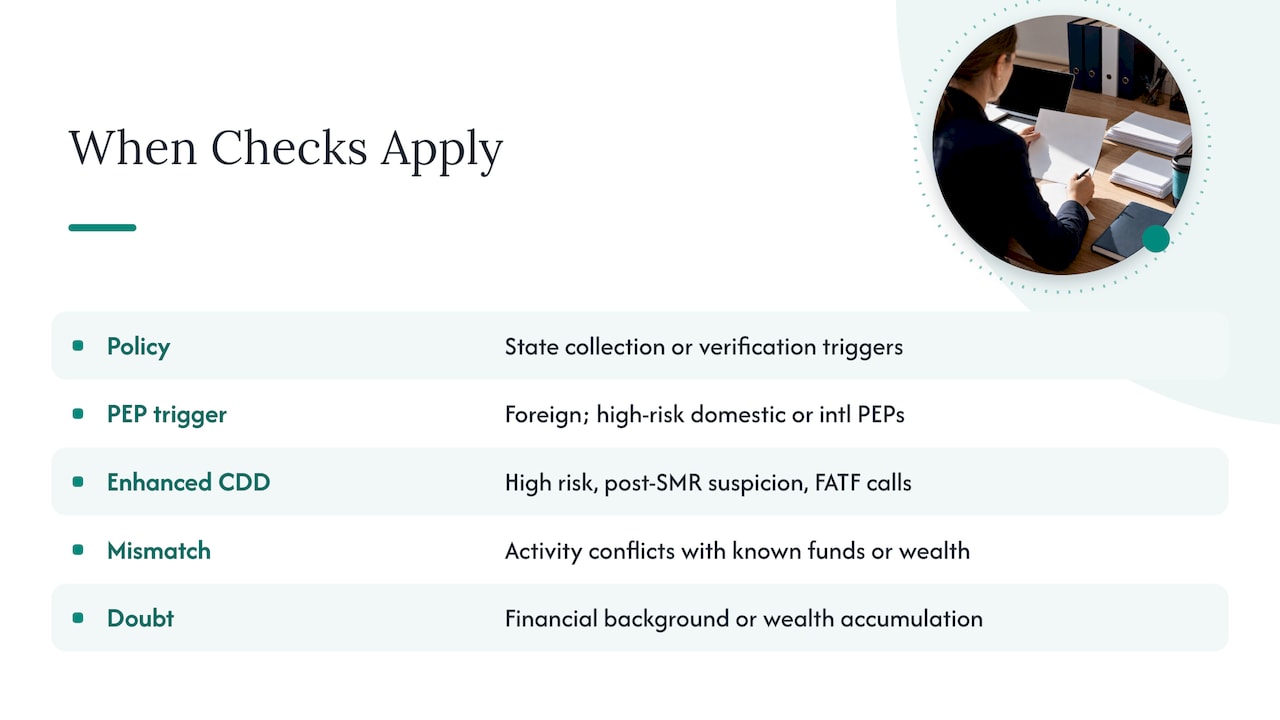
Your policies set the trigger. Under the AML/CTF Rules 2025, your policies must state when you collect, or collect and verify, source of funds and source of wealth information (Rules 5-2). This is a drafting obligation as much as a practical one: if your policy is silent, staff will improvise, and improvisation is hard to defend.
Politically exposed persons. For a foreign PEP, and for a domestic or international organisation PEP where the risk is high, the Rules require the PEP’s own source of wealth and source of funds (Rules 6-23). Note the wording: it is the politically exposed person’s own source of wealth and funds.
Enhanced CDD. Enhanced customer due diligence applies for high-risk customers, where you continue a matter after forming a suspicion that led to a suspicious matter report, and where a customer, beneficial owner or person acting for the customer is physically present in, or an entity was formed in, a jurisdiction subject to a FATF call for action. Source of funds and wealth are collected where relevant to the risk (Rules 6-21). Our guide to customer due diligence in Australia under Tranche 2 explains how initial, ongoing and enhanced CDD fit together, and the enhanced stream is covered there in more detail.
When something does not fit. Section 30(5)(d) treats activity that is at odds with the customer’s known source of funds or wealth as unusual. That sentence is the reason to collect the information at all: you cannot spot a mismatch against a profile you never built.
AUSTRAC also notes that source-of-wealth checks may be appropriate where there is doubt about the customer’s overall financial background or how the wealth was accumulated. Doubt is a legitimate trigger even when no category on your risk matrix has fired.
What evidence supports each claim
The principle is simple: the evidence must match the claimed source, and its depth must be appropriate to the customer’s ML/TF risk. AUSTRAC’s guidance lists documents including bank statements, payslips, tax returns, probated wills, loan agreements, investment statements, share-registry extracts, trust documents, business records, audited accounts, professional confirmations and signed gift documents.
Matched to claims, that looks like this:
| Claimed source | Evidence that fits |
|---|---|
| Salary or wages | Payslips, an employer letter, tax returns |
| Business income | Business records, audited accounts, an accountant’s confirmation |
| Sale of a property | Settlement statement, title deed or sale record |
| Inheritance | Grant of probate, executor’s letter |
| Gift | Signed gift declaration, plus evidence of the donor’s own means where the amount is large |
| Loan | Loan agreement or lender approval |
| Investments or shares | Investment statements, share-registry extract |
AUSTRAC’s own examples are concrete. In its initial CDD example for individuals, a customer explains that physical currency came from an inheritance and provides a grant of probate as verification. Its public guidance on proof gives further source-of-funds examples, including an accountant’s signed confirmation, a payslip summary or employer letter, an executor’s letter and a property sale record or title deed.
A bank statement on its own is the weakest answer to a source-of-funds question. It proves the money arrived, not how it was generated: AUSTRAC is explicit that the source of funds is not the account the money was transferred from. Enquiries should establish how the funds were generated, not just record an account number or payee. Practical steps include asking for written confirmation from the customer’s accountant and reviewing tax returns and business records.
How to verify, step by step
AUSTRAC’s approach to verification has a clear sequence. Apply it the same way every time so your records are consistent.
- Review what you already hold. Start with onboarding information. The answer is often partly there, and re-asking what you have already collected wastes the customer’s goodwill.
- Ask for more where appropriate. Request further information when the picture is incomplete or the risk calls for it.
- Verify through reliable, independent sources. A document the customer wrote themselves is a claim, not verification. A payslip, a registry extract or an accountant’s signed confirmation carries more weight.
- Assess the story. Is the explanation legitimate? Could the origin be unlawful? Is it consistent with the customer’s profile and expected activity?
- Scale the depth. Increase verification for high-risk customers, for inconsistent activity and for sources that are less common or more easily exploited.
- Record the outcome and the reasoning.
In AUSTRAC’s foreign PEP example, salary was verified with payslips and shareholdings with a share-registry summary. The entity documented the customer’s explanation, conducted ongoing CDD, escalated the risk assessment for senior manager approval and applied risk controls before proceeding. That is a good template for what a defensible file looks like: evidence, a written conclusion, and a named person who approved it.
When the evidence does not fit
A mismatch is the most useful thing the process can surface. A customer who declares a modest salary and arrives with a large cash deposit has not failed a test. They have given you a reason to look closer.
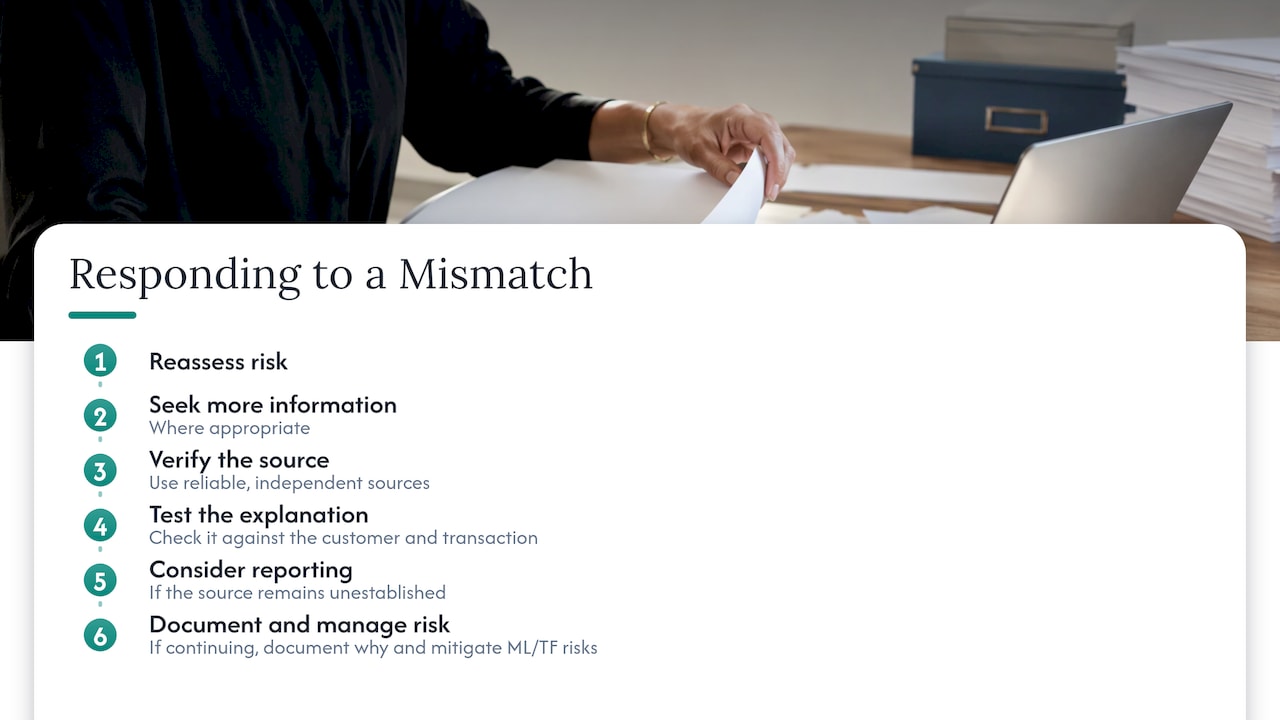
AUSTRAC’s guidance on what to do runs in order: reassess the risk, seek further information where appropriate, verify it with reliable and independent sources, and test whether the explanation fits what you know about the customer and the transaction. If the source still cannot be established, you should consider whether a suspicious matter report is warranted, document why continuing is appropriate if you do continue, and manage and mitigate the ML/TF risks. Closer monitoring or enhanced CDD may be appropriate in that situation. Where you are required to establish the source, for example under enhanced CDD during initial CDD, and cannot, AUSTRAC says you must not provide the designated service.
Two cautions on what not to do. First, do not treat a reputable bank as a substitute for the answer: knowing where money was held is not the same as knowing how it was generated. Second, do not tip off the customer if you are considering a report. Keep the conversation to the ordinary information you need for the transaction.
Overseas funds and overseas buyers
Funds from abroad deserve particular attention. AUSTRAC lists a party to the transaction being established in a high-risk country among the examples that could call for verification of what the customer has told you. Our article on overseas buyer AML checks for Australian agents walks through how that plays out at the contract stage, and the page on power of attorney and executor sales covers the cases where the person you deal with is not the person funding the deal.
Putting it in your policies and risk assessment
The risk assessment and the policies have to agree. If your business-wide assessment rates cash-heavy or overseas-funded purchases as high risk, your policies need to say that these require verified source of funds, and sometimes source of wealth. If the policy says one thing and the assessment another, a supervisor will notice. Our guide to the AML risk assessment for real estate agencies shows how to set those risk factors, and buyer due diligence for real estate agencies covers how the checks flow through a purchase.
A workable policy statement answers four things for each risk tier:
- what information staff must collect
- whether it must be verified, and to what standard
- who can approve proceeding when the evidence is incomplete
- how the decision is recorded
Staff also need to be able to apply it. A policy nobody has been trained on is not a control, which is why the training obligations for real estate agencies belong in the same conversation.
Recording the check for an audit
What an auditor or supervisor wants to see is the thread: the customer’s claim, the evidence you obtained, how you tested it, who decided, and why. Where you continued despite not establishing a source, the documented reason and the risk controls you applied are the essential part.
A practical record includes:
- the customer’s stated source of funds and, where required, source of wealth
- copies or references to the evidence, with the date obtained
- your assessment of whether it is consistent with the customer profile and the transaction
- the risk rating and the reasoning behind it
- the approver’s name and decision
- any SMR consideration and the rationale
Scattering these across email, a shared drive and a CRM note is how files fail. Keep them together.
Our perspective
Most agencies we speak with understand the definitions within a few minutes. The difficulty is consistency: the same question asked a different way by every agent, evidence saved in different places, and a conclusion that lives in someone’s head.
We built AML Guard for Australian Tranche 2 reporting entities so that source of funds and source of wealth are not a separate form bolted onto the file. Its guided wizards produce the risk assessment, the AML/CTF program, a customer acceptance policy and the training manual, and can pre-fill from your risk assessment, so the point at which your policies say you verify source of wealth starts from the risks you assessed.
Identity checks, screening results and the officer’s decision sit in one case record. The platform automates the lookups and the record keeping. It does not automate the judgement: for companies, beneficial ownership is determined from the ACN, and an officer approves each determination.
That is the standard we think the work deserves: evidence matched to risk, and a record that explains itself.
AML Guard
Where AML Guard fits
If you are administering this for an agency, the aim is a single place where the claim, the evidence and the officer’s decision sit together. AML Guard keeps one case record holding each identity check, screening result and officer decision, with ACN-based beneficial ownership determination and an officer approving each one. See the pricing page for the subscription and per-check fees.
AML Guard is not self-service; every firm starts with a demo. Book a demo to see how a case record looks in practice.
FAQ
Do I need both source of funds and source of wealth for every buyer?
Not necessarily. Your AML/CTF policies must state when you collect, or collect and verify, each of them, and the depth should match the customer’s ML/TF risk. A lower-risk buyer may need only a reasonable explanation of the funds. A foreign PEP, or a high-risk customer, will need both, verified to a higher standard.
Is a bank statement enough to prove source of funds?
Usually not on its own. A bank statement shows where money was held and when it arrived, not how it was generated. Pair it with evidence of the origin, such as a settlement statement for a property sale, a grant of probate for an inheritance or a signed gift declaration.
What if a customer cannot explain where the money came from?
Reassess the risk, ask for further information and try to verify it independently. Where the source is required and cannot be established, AUSTRAC says you must not provide the designated service. In other cases, if the source still cannot be established, consider whether a suspicious matter report is warranted, document why you are or are not continuing, and manage the risk through closer monitoring or enhanced CDD. Escalate to your AML/CTF compliance officer rather than deciding at the desk.
Sources
- Source of funds and source of wealth | AUSTRAC
- Initial CDD for individuals | AUSTRAC
- Proof of source of funds and source of wealth | AUSTRAC
- Foreign PEP example | AUSTRAC
Recommended
- Beneficial owners: two tests, one 25% trigger
- Who is a company’s beneficial owner under Australian law?
- AUSTRAC reporting: SMRs, TTRs and annual reports
- Overseas buyer AML checks for Australian agents
See How AML Guard Works
Tranche 2 obligations are now in force.
Book a 20-minute demo to see how AML Guard supports your compliance from the moment your designated service begins.