

Overseas buyers commonly trigger identity verification, sanctions and PEP screening, beneficial ownership tracing, and source of funds or wealth checks, with enhanced measures required whenever a foreign PEP is involved or the buyer is in, or was formed in, a jurisdiction the FATF has called for enhanced due diligence on. Some verification can wait: under Rule 6-32 of the AML/CTF Rules 2025, an agent acting for the seller may complete CDD on the buyer by the earlier of 28 days after exchange or 3 days before the initially agreed settlement day, where the conditions for delay are met.
TL;DR:
- Overseas buyers can verify with a passport, a foreign national identity card or a current driver’s licence; AUSTRAC lists all of these as primary photographic documents.
- Remote verification should carry documented reasoning about the risk, combining document capture with biometric liveness checks, and escalate if quality or jurisdiction risk is high.
- Sanctions screening against DFAT’s current Consolidated List is ongoing, not one-off; a match means escalation, legal advice and a full record.
- Rule 6-32 lets a selling agent complete the buyer’s CDD by the earlier of 28 days after exchange or 3 days before the agreed settlement day, but only where the section 29 conditions are met.
- Common pitfalls include incomplete ownership tracing, undocumented remote verification decisions, and missed deadlines, which can be addressed through structured templates and clear ownership.
Table of Contents
- Which identity documents and verification evidence to collect for overseas buyers
- How to verify overseas buyers remotely, and when reliance on another party is allowed
- Sanctions screening and politically exposed persons: obligations and ongoing monitoring
- Timing: completing buyer CDD under Rule 6-32 and managing the delay
- What to collect and verify for source of funds, source of wealth and beneficial ownership
- If you suspect wrongdoing: reports, escalation and record-keeping
- How a Tranche 2 compliance platform supports overseas buyer checks
- Practical steps and templates for an overseas buyer file
- Legal obligations and penalties for AML breaches involving overseas buyers
- Fitting overseas buyer checks into the Australian property transaction framework
- Common pitfalls and best practices in overseas buyer AML checks
- Practical perspective: three mistakes agencies make with overseas buyers
- How AML Guard helps firms meet Tranche 2 obligations
- Sources
- FAQ
Which identity documents and verification evidence to collect for overseas buyers
For an overseas individual, a foreign passport or a foreign national identity card is acceptable primary photographic identification, and so is a current driver’s licence. Australia has no national identity card of its own, so there is no Australian equivalent to ask for: AUSTRAC’s initial CDD guidance for individuals lists a passport, a driver’s licence, a proof of age card or a foreign national identity card as primary photographic documents.
For companies and trusts, the documentation task is different again:
- For an Australian company, resolve it against its ACN and confirm its directors and shareholders; for a foreign company, use its home registry records (and its ARBN if it is registered with ASIC), and trace ownership through every layer.
- Where a trust is buying, identify the trustee, the beneficiaries, the settlor, the appointor and anyone else with control; an Australian corporate trustee resolves on its own ACN.
- Review the trust deed to identify beneficiaries and confirm who controls distributions.
- Check for altered pages, mismatched names across documents, or a signature that does not match the identity document; any of these is a reason to ask for further evidence.
AUSTRAC treats confirming that the customer is the person they claim to be as its own step for every customer (section 28(3)(a)); for remote files it gives a video call or biometric comparison against the photo ID as ways to do it.
How to verify overseas buyers remotely, and when reliance on another party is allowed
Remote verification is permitted, but document why your chosen method manages the risk that particular buyer presents, not just that a method exists. The usual combination is document capture paired with biometric liveness, supported by certified copies or third-party identity verification where the buyer cannot attend in person.
- Capture the document images and the liveness check, and timestamp both.
- Have a compliance officer review the match and record the decision.
- File the rationale: why this method, for this buyer, manages this risk.
- Retain the evidence and the rationale together, not separately.
- Escalate to in-person or certified verification if the images are poor quality, the buyer’s answers are inconsistent, or the jurisdiction carries elevated risk.
Relying on another reporting entity’s CDD is possible only where the conditions in sections 37A or 38 and the Rules are met, and you still need your own risk assessment of the customer. Obtain their verification records in writing and confirm they were collected to the standard your own program requires.
Pro Tip: Record the non-face-to-face rationale in the same file note as the verification result, not in a separate compliance log; anyone reviewing the file should not have to hunt for it.
Sanctions screening and politically exposed persons: obligations and ongoing monitoring
Check the customer against DFAT’s Consolidated List, and cover any beneficial owners, anyone acting on the customer’s behalf and anyone the customer is buying for, not just the named buyer on the contract.
- Dealing with the assets of a person or entity designated for targeted financial sanctions without a permit from the Australian Sanctions Office can attract criminal penalties, and the list changes often, so a one-off check at onboarding is not enough.
- A politically exposed person is not limited to a foreign head of state: the definition covers prominent public functions in foreign and Australian governments and in international organisations, and extends to immediate family members and close associates.
- A foreign PEP as the buyer, a beneficial owner or anyone acting for the buyer requires enhanced CDD (section 32), including establishing the PEP’s source of wealth and source of funds (Rules section 6-23).
Beneficial ownership and screening workflows must check against the current Consolidated List, maintained by DFAT, because the list changes and a name cleared six months ago is not necessarily clear today.
A positive match is not a reason to panic, but it is a reason to stop and escalate: pause, do not deal with the person’s assets, notify your AML/CTF compliance officer, and get legal advice promptly on the freezing and reporting steps Australia’s sanctions laws require and on whether a suspicious matter report is due. Note too that foreign investment approval (the FIRB process) is a separate regime, not an AML/CTF check, and clearing it tells you nothing about sanctions or beneficial ownership risk.
Timing: completing buyer CDD under Rule 6-32 and managing the delay
Rule 6-32 of the AML/CTF Rules 2025 lets an agent acting for the seller start providing the service before completing CDD on the buyer, the party it is not acting for, but only where the conditions in section 29 of the AML/CTF Act are met, including that starting first is essential to avoid interrupting the ordinary course of business, that the added risk is low, and that your policies manage it. CDD must then be completed by the earlier of 28 days after exchange or 3 days before the initially agreed settlement day, as AUSTRAC’s delayed CDD guidance sets out. This gives selling agents room to manage a buyer who is still overseas or assembling documents, without stalling exchange.
The delay is a timing allowance, not an exemption: you must complete CDD by the deadline, and AUSTRAC says civil penalties may apply if you don’t. It is also unlikely to suit a buyer whose added risk is not low, such as one with a foreign PEP or an opaque structure. Set a firm internal deadline shorter than the rule’s outer limit, write down the decision to delay and why, and name who in the file is responsible for chasing it.
What to collect and verify for source of funds, source of wealth and beneficial ownership
Source of funds is the specific money paying for this property: a sale contract for a prior property, a loan approval, or a bank statement showing the transfer. Source of wealth is broader: how the buyer accumulated their overall net worth, evidenced by tax filings, business ownership records or inheritance documents.
- Match the amount and the timing of funds to the transaction before accepting the explanation.
- Trace beneficial ownership along the chain until you reach a natural person with 25% or more ownership or effective control.
- Where an Australian company sits in that chain, resolve it on its own ACN; for a foreign company, use its home registry records; where a trust sits in the chain, identify its trustee, and an Australian corporate trustee resolves on its own ACN.
- Escalate to senior management sign-off when the structure is opaque, layered across multiple jurisdictions, or involves a foreign PEP.
- Scale the depth of evidence to the assessed risk: a straightforward owner-occupier buyer needs less than a shell company buying through a chain of foreign trusts.
Pro Tip: Ask for the document that shows the money moving, not just the document that explains where the buyer says it came from; a bank statement beats a letter every time.
If you suspect wrongdoing: reports, escalation and record-keeping
A suspicious matter report to AUSTRAC under section 41 is due within 3 business days of forming the suspicion, or 24 hours for terrorism financing, whether or not the transaction proceeds; the obligation does not wait for the file to close.
- Filing an SMR does not by itself require you to stop acting, but if you continue, enhanced CDD applies (section 32); take legal advice on the file.
- Disclosing an SMR in a way that could prejudice an investigation is the tipping off offence (section 123), so keep the SMR decision confined to those who need to know.
- Where a sanctions match is involved, document the check against the Consolidated List, notify your compliance officer, and get legal advice before taking further steps.
- Retain records for the periods the Act sets: seven years from when a transaction record is made, and for CDD records, seven years after the business relationship ends or the occasional transaction is completed.
Keep a simple file checklist: the trigger, the evidence reviewed, who decided what, and the date each step occurred.
How a Tranche 2 compliance platform supports overseas buyer checks
Software does not replace judgement, but it removes a lot of the manual chasing that overseas buyer files demand.
- End-to-end CDD and enhanced CDD workflows that carry a file from identity capture through to sign-off.
- Remote identity verification through the client intake portal, with document and biometric checks completed before an officer reviews the result.
- Sanctions and PEP screening with an officer reviewing each match before a decision is recorded.
- Beneficial ownership resolved against a company’s ACN, with corporate trustees run through their own separate ACN determination.
- Suspicious matter report workflows and an audit trail that retains for 8 years, above the Act’s seven-year minimum.
Status indicators are pushed into REX CRM, without exposing underlying CDD data, and firms typically begin with a demo and a configured tenant rather than self-service sign-up.
Practical steps and templates for an overseas buyer file
A workable file structure makes the difference between a smooth audit and a scramble. Start every overseas buyer file with the same sequence, regardless of how straightforward the buyer looks at first contact.
Open the file at first enquiry, not at exchange. Record the buyer’s stated residency, the source of the enquiry, and whether a buyer’s agent or interpreter is involved. Collect the identification document (foreign passport or foreign national identity card) before progressing to contract terms, and note the sanctions and PEP screening result against the file date, not just the screening date, because the two can drift apart on a slow transaction.
Build a standing template with four sections: identity evidence, screening results, beneficial ownership and source of funds or wealth, and a timing log showing the Rule 6-32 deadline if verification is delayed. Each section should carry a single sign-off line: officer name, date, decision. Avoid templates that mix narrative and evidence in one block of text, because anyone reviewing the file later needs to find the decision without reading the whole history.
Where the buyer is purchasing through a company or trust, attach the company search and trustee determination to the same file rather than a separate corporate record, so the property file tells the whole story on its own. Revisit the file at two points beyond onboarding: before settlement, to confirm nothing has changed since screening, and at any point a red flag surfaces, such as a change in the source of funds or a new party appearing on the transfer documents. A consistent template across every overseas buyer file is what turns a compliance obligation into a repeatable process rather than a one-off scramble each time a new buyer appears.
Legal obligations and penalties for AML breaches involving overseas buyers
The governing law is the Anti-Money Laundering and Counter-Terrorism Financing Act 2006 (Cth) and the AML/CTF Rules 2025, and Tranche 2 obligations for real estate professionals commenced 1 July 2026 and are now in force, not a future deadline. A real estate agency acting as a reporting entity carries the same core obligations as any other Tranche 2 entity: identify and verify customers and beneficial owners, screen against sanctions lists, monitor on an ongoing basis, and report suspicious matters.
Breaches of these obligations carry civil and criminal consequences under the Act, and AUSTRAC has enforcement powers that extend from remedial directions through to court-ordered penalties for serious or repeated non-compliance. Dealing with the assets of a designated person or entity without a permit is a separate criminal matter under Australia’s sanctions laws, apart from any AML/CTF program failure.
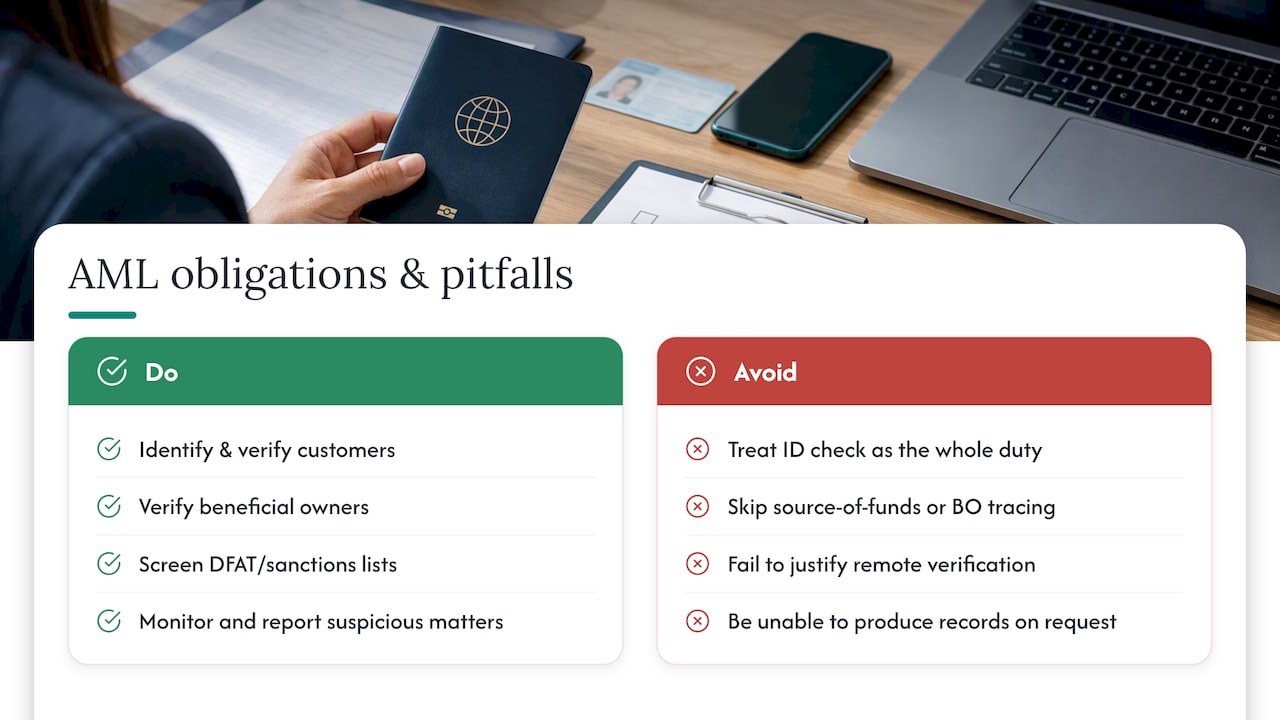
Two things trip up agencies specifically on overseas buyer files. The first is treating identity verification as the whole obligation and skipping source of funds or beneficial ownership tracing, which leaves the file incomplete even though the buyer “passed” the ID check. The second is failing to document why a remote verification method was adequate for that buyer’s risk profile, which leaves the file hard to defend even if the verification itself was accurate.
Record-keeping failures compound the risk: the Act requires records to be kept for seven years, and a file that cannot be produced on request is hard to defend, whether or not the underlying check was done properly. None of this is specific to foreign buyers as a category: the obligations apply to every customer, but overseas buyers are more likely to present the beneficial ownership complexity and PEP exposure that turns a routine file into one needing enhanced measures.
Fitting overseas buyer checks into the Australian property transaction framework
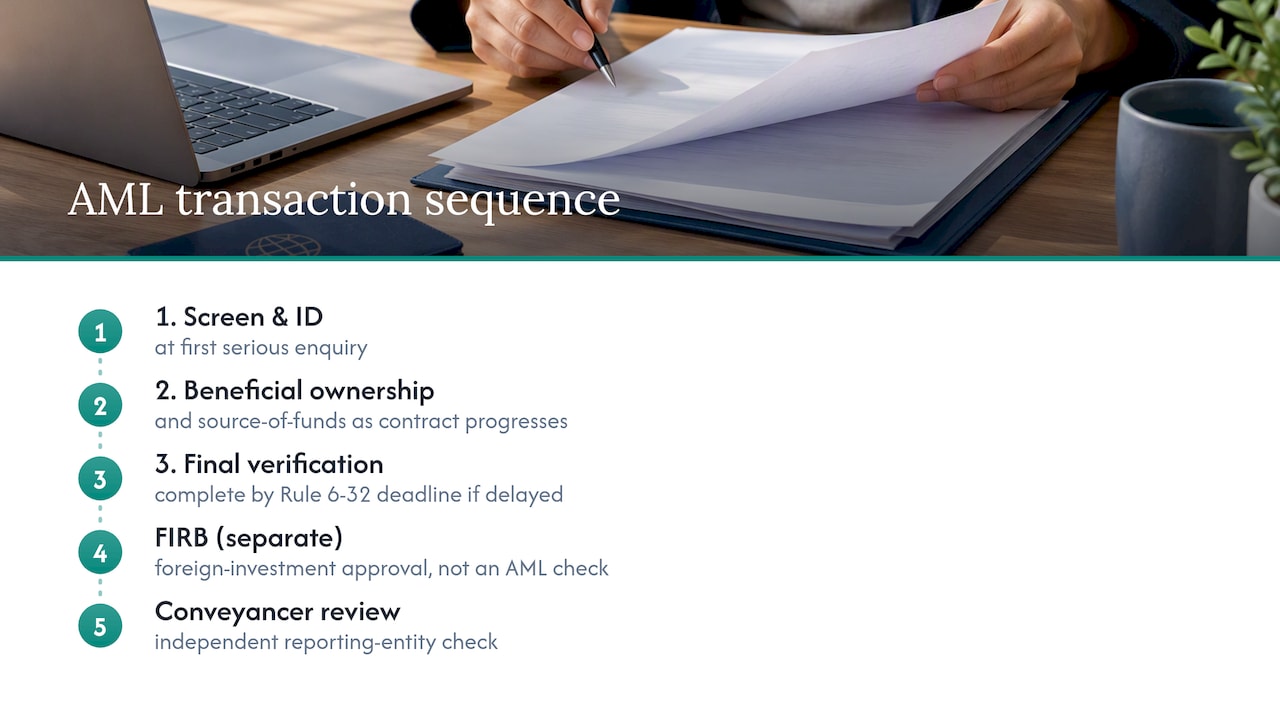
AML/CTF obligations sit alongside, not instead of, the other checks that already apply to a property transaction. FIRB approval is a foreign investment rule administered separately from AML/CTF compliance: a buyer clearing FIRB has satisfied a foreign investment test, not a sanctions check, a beneficial ownership check or a source-of-funds review. Treat them as two independent gates, and never assume one substitutes for the other.
Within the transaction timeline, the practical sequence for a selling agent looks like this: screen and begin identity verification at first serious enquiry, complete beneficial ownership tracing and source of funds checks as the contract moves toward exchange, and finalise any outstanding verification by the Rule 6-32 deadline if a delay was used. Conveyancers and settlement agents run their own parallel obligations as reporting entities in their own right, which means a buyer’s file may be checked independently by more than one party in the same transaction. That is not duplication for its own sake: each reporting entity is accountable for its own risk assessment and cannot simply adopt another party’s conclusion without meeting the reliance conditions in the Act.
Agencies that integrate AML checks into their existing settlement workflow, rather than bolting them on as a separate compliance task, tend to catch problems earlier: a source-of-funds gap noticed at the offer stage is far easier to resolve than one discovered three days before settlement under a Rule 6-32 deadline. Build the AML checkpoints into the same checklist used for contract conditions, deposit handling and settlement booking, so a buyer file cannot progress to the next transaction stage without the relevant compliance step being signed off.
Common pitfalls and best practices in overseas buyer AML checks
The most frequent pitfall is scope: an agent verifies the named buyer’s passport, screens that one name, and considers the job done. The buyer turns out to be purchasing through a company with an offshore corporate shareholder, and nobody traced ownership past the first layer. The fix is procedural, not clever: every corporate or trust buyer gets its ownership traced through each layer to the individuals (an Australian company on its ACN, a foreign company through its home registry, an Australian corporate trustee on its own ACN), as a standing step rather than a judgement call made case by case.
A second recurring issue is documentation of remote verification. An agent runs a competent biometric and document check on an overseas buyer, gets a clean result, and moves on without recording why that method was appropriate for this buyer’s risk level. When a file is reviewed later, the verification looks sound, but the file is hard to defend because the adequacy decision was never written down.
A third pattern involves Rule 6-32 deadlines slipping. An agent delays CDD on a legitimate overseas buyer who is travelling, intending to complete it well before the Rules 2025 deadline, but no one owns the follow-up and the file drifts past the earlier of the two trigger points. The practical fix is unglamorous: a named deadline in the file, owned by one person, checked against both the 28-day and 3-day-before-settlement triggers, with the earlier one treated as the real deadline from day one.
Best practice across all three pitfalls is the same: scope the check to the actual ownership structure, write down the reasoning behind remote verification, and manage timing deliberately rather than by default.
Practical perspective: three mistakes agencies make with overseas buyers
Agencies tend to stop at the passport. A clean identity check feels like due diligence completed, but source of funds and beneficial ownership tracing are where the real risk usually sits.
- Treating ID verification as sufficient: fix it by making source-of-funds and ownership tracing a standing step, not a judgement call.
- Skipping the adequacy write-up for remote verification: fix it by recording the rationale and the officer’s sign-off in the same file note.
- Letting Rule 6-32 deadlines drift: fix it with a named owner and a deadline set against the earlier trigger point.
Pro Tip: If a step feels optional on a “straightforward” overseas buyer, that is usually the step someone will ask about later.
How AML Guard helps firms meet Tranche 2 obligations
Running overseas buyer checks by hand means juggling identity documents, sanctions lists, beneficial ownership chains and a Rule 6-32 clock, often across several files at once. AML Guard is built for Tranche 2 reporting entities to carry that load as one connected workflow rather than a set of disconnected tasks.
- End-to-end CDD and enhanced CDD, including remote identity verification through a client intake portal.
- PEP and sanctions screening with an officer reviewing each match before a decision is logged.
- Beneficial ownership resolved against a company’s ACN, with corporate trustees verified through their own separate ACN determination.
- Suspicious matter report workflows and an 8-year tamper-evident audit trail, above the Act’s seven-year minimum.
- Status indicators pushed into REX CRM without exposing underlying CDD data.
The process starts with a demo, after which the tenant is configured to your services and risk profile, on a month-to-month or 12-month term. Review the platform overview or the pricing page for Standard Individual, High-Risk Individual and Company / Trust services, and book a demo when ready to move overseas buyer files onto a documented workflow.
Sources
- Initial CDD for individuals | AUSTRAC
- Delayed initial customer due diligence | AUSTRAC
- Consolidated List | Australian Government Department of Foreign Affairs and Trade
- Anti-Money Laundering and Counter-Terrorism Financing Rules 2025
- Anti-Money Laundering and Counter-Terrorism Financing Act 2006 (Cth)
FAQ
What are the new AML rules in Australia?
Tranche 2 obligations under the Anti-Money Laundering and Counter-Terrorism Financing Act 2006 (Cth) and the AML/CTF Rules 2025 commenced 1 July 2026 and apply to real estate professionals, lawyers, accountants, trust and company service providers, and dealers in precious metals and stones. They require customer due diligence, enhanced CDD for higher-risk customers, sanctions and PEP screening, and suspicious matter reporting.
Do estate agents need to do AML checks on buyers?
Yes. When an agent acting for the seller brokers a sale, the buyer is also the agent’s customer. Rule 6-32 lets the agent complete the buyer’s CDD after it starts providing the service, by the earlier of 28 days after exchange or 3 days before the initially agreed settlement day, where the section 29 conditions are met.
What are the new rules for foreigners buying property in Australia?
Overseas buyers go through the same Tranche 2 CDD process as any other buyer: identity verification, beneficial ownership tracing, sanctions and PEP screening against the DFAT Consolidated List, and enhanced CDD where section 32 requires it, for example a foreign PEP. FIRB approval is a separate foreign investment requirement and does not substitute for any of these AML/CTF checks.
Are AML checks mandatory?
Yes, AML/CTF checks are mandatory for Tranche 2 reporting entities, including real estate agencies, under the Act and the AML/CTF Rules 2025. Failing to complete them exposes the firm to civil and criminal penalties and puts the transaction itself at risk if a sanctions or beneficial ownership issue surfaces later.
Recommended
- AML/CTF Compliance Checklist for Real Estate Agents: What You Need Before 1 July 2026
- AML training real estate: what agencies must do
- Tranche 2 customer due diligence in Australia
- AML/CTF Program Documents for Tranche 2
See How AML Guard Works
Tranche 2 obligations are now in force.
Book a 20-minute demo to see how AML Guard supports your compliance from the moment your designated service begins.