
A beneficial owner is a natural person who ultimately owns or controls a customer that isn’t a natural person themselves. Two separate tests apply: an ownership test, where an individual holds 25 per cent or more directly or indirectly, and a control test, where an individual directs the entity through appointment rights, voting arrangements, or a decision-making role, regardless of shareholding. Trusts and layered corporate structures need tracing to a natural person, and an AML/CTF compliance officer must approve the final determination before customer due diligence proceeds.
TL;DR:
- Beneficial owners are identified through both ownership and control tests, with ownership defined by holding 25% or more of a company’s shares and control by appointment rights or voting arrangements.
- Consistent documentation, including ASIC extracts, deed reviews, and verification records, is essential to prove a reasonable and auditable beneficial ownership determination.
- Trust and layered ownership structures require tracing through trustees and corporate chains, with special attention to beneficiaries, deed provisions, and recent distribution records.
- Automated platforms can streamline the lookup and verification process, but officer approval remains a critical gatekeeper before conducting identity and sanctions screening.
- Australia’s planned reforms aim to establish a public beneficial ownership register, but until then, firms must maintain detailed internal records and update them regularly.
Table of Contents
- What are the two legal tests for ultimate beneficial owner status in Australia?
- How do you identify and verify a beneficial owner step by step?
- How do you handle trusts, SMSFs and layered ownership chains?
- What records prove you were ‘reasonably satisfied’ of a beneficial owner?
- How do current register gaps and reforms change your approach?
- Practitioner notes: where beneficial ownership determinations actually fail
- Why thorough beneficial ownership procedures reduce supervisory risk
- Get beneficial ownership determination right without the manual slog
- Sources
- FAQ
What are the two legal tests for ultimate beneficial owner status in Australia?
The Act uses the term “beneficial owner.” UBO is the common shorthand, but your policy documents and your officer sign-offs should stick to the statutory term. AUSTRAC’s glossary defines a beneficial owner as an individual who ultimately owns, directly or indirectly, 25% or more of a non-individual customer, or who controls that customer directly or indirectly.
That definition splits into two tests, and treating them as one is where most determinations go wrong.
- Ownership test. Combine every direct and indirect shareholding an individual holds through the corporate chain. A person holding 15% directly and a further 12% through a family holding company crosses the 25% floor.
- Control test. An individual can be a beneficial owner with zero shares. Appointment rights over directors, a voting agreement, or a contractual right to direct the entity’s operations all satisfy this test on their own.
The AUSTRAC guidance on determining ownership and control structures is explicit that the 25% threshold is a trigger for further inquiry, not proof of anything. A shareholder sitting at 24% who also chairs the board and holds a casting vote is very likely a beneficial owner through control, even though the ownership test alone says no.
How do you identify and verify a beneficial owner step by step?
Run the same sequence every time, and document each step as you go. Consistency is what turns a determination into evidence.
- Collect customer disclosure first. Ask the customer to name every individual they believe meets either test, then verify rather than accept it at face value.
- Search the ASIC company register by ACN. This gives you the registered shareholders, officeholders, and any related corporate entities in the structure.
- Trace through intermediate companies. Where a shareholder is itself a company, resolve that company’s own ACN and repeat the search until you reach natural persons.
- Combine percentages across the chain. Add direct and indirect holdings for each individual before testing against the 25% floor.
- Request supporting documents. Shareholder registers, share certificates, and constitutional documents corroborate what the registry shows.
- Verify identity and screen. Run identity verification and sanctions, PEP, and adverse media screening on every individual identified as a beneficial owner.
- Escalate where registry data ends. Overseas owners, private trusts, or unlisted holding structures require deed requests, distribution records, and enhanced due diligence.
- Timestamp every action and route to sign-off. No determination is relied upon until an AML/CTF compliance officer has reviewed and approved it.
Pro Tip: Never rely on a single ASIC extract as your final record. Registry snapshots go stale the moment a share transfer or director change is lodged, so date every document you pull and re-check before you rely on it for a live transaction.
A practical process for tracing ownership through multiple companies and legal vehicles is worth building into your standard operating procedure, because the same sequence repeats for almost every corporate customer you’ll encounter.
How do you handle trusts, SMSFs and layered ownership chains?
A trust doesn’t resolve like a company, and treating it that way is a common audit finding. You reach a trust through its corporate trustee, and that trustee runs its own beneficial ownership determination on its own ACN, separate from the trust’s ownership question.
Deed review is officer work, not an automated lookup. Request:
- The trust deed itself, including any amendments or variations.
- Recent distribution records, ideally covering the last three years.
- Appointor details, since the appointor can usually remove and replace the trustee.
- Any beneficiary register the trustee maintains, where one exists.
For discretionary trusts, actual beneficiaries only crystallise when a distribution is made. The Treasury consultation paper on beneficial ownership reform points practitioners toward recent distribution history and appointor powers as the practical basis for identification, and recommends escalating to enhanced due diligence whenever the beneficiary class stays genuinely open-ended. SMSFs follow the same corporate-trustee logic: identify the members, confirm trustee identity, and trace any corporate trustee chain back to a natural person exactly as you would for a standard company. Guidance on beneficial ownership determination for trusts and SMSFs sets out the document sequence in more depth.
What records prove you were ‘reasonably satisfied’ of a beneficial owner?
An auditable file needs more than a name and a percentage. AUSTRAC’s own guidance on determining ownership and control structures points to a recorded chain map as the baseline: every legal entity in the structure, the source document for each link, the officer’s reasoning wherever control was established by means other than shareholding, and the verification method used for each individual.
At minimum, keep:
- ASIC extracts and company search results, dated.
- Trust deed excerpts and distribution records where relevant.
- Identity verification and screening outputs for each beneficial owner.
- The officer’s written reasoning and final sign-off.
Beneficial ownership determination is an officer-led judgement. Automated lookups can assemble the ownership chain faster than a manual search ever could, but a person still has to approve it before you rely on it. Retain everything for seven years in a tamper-evident format, because the most common audit failure isn’t a wrong determination. It’s a right determination with no record showing how you got there.
How do current register gaps and reforms change your approach?
Australia doesn’t operate a central public beneficial ownership register. Reporting entities carry the full weight of building and maintaining their own records.
Treasury has flagged a staged fix. Under the proposed reform, stage one asks entities to maintain internal registers of registrable beneficial owners, and stage two moves toward a Commonwealth-operated public register, with ASIC already funded to develop the underlying registry infrastructure.
Until that public register exists, three things matter:
- Keep a current internal register for every corporate customer, not just the high-risk ones.
- Build systems that can ingest public register data once it arrives, rather than starting from scratch later.
- Revise your policies and staff training now so the shift to registrable beneficial owners as recognised stopping points in a chain doesn’t catch your program off guard.
Practitioner notes: where beneficial ownership determinations actually fail
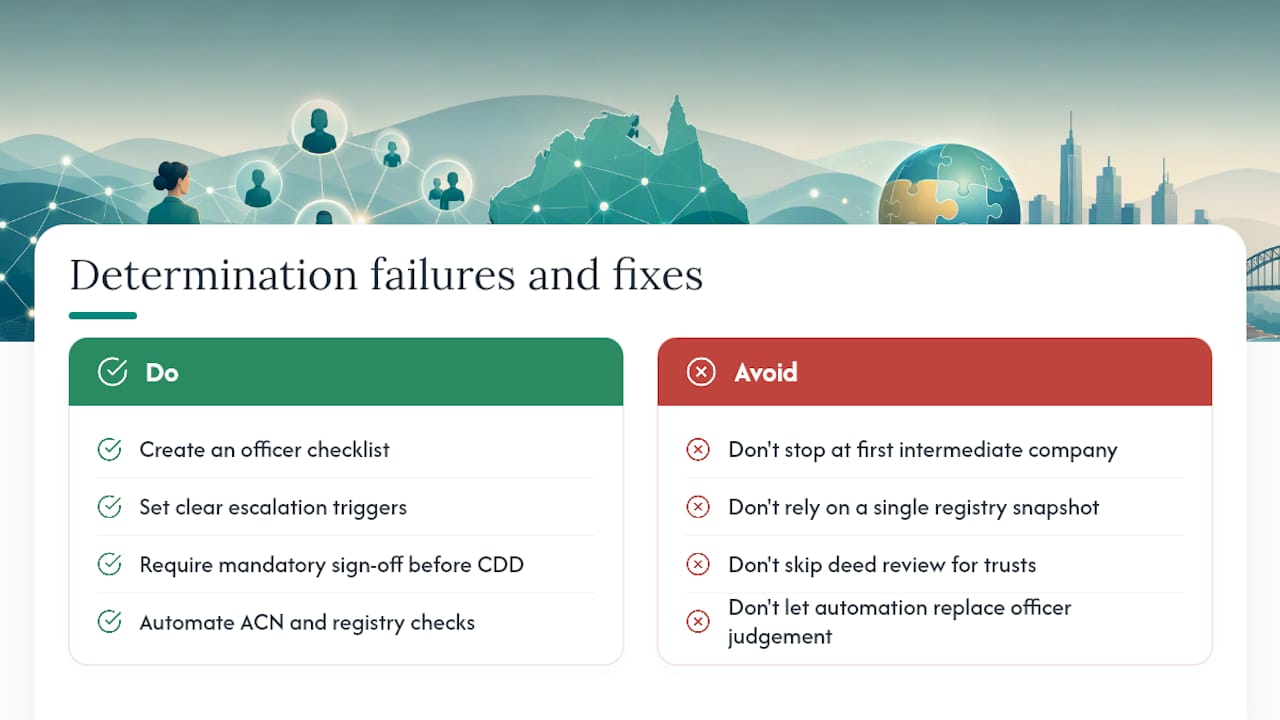
The recurring pitfalls are structural, not exotic. Officers stop tracing at the first intermediate company instead of pushing to a natural person, lean on a single stale registry snapshot, or skip deed review because a trust “looks simple.” Fix this with an officer checklist, clear escalation triggers for enhanced due diligence, and mandatory sign-off before any determination feeds into customer due diligence. A compliance platform can automate the ACN lookups and the registry checks. It cannot, and should not, replace the officer’s judgement on control.
Why thorough beneficial ownership procedures reduce supervisory risk
Getting beneficial ownership right isn’t a paperwork exercise. It’s what a supervisor checks first, because a sloppy determination usually signals a sloppy program overall. Consistent policies, properly trained staff, and a documented decision trail turn a beneficial ownership file from a liability into evidence your Tranche 2 program actually works as designed.
Get beneficial ownership determination right without the manual slog
Chasing ACN lookups, chasing deed pages, and building a defensible chain map by hand eats hours every Tranche 2 reporting entity can’t spare. A compliance platform can run beneficial ownership determination on a company’s ACN directly against registry data, and reach trusts and SMSFs through their corporate trustee, which gets its own determination on its own ACN. Deed review stays exactly where it belongs, with your officer, but every lookup, screening result, and decision is logged into a seven-year tamper-evident audit trail the moment it happens.
Nothing proceeds to identity verification or sanctions and PEP screening until an AML/CTF compliance officer has approved the determination. That gating is deliberate: the platform automates the lookups and the record keeping, never the judgement call. If your current process relies on spreadsheets, email chains, and whoever remembers to check the trust deed, book a demo through the AML Guard platform and see how a linked risk assessment, policy set, and training manual make that judgement easier to defend at your next supervisory review.
Sources
- Beneficial owner | AUSTRAC
- Policy specifications: Beneficial ownership reform in Australia (Treasury consultation paper)
- Improving transparency of the true owners of companies
FAQ
Who is considered an ultimate beneficial owner?
An ultimate beneficial owner, or beneficial owner under the Act, is a natural person who ultimately owns 25% or more of an entity or who controls it through appointment rights, voting power, or a directing role, even without any shareholding.
How do you identify the beneficial owner of a company?
Search the ASIC register by ACN, trace shareholdings through any intermediate companies until you reach natural persons, and combine direct and indirect holdings before checking them against the 25% floor and the separate control test.
Who qualifies as the beneficial owner of a trust?
A trust is reached through its corporate trustee, which runs its own determination on its own ACN; officers must also review the trust deed, appointor rights, and recent distribution history to identify beneficiaries who own or control the trust.
How do you calculate the ownership threshold for a beneficial owner?
Add every direct and indirect shareholding an individual holds across the full corporate chain, then compare that combined figure to the 25% floor set out in AUSTRAC’s definition, remembering that control can apply independently of any ownership percentage.
Recommended
- Who is a company’s beneficial owner under Australian law?
- Beneficial Ownership CDD for Trusts, SMSFs & Companies
- AML/CTF Compliance Checklist for Real Estate Agents: What You Need Before 1 July 2026
- Beneficial Ownership in Property Transactions: How to Trace UBOs Under Tranche 2
See How AML Guard Works
Tranche 2 obligations are now in force.
Book a 20-minute demo to see how AML Guard supports your compliance from the moment your designated service begins.