
A Tranche 2 firm may give AUSTRAC three kinds of report: suspicious matter reports, due within 3 business days, or 24 hours for terrorism financing; threshold transaction reports for $10,000 or more in physical currency, due within 10 business days; and the annual AML/CTF compliance report, which now runs on the financial year. New SMR and TTR forms took effect on 1 July 2026.
TL;DR:
- File an SMR when you suspect on reasonable grounds, not on proof; filing does not require refusing the service, and disclosing a report where that could prejudice an investigation is the tipping off offence.
- TTRs apply when you receive or pay $10,000 or more in physical currency, whether or not anything looks suspicious; electronic transfers and cheques do not count, and splitting cash to avoid the threshold is itself an offence.
- The first financial year report covers 1 July 2026 to 30 June 2027 and must be lodged by 30 September 2027.
- Newly regulated firms use the new SMR and TTR forms from day one; the transition to 30 March 2029 applies only to entities already enrolled on 30 March 2026.
Table of Contents
- SMRs, TTRs and the annual compliance report at a glance
- When does a firm need to file a suspicious matter report?
- Threshold transaction reports and the $10,000 cash rule
- International value transfer service reports: rare for most firms
- Annual AML/CTF compliance report: new financial year timing
- What changed on 1 July 2026
- Submitting reports: methods, records and retention rules
- AUSTRAC’s expectations of newly regulated firms
- Tranche 2 reporting obligations by sector
- How these obligations play out in practice
- Compliance programs and reporting: how they connect
- What we’d prioritise first
- Where AML Guard fits into your reporting workflow
- FAQ
- Sources
SMRs, TTRs and the annual compliance report at a glance
Each report answers a different question, and knowing which one applies saves time when a transaction raises a flag.
- A suspicious matter report tells AUSTRAC about a customer or transaction the firm suspects, on reasonable grounds, is linked to money laundering, terrorism financing or other offences (section 41 of the Act).
- A threshold transaction report records a receipt or payment of $10,000 or more in physical currency, whether or not anything looks suspicious.
- The annual AML/CTF compliance report is a yearly report on the firm’s compliance with the Act, the regulations and the Rules.
In most firms, the AML/CTF compliance officer handles reporting, though front-line staff usually raise the internal flag first. International value transfer service reporting under section 46 starts on 31 March 2029 under the Transitional Rules 2026 (an entity already reporting international funds transfer instructions may choose a later date, up to 30 September 2029); until then the older international funds transfer instruction reporting continues.
When does a firm need to file a suspicious matter report?
A suspicious matter report is required once the firm suspects on reasonable grounds, not on proof. AUSTRAC’s suspicious matter reporting guidance confirms the report is due within 24 hours if the suspicion relates to terrorism financing, or within 3 business days for other matters, under section 41. Filing an SMR does not require refusing the service to the customer, but if you continue to act, enhanced CDD is mandatory (section 32).
A useful SMR is short and specific. It should include:
- A succinct account of the grounds for suspicion, not a full case history.
- The enhanced due diligence steps taken before or after the concern arose.
- Details of the affected transactions and the standard KYC fields completed in full.
Report on time rather than waiting for certainty: the deadline runs from when the suspicion is formed, and AUSTRAC does not require enhanced CDD to be finished before an SMR is submitted.
Tipping off is an offence under section 123: disclosing that a suspicious matter report has been or must be given, where that would or could reasonably be expected to prejudice an investigation. Keep staff notes and internal communications tightly controlled once a concern is raised; AUSTRAC’s tipping off guidance and our guide to suspicious matter reports for Tranche 2 firms set out the controls.
Threshold transaction reports and the $10,000 cash rule
A threshold transaction report is triggered when the firm receives or pays $10,000 or more in physical currency (notes and coins, Australian or foreign of the same value) in providing a designated service. It has nothing to do with suspicion: if the threshold is met, the report is due. AUSTRAC’s TTR guidance gives worked examples.
- Lodgement is due within 10 business days of the transaction under section 43.
- A conveyancer accepting a large cash deposit toward settlement may need to file.
- A real estate agent handed a cash deposit of $10,000 or more faces the same obligation; a deposit the buyer pays into the agency’s bank account does not count.
- Splitting cash payments to stay under the threshold is itself an offence (section 142), so watch for a series of cash amounts just under $10,000.
International value transfer service reports: rare for most firms
Section 46 covers international value transfer service reports, which start on 31 March 2029 under the Transitional Rules 2026. Most professional firms, real estate agencies, law practices, conveyancers and accounting practices among them, will rarely have reason to give one, since their designated services typically do not involve this kind of transfer. Where a firm’s work does intersect with cross-border value transfers, check the obligation against the specific service provided rather than assuming it applies by default.
Annual AML/CTF compliance report: new financial year timing
The annual AML/CTF compliance report now runs on the financial year rather than a calendar cycle. AUSTRAC’s annual compliance reports guidance confirms the next reporting period is 1 July 2026 to 30 June 2027, under section 47 of the Act and section 9-9 of the AML/CTF Rules.
- Lodgement is due within three months of the period ending, meaning the submission window for this first period runs from 1 July to 30 September 2027.
- The report relates to the firm’s compliance with the Act, the regulations and the Rules over the period, and is given in the approved form.
- Failing to lodge within the window can attract a civil penalty (section 47(4)), so this date belongs on the compliance calendar well before the period closes.
What changed on 1 July 2026
AUSTRAC released new SMR and TTR forms on 1 July 2026, designed to improve data quality and streamline reporting in AUSTRAC Online. Newly regulated firms use them from day one; enrolled firms could preview them in AUSTRAC Online before their obligations began, along with training and quick reference guides. The transition period, to 30 March 2029, applies only to entities that were already enrolled on 30 March 2026. Cross-border movement and international funds transfer reporting did not change.
Submitting reports: methods, records and retention rules
Getting the mechanics right matters as much as getting the timing right.
- Submit through AUSTRAC Online, one report at a time or, for higher volumes, through AUSTRAC’s bulk reporting options, using AUSTRAC’s user guides.
- Record the compliance officer’s reasoning and the enhanced CDD steps taken internally, separate from the report itself, so the thinking behind a decision is visible later.
- Keep records for the periods the Act sets, seven years from different starting points; AML Guard’s audit trail holds them for 8 years, above the Act’s seven-year minimum.
- Restrict access to sensitive notes about a pending or filed suspicious matter report to the people who genuinely need it, to avoid an inadvertent tipping-off breach.
Pro Tip: Keep SMR reasoning and TTR records in a system with role-based access, so a tipping-off risk never comes down to who happened to see an open file.
AUSTRAC’s expectations of newly regulated firms
AUSTRAC’s published expectations for newly regulated businesses were that by 1 July 2026 they would be enrolled, have an AML/CTF program (AUSTRAC’s starter program or their own), have a compliance officer, have trained their staff, and be ready to ask clients questions and report suspicious activity. AUSTRAC said it does not expect newly regulated businesses to be perfect from day one, but does expect honest efforts, and that after 1 July 2026 its enforcement in these sectors would focus on entities that wilfully ignore the obligation to enrol, or that it suspects are complicit with, or wilfully blind to, money laundering.
Tranche 2 reporting obligations by sector
The reporting duties above apply uniformly, but the designated services that trigger them differ by sector. Real estate agents, buyers agents and property developers typically trigger reporting obligations around settlement, deposit handling and cash receipts tied to property transactions. Conveyancers and settlement agents sit close to the same transaction flow, so their trigger points often overlap with real estate, though the designated service they provide is framed around the legal and administrative steps of a property transfer rather than the sale itself.
Law firms and accounting practices more often encounter suspicious matter triggers tied to the nature of instructions received, such as a client structuring a matter to obscure the source of funds or the identity of a beneficial owner. Their reporting obligations attach to specific designated services, for example receiving, holding or controlling a client’s money in a transaction or providing company formation services, rather than to the practice as a whole.
Trust and company service providers carry a distinct exposure because the designated service itself, forming companies, acting as a company secretary or providing a registered office, sits at the point where beneficial ownership can be deliberately obscured. For this group, the suspicious matter report often follows directly from beneficial ownership work: if the true owner cannot be identified or the structure looks designed to frustrate identification, that itself can be grounds for suspicion.
How these obligations play out in practice
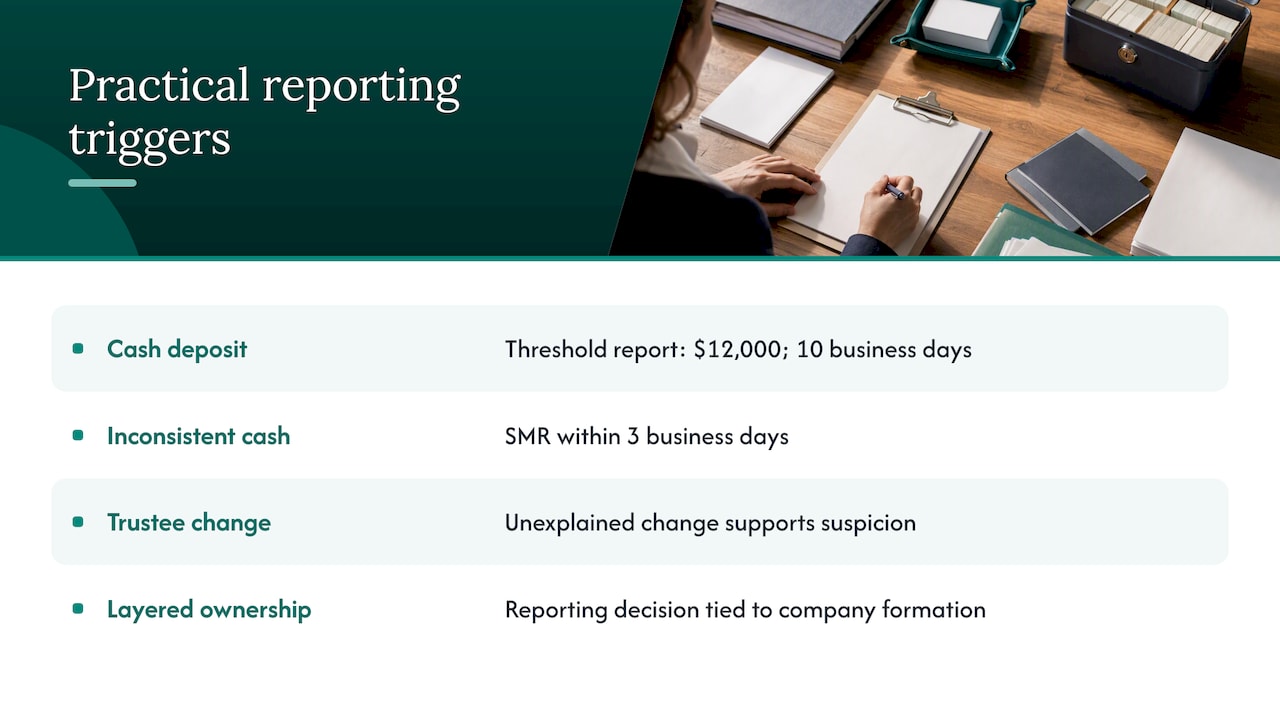
A real estate agency accepting a cash deposit of $12,000 toward a holding deposit files a threshold transaction report within 10 business days, regardless of whether anything about the buyer looks unusual. The same agency, if a buyer insists on paying in cash while providing inconsistent explanations for the source of funds, has separate grounds to consider a suspicious matter report, filed within 3 business days under section 41.
A conveyancing firm handling settlement for a trust-held property may need to look through to the corporate trustee to identify the beneficial owner. If the trustee structure changes shortly before settlement without a clear commercial reason, that pattern itself can support reasonable grounds for suspicion, separate from any cash threshold.
An accounting practice asked to set up a company with unusually layered ownership, where the client is reluctant to name the ultimate beneficial owner, faces a reporting decision tied to the company formation service itself rather than to any single transaction amount. In each case, the designated service provided, not the firm’s size or sector label, determines which report applies and when the clock starts running.
Compliance programs and reporting: how they connect
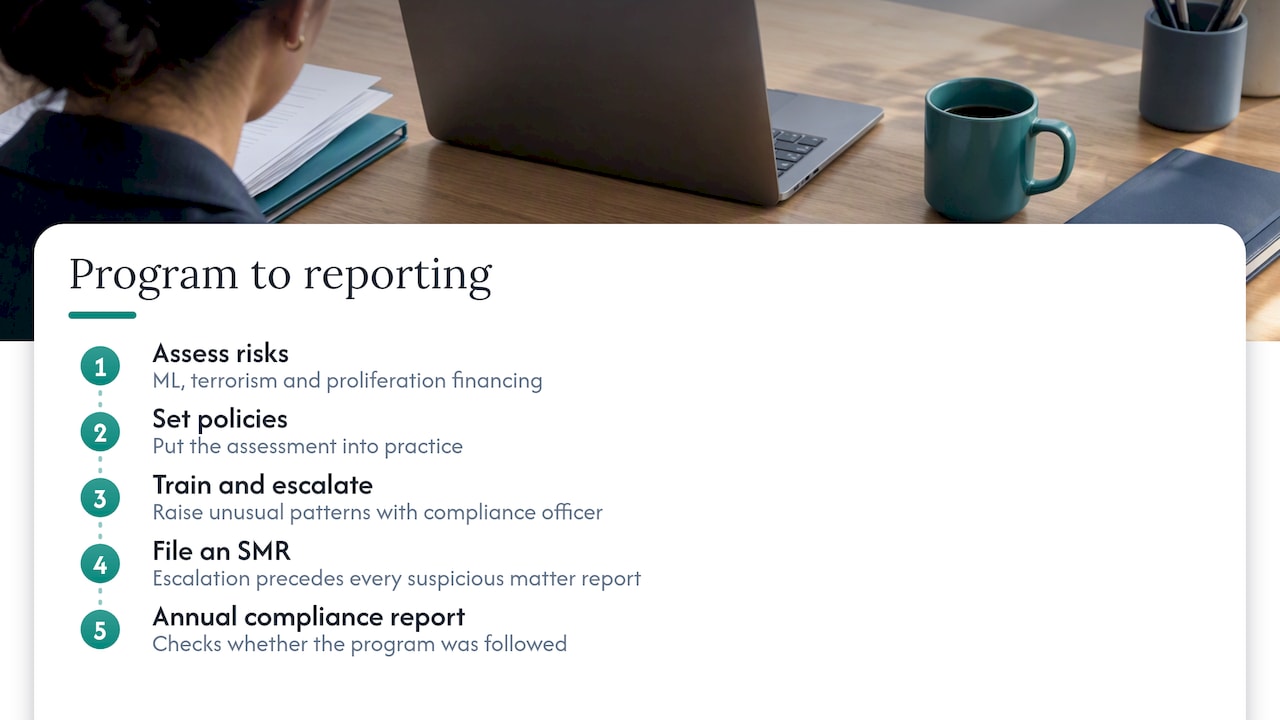
A reporting obligation does not exist on its own. It sits downstream of the AML/CTF program each Tranche 2 entity is required to maintain: a business-wide risk assessment under section 26C, covering money laundering, terrorism financing and proliferation financing, paired with the AML/CTF policies that put that assessment into practice.
The program is what tells staff when a transaction pattern is unusual enough to raise with the compliance officer, which is the step that precedes every suspicious matter report. Policies that specify clear escalation paths and training that keeps staff alert to red flags reduce the risk of a reportable matter being missed or reported late. The annual AML/CTF compliance report then reports on the firm’s compliance over the period, which makes the quality of the underlying program visible to the regulator once a year rather than only when something goes wrong.
For newly captured Tranche 2 entities, this means program design and reporting readiness need to be built together from the outset, since a policy document that does not match how staff actually escalate concerns will show up as a gap the first time a suspicious matter report is required.
What we’d prioritise first
If we were triaging where to spend time right now, it would be enrolment details and form previews first: confirm AUSTRAC Online access, review the new SMR and TTR forms, and close any gap you have found in the program. Next, build a simple internal workflow that captures the compliance officer’s reasoning at the point a concern is raised, with access controls tight enough to avoid a tipping-off breach. A system that records approvals and keeps an auditable trail makes the annual compliance report far less stressful to complete.
Where AML Guard fits into your reporting workflow
Meeting these obligations gets easier when the program, the due diligence and the reporting workflow come from the same system rather than three disconnected spreadsheets. Our guided wizards produce the risk assessment, AML/CTF policies and staff training manual as one linked set, so the policy a staff member follows actually matches the risk assessment behind it. Identity verification, biometric liveness checks, and sanctions and PEP screening run end to end, with an AML/CTF compliance officer approving each determination before customer due diligence proceeds.
We do not draft suspicious matter reports on a firm’s behalf. What our platform does is record the compliance officer’s decision and reasoning in an 8-year tamper-evident audit trail, so the evidence behind every call is there when AUSTRAC or an internal reviewer asks for it. Multilingual training completion records, a compliance action plan that tracks the reporting dates, and compliance status to REX without any CDD detail round out the picture for firms juggling program, CDD and reporting obligations at once. If you want to see how AML Guard would be set up around your designated services, book a demo and we’ll map the workflow against what your firm actually handles.
FAQ
What is a suspicious matter report under AUSTRAC rules?
A suspicious matter report is a notification to AUSTRAC that the firm suspects, on reasonable grounds, that a customer, transaction or service is linked to money laundering, terrorism financing or another relevant offence. It is filed within 24 hours for terrorism financing or 3 business days for other matters, under section 41, and filing it does not require refusing the customer the service, though continuing to act means enhanced CDD (section 32).
What is the threshold for a threshold transaction report?
A threshold transaction report is required for physical currency of $10,000 or more, including foreign currency of the same value, received or paid in providing a designated service. It must be lodged within 10 business days of the transaction under section 43.
When is the annual AML/CTF compliance report due?
The annual compliance report now follows the financial year, with the next reporting period running 1 July 2026 to 30 June 2027. It must be lodged within three months of the period ending.
Do most professional firms need to file international transfer reports?
Most professional services firms, including real estate, legal and accounting practices, will rarely have reason to file an international value transfer service report under section 46 (which starts on 31 March 2029), since their designated services do not typically involve facilitating cross-border value transfers. Firms whose services do intersect with this kind of transfer should check the obligation against their specific designated service.
Is tipping off an offence?
Yes, separate from the reporting obligation itself. Section 123 prohibits disclosing that a suspicious matter report has been or must be given where that would or could reasonably be expected to prejudice an investigation. Firms manage this risk by restricting access to related notes and communications to those who need them.
Sources
- Anti-Money Laundering and Counter-Terrorism Financing Act 2006 (Cth)
- Anti-Money Laundering and Counter-Terrorism Financing Rules 2025
- Anti-Money Laundering and Counter-Terrorism Financing Transitional Rules 2026
- Suspicious matter reports | AUSTRAC
- Threshold transaction reports | AUSTRAC
- Annual compliance reports | AUSTRAC
- Tipping off | AUSTRAC
- Changes to transaction reporting from 1 July 2026 | AUSTRAC
- AUSTRAC regulatory expectations for the implementation of the AML/CTF reforms | AUSTRAC
Recommended
- Tranche 2 AML Australia: your compliance obligations explained
- Suspicious matter reports for Tranche 2 firms
- AUSTRAC penalties 2026: how enforcement works
- Tranche 2 customer due diligence in Australia
See How AML Guard Works
Tranche 2 obligations are now in force.
Book a 20-minute demo to see how AML Guard supports your compliance from the moment your designated service begins.