
Initial customer due diligence must ordinarily be completed before you provide a designated service under the AML/CTF Act 2006 (Cth). AUSTRAC and the Department of Home Affairs are unambiguous on this point, and the exceptions are narrow. Beyond that first check, reporting entities carry three ongoing duties: verify identity and beneficial ownership on reasonable grounds, monitor the relationship for change, and escalate to enhanced measures when risk demands it.
TL;DR:
- Customer verification must be completed before providing designated services unless the ML/TF risk is low and verification would unreasonably disrupt normal business.
- Ongoing due diligence requires regular updates, transaction monitoring, and scheduled re-screenings aligned with the customer’s risk level.
- Enhanced measures are mandatory for high-risk customers, such as PEPs, high-risk jurisdictions, or suspicious filings, with documented rationale required for compliance.
- Beneficial ownership must be traced through detailed ownership structures with supporting documents, especially for trusts, companies, and SMSFs, to identify natural owners.
- Reliance on another entity’s CDD is permissible but requires verification of their regulated status, scope of checks, and access to evidence, with records kept for seven years.
Table of Contents
- What is customer due diligence in Australia, and what must you establish first?
- How do you run ongoing customer due diligence and re-screening?
- When must you apply enhanced customer due diligence?
- What are your PEP and sanctions screening obligations?
- How do you verify beneficial ownership for companies, trusts and SMSFs?
- Can you rely on another entity’s CDD checks?
- What records must you keep, and for how long?
- When does CDD actually start in a property transaction?
- How does a dedicated platform operationalise your CDD program?
- Three implementation traps compliance teams keep falling into
- AML Guard: built for Tranche 2 reporting entities
- Sources
What is customer due diligence in Australia, and what must you establish first?
Customer due diligence Australia obligations require you to establish, on reasonable grounds, who your customer actually is before you act for them. That means identifying the customer, anyone acting on their behalf, and any beneficial owners standing behind the transaction. You also need to understand the nature and purpose of the relationship and form a view on the money laundering and terrorism financing (ML/TF) risk it presents.
Verification has to rely on reliable and independent data, not a customer’s say-so. Reporting entities must verify identity using reliable, independent data before providing the designated service, and records of that verification must be kept for an extended period following the end of the business relationship. In practice, this usually means:
- A government-issued photo identifier, such as a driver licence or passport, cross-checked against an independent data source.
- A secondary document confirming the customer’s details where the primary identifier alone doesn’t satisfy your risk-based procedures.
- Documentary evidence of beneficial ownership for any customer that isn’t a natural person.
- A documented ML/TF risk rating recorded against the customer file, not just in your head.
Delayed initial CDD is permitted only in limited circumstances set out in the Rules, typically where the ML/TF risk is low and immediate verification would unreasonably interrupt ordinary business. If identity can’t be established on reasonable grounds, you don’t provide the service, and you consider whether a suspicious matter report is warranted.
How do you run ongoing customer due diligence and re-screening?
Ongoing customer due diligence (OCDD) is where most reporting entities lose momentum after the initial rush of onboarding. The obligation doesn’t stop once a file is opened. You must keep customer identification information current, monitor transactions against the profile you built at onboarding, and revisit the ML/TF risk rating whenever something changes.
A workable OCDD framework usually follows this sequence:
- Set a re-verification trigger list: change of beneficial owner, unusual transaction size, a new jurisdiction, or a lapsed identity document.
- Schedule automated re-screening against sanctions and politically exposed person (PEP) lists at a frequency matched to the customer’s risk rating.
- Give frontline staff a clear escalation path the moment a transaction or behaviour looks inconsistent with the customer’s stated purpose.
- Record every re-screening outcome, even a clean one, so the file shows continuous monitoring rather than a single point-in-time check.
Pro Tip: Build re-screening into your calendar rather than your memory. A missed annual re-screen on a long-standing client is one of the easiest gaps for an AUSTRAC reviewer to find.
When must you apply enhanced customer due diligence?
Enhanced customer due diligence (ECDD) isn’t optional once specific triggers arise. AUSTRAC requires enhanced CDD to be applied in specified high-risk circumstances, and reporting entities need documented procedures ready before, not after, a trigger fires.
The statutory triggers you need to build into your risk assessment include:
- A customer or beneficial owner assessed as high ML/TF risk under your own risk-based systems.
- A foreign politically exposed person, or in some cases a domestic PEP with elevated risk indicators.
- A suspicious matter report already filed on that customer.
- Connections to high-risk jurisdictions, complex ownership structures, or nested designated services.
Proportionate enhanced measures typically mean source of funds or source of wealth checks, a deeper look at ownership layers behind a trust or corporate vehicle, and more frequent file reviews. Every ECDD decision, and the reasoning behind it, belongs in your AML/CTF policies, which must set out how you conduct ongoing customer due diligence. A reviewer who can’t see why enhanced measures were or weren’t applied will treat that as a gap, even if the underlying decision was sound.
What are your PEP and sanctions screening obligations?
Politically exposed persons carry higher inherent ML/TF risk because of the influence, and potential corruption exposure, that comes with public office. Identifying a PEP isn’t a one-off tick box. It requires screening against credible, regularly updated data sources and a documented decision on whether the relationship needs enhanced measures.
Practical screening obligations include:
- Screening every new customer and beneficial owner against PEP and sanctions data before the designated service begins.
- Re-screening existing customers on a schedule proportionate to their risk rating.
- Treating a foreign PEP match as an automatic ECDD trigger, not a discretionary one.
- Escalating any match against a targeted financial sanctions list immediately, including freezing the relevant assets and reporting to AUSTRAC without delay.
Where a customer is designated for targeted financial sanctions, the obligation to act is immediate rather than something you schedule for the next compliance meeting. Delay in that scenario is itself a compliance failure, independent of anything else in the file.
How do you verify beneficial ownership for companies, trusts and SMSFs?
Identifying the entity isn’t the same as identifying its owners, and this is where many otherwise diligent files fall short. The obligation is to establish the natural persons who ultimately own or control the customer, and a company extract or ASIC search alone rarely gets you there.
For a company, that means tracing ownership through the share register to the natural persons at the top, including where holding companies stack on top of each other. For a trust, it means reading the trust deed to identify trustees, appointors, and beneficiaries with a meaningful entitlement, not just naming the trust itself. For a self-managed super fund, it means identifying the members and trustees, who are usually the same people but not always.
- Pull an ASIC extract as a starting point, never as the finishing point.
- Review the trust deed in full, including schedules and any deed of variation.
- Confirm SMSF trustee and member details against the trust’s own governing documents.
- Escalate to enhanced due diligence where ownership sits behind nominee arrangements or offshore structures.
Pro Tip: Keep a copy of the specific deed pages you relied on, not just a summary. If AUSTRAC asks how you reached your conclusion, the underlying document is your evidence. Our beneficial ownership guide for trusts, SMSFs and companies walks through each structure in more depth.
Can you rely on another entity’s CDD checks?
Sections 37A and 38 of the AML/CTF Act allow one reporting entity to rely on customer due diligence already performed by another, which avoids duplicated checks on the same party across a single transaction. Relying on someone else’s work doesn’t transfer your legal responsibility, though. You remain accountable for the adequacy of the CDD you’re leaning on.
Before relying on another party’s checks, confirm:
- The other entity is itself a reporting entity subject to the AML/CTF Act, or an equivalent regulated status recognised under the Rules.
- The scope and date of their original verification actually cover the matters you need established.
- You can obtain the underlying verification evidence on request, not just a one-line assurance that “checks were done.”
Failing to verify the relying party’s regulated status and the standard of their original checks is a recurring compliance failure uncovered in reviews. Delayed initial CDD for pre-commencement customers follows the same logic: monitor the file closely until verification catches up.
What records must you keep, and for how long?
Every reporting entity must retain CDD records for seven years after the relationship ends, covering verification evidence, the risk rating assigned, and the reasoning behind any enhanced or simplified measures applied.
- Identity verification documents and the independent data source used to check them.
- Beneficial ownership evidence, including deed extracts and share register copies.
- Dated decision notes explaining risk ratings and any ECDD reasoning.
- Staff training completion records tied to the relevant policy version in force at the time.
A tamper-evident audit trail matters as much as the records themselves. A reviewer trusts a file they can see wasn’t altered after the fact, and privacy obligations still apply to how you store and access that identity data.
When does CDD actually start in a property transaction?
The trigger is the start of the designated service, not settlement. A real estate agent’s CDD obligation begins when they’re instructed to act for a seller, not when the contract exchanges and certainly not on settlement day. Waiting until settlement is the single most common timing error we see in real estate compliance files.
Who you verify depends on who you’re acting for:
- The seller, once instructed, including any beneficial owners behind a selling entity.
- The buyer, where your firm is acting for them directly rather than just facilitating the transaction.
- Any representative signing on behalf of a principal, verified separately from that principal.
- Beneficial owners of any corporate, trust, or SMSF party to the sale.
Cooperating firms in the same transaction can use reliance arrangements to avoid re-verifying a party someone else has already checked properly, and some firms pass the verification fee to the transaction party rather than absorbing it. Our detailed breakdown of when AML compliance actually starts in a transaction covers edge cases like off-market sales and deceased estates.
How does a dedicated platform operationalise your CDD program?

Since the 2024 amendments your AML/CTF program has two parts, and they are not the old Part A and Part B. It is a business-wide ML/TF risk assessment under section 26C, and a set of AML/CTF policies that manage and mitigate the risks that assessment identifies. The two are supposed to describe the same reality, and in practice most inconsistencies AUSTRAC flags come from documents drafted separately and never reconciled.
AML Guard generates both from one linked set of answers, so the policy matches the risk assessment and the training manual matches both. Beyond documentation, the platform runs:
- Identity verification with document capture and biometric liveness checks.
- Beneficial ownership determination on a company’s ACN, with trusts and SMSFs reached through their corporate trustee.
- PEP and sanctions screening with ongoing re-screening scheduled automatically.
- An 8-year tamper-evident audit trail tied to every decision made.
Our plain-English guide to AML/CTF programs walks through how the risk assessment and the policies fit together.
Three implementation traps compliance teams keep falling into
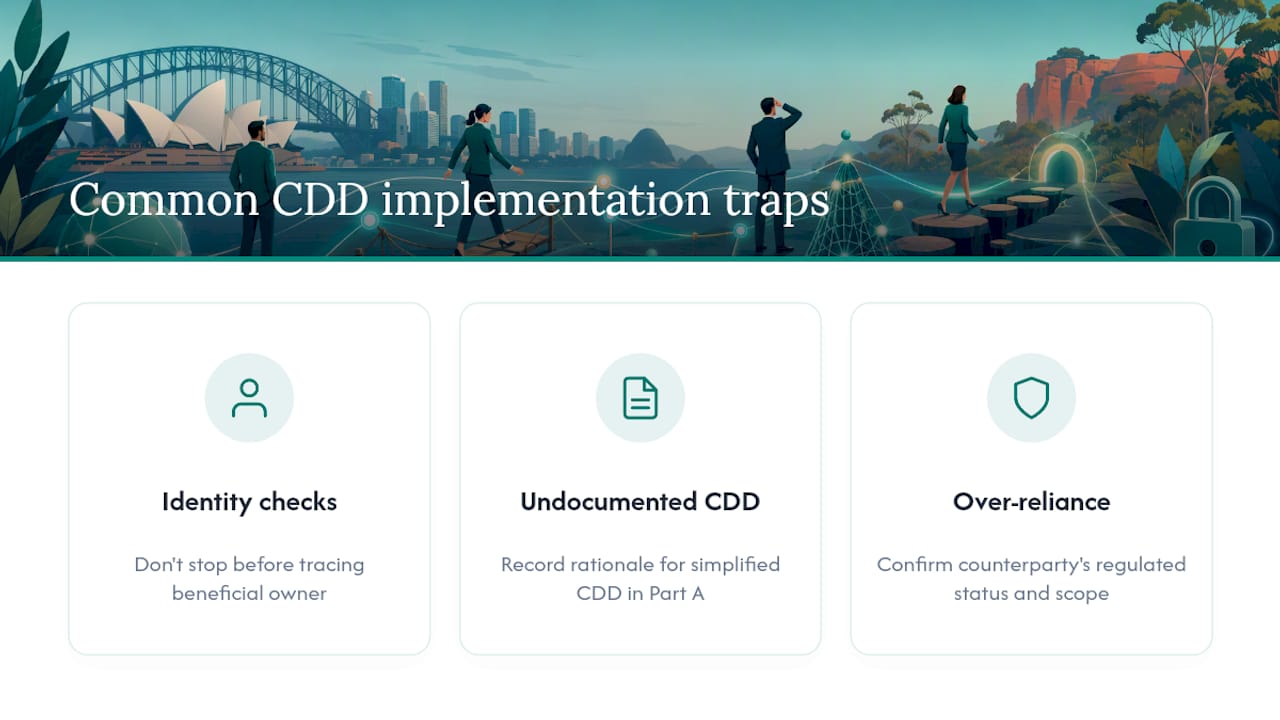
Identity checks alone aren’t customer due diligence. If you stop before tracing beneficial ownership, you’ve done half the job and left the harder half undocumented.
Simplified CDD without a written rationale traceable to your risk assessment invites challenge later. Record why the lower-risk treatment applied at the time, not just that it did.
Reliance arrangements fail quietly. Confirm the other party’s regulated status and the scope of their checks before you lean on them, every time.
AML Guard: built for Tranche 2 reporting entities
Real estate agencies, conveyancers, law firms, accounting practices and trust and company service providers are now squarely within scope of Tranche 2 obligations. Unlike a template pack you download once and hope stays current, AML Guard keeps your ML/TF risk assessment, AML/CTF policies, compliance action plan and training manual generated as one linked set, so they actually agree with each other when AUSTRAC asks. An officer approves each determination before CDD proceeds; the platform automates the lookups and the record keeping, not the judgement.
The platform runs identity verification with biometric liveness, traces beneficial owners through companies, trusts and SMSFs, screens against PEP and sanctions lists with ongoing re-screening, and keeps an 8-year tamper-evident audit trail behind every decision. It’s built specifically for AUSTRAC’s rules and the designated services listed in Table 5 and Table 6 of the Act, not adapted from an offshore compliance model. If your firm needs a working CDD program rather than another set of documents to interpret, book a demo with AML Guard and see how your tenant would be configured to your designated services and risk profile.
Sources
Recommended
- AML/CTF Compliance Checklist for Real Estate Agents: What You Need Before 1 July 2026
- AML/CTF Program Documents for Tranche 2
- Beneficial Ownership CDD for Trusts, SMSFs & Companies
See How AML Guard Works
Tranche 2 obligations are now in force.
Book a 20-minute demo to see how AML Guard supports your compliance from the moment your designated service begins.