
A shell company is not unlawful, and the term has no definition in the Anti-Money Laundering and Counter-Terrorism Financing Act 2006 (Cth). What matters to a Tranche 2 reporting entity is whether a company in front of you is being used to put distance between the money and the person who really owns or controls it. The red flags below, drawn from AUSTRAC’s own guidance, tell you when to look harder. The response is the same each time: find the individuals behind the entity, apply enhanced customer due diligence where the risk is high, and report a suspicious matter where grounds arise. Since 1 July 2026 these obligations have applied to real estate agencies, conveyancers, law firms, accountants and trust and company service providers, so the checks sit inside your own AML/CTF program.
TL;DR
- “Shell company” is not defined in the Act, and it is neither a shell bank (section 94A) nor a shelf company. Treat it as a description of how an entity behaves, not a legal category.
- The strongest real estate flags are a complex structure such as a shell company or trust (especially for a home purchase), a business with little or no trading, nominees hiding control, and title moved into a complex structure instead of the buyer.
- One flag alone may not be suspicious. Weigh flags together and record your reasoning.
- Response: identify beneficial owners by ownership (25% or more) and by control, apply enhanced CDD where risk is high (section 32), and lodge an SMR where grounds arise (section 41).
- Law firms and accountants face their own, overlapping indicators, set out below.
Table of Contents
- What a shell company is, and what it is not
- Shell company red flags for real estate agencies
- Red flags for law firms
- Red flags for accounting practices
- What to do when a flag appears
- Worked example: a family company buying a home
- How the work is recorded and defended
- Handling these checks across a busy pipeline
- FAQ
- Sources
What a shell company is, and what it is not
AUSTRAC’s glossary describes a shell company as a company that exists on paper and is often used to hold assets, manage transactions or structure ventures. Its 2019 real estate brief adds the typical profile: no significant assets or operations at incorporation, no physical presence, employees or products, and ownership that may sit with other corporations, nominee owners or bearer shares, which obscures who benefits financially.
Three terms are often confused, and the difference matters when you write a file note:
- Shell company. Not defined in the Act. It describes a company with little or no real activity, used as a vehicle.
- Shell bank. A defined concept under section 94A of the Act, concerning a bank with no physical presence. It is a different thing from a shell company.
- Shelf company. A registered company that has not traded. Selling a shelf company is a designated service under section 6, Table 6, item 5, so a trust and company service provider doing so is itself a reporting entity.
One further point is worth remembering: a company with an office, staff or assets can still operate as a shell if it carries on no business or only nominal business. Appearance of substance is therefore not a clearance. Look at what the entity actually does.
Why criminals favour company structures
AUSTRAC’s real estate risk insights explain the appeal. Companies handle larger and more frequent transactions, so a suspicious transfer can hide among legitimate ones, and assets held in a company name are harder for authorities to confiscate. Layers of companies add further distance between the person and the proceeds. A shell is rarely the whole scheme. It is usually one layer in a chain.
Shell company red flags for real estate agencies
AUSTRAC groups real estate indicators into customer profile, transaction behaviour and structure. The customer-profile and structure flags most relevant to shell companies are these.
| Red flag | What it looks like at your desk | Why it matters |
|---|---|---|
| Complex structure such as a shell company or trust, especially for a home purchase | A buyer entity with several layers of corporate or trust owners and no commercial reason for them | Complexity with no apparent purpose is a classic way to hide who owns the property |
| Business with little or no trading | A company that has been registered but shows no revenue, staff or activity, yet is buying property | The money buying the property may not come from the business |
| Nominees hiding control | Directors or shareholders who defer to an unnamed person for instructions | The real decision-maker is not on the register |
| Title moved to a complex structure instead of the buyer | The contract is signed by one party, then the purchaser changes to a newly formed entity | Ownership shifts to a vehicle that is harder to trace |
| Lifestyle or transactions inconsistent with known information | A purchase well beyond anything the company’s profile supports | Source of funds is unexplained |
| Large unexplained cash purchases | Funds arriving in cash or from unrelated third parties | Funds cannot be tied to a legitimate source |
The customer-profile items in the table come from AUSTRAC’s risk insights for the real estate sector, which also describes the structural flag in its own words as a corporate or legal entity with a complex structure or financing, “such as a shell company or trust”, especially when buying residential property.
Transaction behaviour that compounds the risk
The same AUSTRAC guidance lists behaviour during the transaction that, combined with a shell-like buyer, raises concern:
- unusual instructions with no obvious financial purpose, or instructions that keep changing
- a request to hold a deposit in trust longer than needed, followed by a change to how funds are distributed
- buying or selling quickly for no clear reason
- paying above, or accepting below, market value
- directing sale proceeds to an unrelated third party
- back-to-back transactions with rapidly increasing values
- title transfers where no money changes hands
AUSTRAC’s 2019 real estate brief adds further indicators: deposits sourced from an offshore bank, unknown parties introduced late, and property being the customer’s only link to Australia.
One flag is a prompt, not a conclusion
Many legitimate buyers use companies, trusts and self-managed super funds for sound reasons such as asset protection, family arrangements or investment. A company with little trading may be a newly formed family investment vehicle. A single flag therefore may not be suspicious. What changes the picture is accumulation, and the absence of a credible explanation when you ask for one. Ask the question neutrally, as part of normal due diligence, and write down the answer.
Red flags for law firms
Legal practices face their own version of the problem, because they form companies, hold funds in trust and advise on structures. AUSTRAC’s legal professionals guidance warns that complex companies and trusts can obscure beneficial owners, and that criminals may use layers of companies or nominee directors and shareholders to distance themselves while keeping control. The indicators it points to include:
- nominee arrangements with no justification
- shelf or liquidation-company purchases without a commercial reason
- trusts that serve no evident purpose
- opaque, layered structures and unexplained changes in ownership
- complex or unexplained transfers through the trust account
- rushed instructions, or instructions that keep changing
These are indicators for scrutiny and not proof of wrongdoing. A matter with one or two of them still needs a documented explanation before you proceed.
Red flags for accounting practices
Accountants see the structure from the inside: ownership registers, management layers and the books themselves. AUSTRAC’s accountants guidance identifies unexplained complex or cross-border ownership, nominee shareholders, trustees or directors, and attempts to hide ultimate ownership through layers of management as warning signs. On the money side it points to:
- unrelated third-party funds and pass-through accounts
- rapid transfers in and out of an account
- unexplained same-account “U-turn” transactions
- rounded sums
- funds moved without economic benefit
Trust and company service providers have a parallel list. AUSTRAC’s January 2026 quick guide for trust and company service providers names complex legal structures that make the true beneficial owner hard to identify, frequent changes of provider without a legitimate reason, unexplained source of wealth, frequent changes in ownership or structure without a clear rationale, and funds from countries with weak AML/CTF regimes.
What to do when a flag appears
The response follows a fixed order. Each step builds the record a supervisor will ask to see.
1. Determine the beneficial owners
Under AUSTRAC’s guidance on ownership and control structures, a beneficial owner is an individual who directly or indirectly owns 25% or more of the customer, or who controls it. Control is a separate test from ownership: ownership is a stake, control is influence. Follow the chain upward through each company or trust in the structure, counting indirect holdings, until you reach the individuals.
AUSTRAC lists the places to research this: ASIC registers, annual statements and amendments, current and historical company extracts, constitutions, trust deeds, partnership agreements, shareholder distribution statements and, optionally, paid third-party ownership services. For a closer walk-through of tracing owners in a property purchase, see our guide to beneficial ownership in property transactions.
If you take every reasonable step and still cannot identify a beneficial owner, Rules 6-8 of the AML/CTF Rules provide a fallback: collect and verify the identity of the chief executive (or equivalent). That fallback applies only after all reasonable steps have been taken, and those steps must be recorded. It is not a shortcut for a hard file. A structure that resists identification is itself a reason to escalate.
2. Test the business purpose and trading history
Ask why this entity is buying, and check the answer against evidence. A company that says it trades should show filings, an operating footprint and activity consistent with the purchase. A company with no trading and no explanation for a significant residential purchase is the pattern AUSTRAC describes. Record what you asked, what you were told and what you verified.
3. Apply enhanced CDD where risk is high
Where your risk assessment of the customer is high, section 32 requires enhanced customer due diligence. In practice that means deeper source-of-funds and source-of-wealth enquiries, approval as your policies require, and closer monitoring. Our enhanced due diligence examples for real estate show what this looks like on a typical file.
4. Report where grounds arise
Where you form a suspicion on reasonable grounds, section 41 requires a suspicious matter report. The report is due within three business days of forming the suspicion, or 24 hours where it relates to terrorism financing. Do not tip off the customer. Our guide to suspicious matter reports for Tranche 2 firms covers the workflow.
5. Keep monitoring after onboarding
Shell-company risk does not end at onboarding. AUSTRAC’s guidance on what you must monitor for includes legal entity structures used for no apparent commercial reason or to obscure ownership, domestic companies registered with no apparent commercial activity, transactions with no apparent economic or lawful purpose, and activity inconsistent with the customer’s known risk. Ongoing monitoring and periodic review are how those changes surface.
Worked example: a family company buying a home
A company with an ACN registered eight months ago approaches your agency to buy a residential property. The director, who signs the offer, says the purchase is for “the family”. ASIC records show one shareholder, another company, whose own shareholder is a discretionary trust.
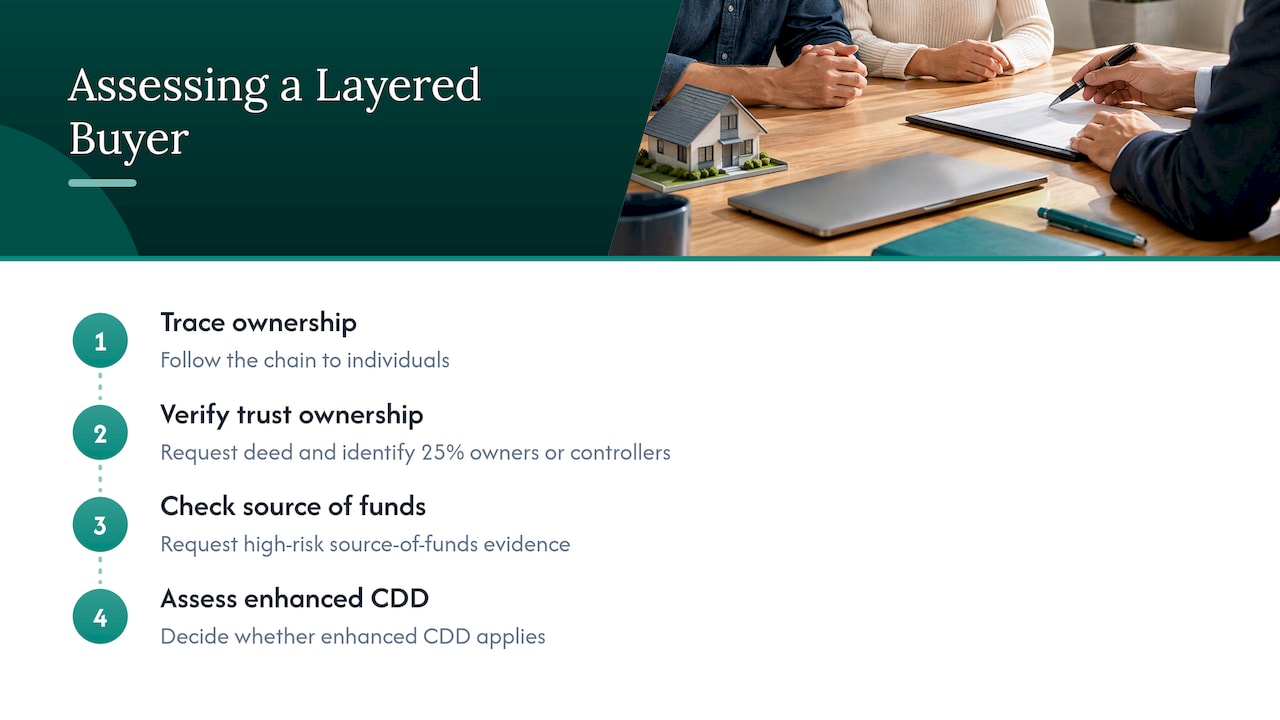
Several flags stack up: a layered structure, a recently registered company with no trading history, and a buyer who cannot say who ultimately benefits. None proves wrongdoing. Your steps are to follow the chain to the individuals, ask for the trust deed and the identity of the people with 25% or more or with control, request source-of-funds evidence suited to a high-risk profile, and decide whether enhanced CDD applies. If the answers are credible and documented, the matter can proceed with the reasoning on file. If the director cannot explain the structure or the funds, or the instructions keep shifting, the grounds for an SMR may have arisen, and a senior person should decide.
How the work is recorded and defended
AUSTRAC does not only ask whether you spotted a flag. It asks whether your program required you to look, whether your risk assessment anticipated structures like this, and whether the file shows consistent reasoning. Three weaknesses recur in programs built from loose templates:
- The risk assessment says companies and trusts are higher risk, but the policies do not say what staff must do about it.
- The training manual describes a different process from the one staff actually follow.
- File notes record the outcome but not the reasoning.
The fix is to keep the program documents consistent with each other and to log the reasoning at the point of decision. Keep the records so they can be retrieved on request.
Our view: the judgement stays with your officer
We built AML Guard for Australian Tranche 2 reporting entities, not as an adaptation of banking tools. Shell-company risk is a good test of that, because it asks for both lookups and judgement, and the two should not be confused.
A company’s beneficial ownership determination in AML Guard starts from its ACN, and an officer approves each one. The platform automates the lookups and the record keeping. It does not replace the decision about whether an explanation is credible.
Guided wizards produce the risk assessment, the AML/CTF program, a customer acceptance policy and the training manual, and can pre-fill from your risk assessment, so the policies start from the risks you assessed. Each identity check, screening result and officer decision sits in one case record.
That is how we think a shell-company flag should be handled: found early, explained on the record, and decided by a person who can show why.
AML Guard
Handling these checks across a busy pipeline
An agency running many transactions at once cannot rely on memory to catch the third layer of a corporate structure. AML Guard is a compliance platform for Tranche 2 entities: its guided wizards produce the risk assessment, the AML/CTF program, a customer acceptance policy and the training manual, and each customer’s identity checks, screening results and officer decisions sit in one case record.
AML Guard is not self-service; every firm starts with a demo. Subscription and per-check fees are on the pricing page, and you can see the full platform at amlguard.com.au.
FAQ
Is a shell company illegal in Australia?
No. The Act does not define the term, and a company with little activity can be lawful. What AUSTRAC asks you to notice is when such an entity, or a complex structure around it, is used for no apparent commercial purpose or to obscure who owns or controls a property or funds.
What is the difference between a shell company and a shelf company?
A shelf company is a registered company that has not traded, often sold ready-made. Selling one is a designated service under section 6, Table 6, item 5. A shell company has no statutory definition and describes how an entity is used. A shelf company can become a shell, but the two terms are not interchangeable.
Does one red flag mean I must lodge an SMR?
Not by itself. One flag alone may not be suspicious. An SMR is required where you form a suspicion on reasonable grounds under section 41, usually after several flags, or after an explanation that does not hold up. Record your reasoning either way, and report within three business days once grounds arise.
What if I cannot identify the beneficial owner?
Follow the chain of ownership and control until you reach individuals, using all reasonable steps. Only after those steps, recorded, does the fallback to the chief executive in Rules 6-8 apply. A structure that stays opaque after that effort is a reason to apply enhanced CDD and consider an SMR.
Do law firms and accountants use the same red flags?
They overlap on nominees, layered ownership and unexplained transfers, but each has its own AUSTRAC indicators. Law firms should watch trust-account activity and shelf-company purchases, and accountants should watch pass-through and U-turn transactions and altered bookkeeping entries.
Sources
- AUSTRAC glossary: shell company
- AUSTRAC: Risk insights and indicators of suspicious activity for the real estate sector
- AUSTRAC: Real estate SA brief, July 2019
- AUSTRAC: Risk insights for legal professionals
- AUSTRAC: Risk insights for accountants
- AUSTRAC: ML/TF risk assessment quick guide for trust and company service providers, January 2026
- AUSTRAC: Determining ownership and control structures
- AUSTRAC: What you must monitor for
Recommended
- AML Compliance Failures in Australia: 7 Patterns
- Suspicious matter reports for Tranche 2 firms
- Tranche 2 customer due diligence in Australia
- AML/CTF Policies in Australia: What the Law Asks
See How AML Guard Works
Tranche 2 obligations are now in force.
Book a 20-minute demo to see how AML Guard supports your compliance from the moment your designated service begins.