
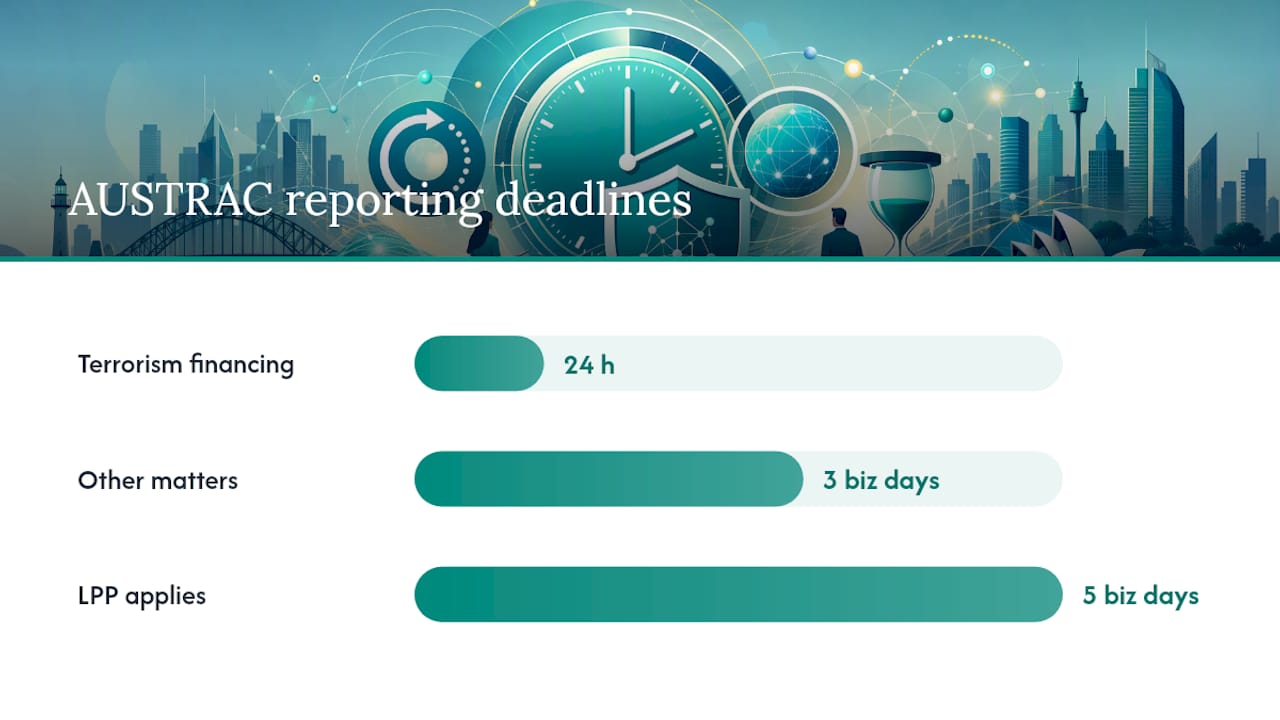
An SMR is a report lodged with AUSTRAC under section 41 of the AML/CTF Act 2006 (Cth), triggered the moment you form a suspicion on reasonable grounds. You have a statutory deadline to submit the report within 24 hours if the suspicion relates to terrorism financing, and within 3 business days for other matters; this extends to 5 business days where legal professional privilege applies. The approved form and lodgement path sit in AUSTRAC Online.
TL;DR:
- SMRs must be submitted within 24 hours for terrorism financing suspicions and within three business days for other concerns, extending to five days if legal privilege applies.
- Suspicion is triggered by reasonable, objective grounds based on transaction patterns or client interactions, not proof of wrongdoing.
- AUSTRAC Online requires prior enrolment, accurate completion of all mandatory fields, and submission before the statutory deadline, with timestamps supporting compliance.
- Grounds for suspicion should follow a clear, structured format with factual, specific details, avoiding speculation or vague narratives.
- Maintaining an 8-year, tamper-evident audit trail of SMRs and decisions is essential for compliance audits and potential enforcement actions.
Table of Contents
- When you must submit a suspicious matter report in Australia
- Submission deadlines and timing: how the clock starts and what counts
- How to submit an SMR through AUSTRAC Online
- Writing effective grounds for suspicion: structure and language
- What to include in an SMR: mandatory fields and useful context
- Red flags Tranche 2 firms should watch for
- What happens after you form a suspicion: tipping off and next steps
- Records and audit trail: what a seven-year retention policy looks like
- AUSTRAC resources worth keeping close
- How AML Guard fits the SMR workflow
- Book a demo to see SMR workflows in action
- Sources
When you must submit a suspicious matter report in Australia
Section 41 sets out a defined set of trigger events, not a vague obligation to “report anything odd.” The duty arises when you are providing, have provided, or have been asked to provide a designated service, and something about that request gives you reasonable grounds to suspect it relates to money laundering, terrorism financing, or another serious offence such as fraud, tax evasion, or proceeds of crime.
The bar is deliberately lower than proof. You do not need to know who committed an offence, or whether one has occurred at all. Reasonable grounds mean an objective, articulable basis for suspicion, formed by a person familiar with the transaction, not a hunch and not certainty.
For Tranche 2 entities, the trigger often surfaces in ordinary client interactions rather than dramatic red flags:
- A property buyer asks a real estate agent to accept a deposit from an unrelated third party with no stated connection to the purchase.
- A conveyancer notices settlement funds arriving from a jurisdiction with no link to the client’s stated circumstances.
- A client requests structuring of a purchase price across multiple entities shortly after being asked for identification documents.
- An agent representing a customer gives inconsistent explanations for the source of funds when asked a routine question.
None of these examples proves wrongdoing. Each one is enough, on its own, to justify forming a suspicion and starting the reporting clock.
Submission deadlines and timing: how the clock starts and what counts
The clock starts the moment suspicion is formed, not when you finish investigating it. AUSTRAC’s guidance sets the deadline at 24 hours for terrorism financing suspicions and 3 business days for other matters, extending to 5 business days where legal professional privilege genuinely applies to part of the report.
Pro Tip: Timestamp the exact moment your compliance officer forms the suspicion, with a one-line rationale attached. That record is what proves your deadline calculation is correct if AUSTRAC or an auditor ever asks.
Subsection (2) of section 41 makes the deadline a civil penalty provision. Missing it is not a paperwork slip. It is an enforceable breach, independent of whether the underlying suspicion turns out to be correct.
How to submit an SMR through AUSTRAC Online
Reporting entities lodge SMRs through AUSTRAC Online, which requires enrolment before you can submit anything. Enrolment should happen well before you ever need to file, not scrambled together at the point a suspicion arises.
- Enrol your business with AUSTRAC Online and confirm your reporting entity details, including your AUSTRAC reference number, are current.
- Select the correct SMR form. A new form applies for entities enrolling after 30 March 2026, with full availability from 1 July 2026, so confirm which version applies to your enrolment date before you start drafting.
- Complete every mandatory field accurately, including reporter details, subject details, and the date suspicion was formed.
- Submit within the statutory deadline and retain a copy of the lodged report alongside your internal decision record.
For urgent terrorism financing matters, AUSTRAC’s contact channels allow escalation outside standard lodgement if the 24 hour window is at risk.
Writing effective grounds for suspicion: structure and language
AUSTRAC’s refreshed SMR reference guide pushes reporting entities toward plain, structured language over narrative prose, because clear text speeds up both human analysts and the text-analysis tools AUSTRAC runs across incoming reports. A well-written grounds for suspicion (GFS) section starts with a one or two sentence summary of the concern, then breaks the detail into who, what, where, when, and how.
Avoid ALL CAPS entirely. It does nothing for emphasis and actively interferes with the named-entity recognition AUSTRAC’s systems use to extract identifiers from your text.
- Lead with a plain summary: “Customer requested settlement funds be split across three unrelated bank accounts shortly after providing identification.”
- Follow with dated, factual bullet points rather than a long paragraph of history.
- Name specific identifiers where you have them: account numbers, transaction references, dates, and prior SMR references.
- Write in complete, simple sentences. Avoid speculation dressed up as fact.
A poor GFS reads like a diary entry: “The client seemed nervous and we thought something was off about the whole deal.” A strong GFS reads like a brief: “On 14 February 2026, client requested transfer of $340,000 from an account not previously disclosed during CDD, held by a third party with no stated relationship to the purchase (reference TXN00219).” The second version gives an analyst something to act on immediately.
What to include in an SMR: mandatory fields and useful context
The AML/CTF Rules 2025 specify the fields your SMR must contain, and missing one of them can delay processing even when your grounds for suspicion are sound.
- Reporting entity details, including your AUSTRAC reference number and business identifiers.
- The date and time suspicion was formed, matched to your internal timestamp record.
- Reporter details, being the person or role submitting the report on the entity’s behalf.
- Subject details, covering every individual or entity the suspicion concerns.
- Grounds for suspicion, structured as outlined above.
Beyond the mandatory fields, include transaction IDs, account numbers, and references to any prior SMRs involving the same customer where relevant. Where part of your information is genuinely covered by legal professional privilege, note that a portion has been withheld and why, rather than omitting it silently. Keep privileged material out of the report itself; the non-privileged portion still needs to go in within the applicable deadline.
Red flags Tranche 2 firms should watch for
Property and trust transactions carry their own recognisable patterns of concern, distinct from the retail banking indicators most AML training defaults to.
- Rapid, sequential property purchases by the same buyer with no clear investment rationale.
- Settlement funds routed through multiple third-party accounts before reaching the vendor.
- A buyer or client insisting on cash components in a transaction where finance would be the obvious route.
- Trust or company structures established immediately before a transaction, with beneficial ownership that is difficult to verify.
- A client who is unusually resistant to standard identification or source-of-funds questions.
These signals typically surface through ongoing monitoring rather than a single alarming moment, which is why transaction monitoring and periodic file review matter as much as the initial onboarding check. Once a signal crosses your internal escalation threshold, it moves to your compliance officer for a formal decision on whether reasonable grounds exist.
What happens after you form a suspicion: tipping off and next steps
Filing an SMR does not, by itself, require you to refuse the transaction or unwind a deal already in progress. AUSTRAC’s own guidance confirms that decision sits separately, assessed on its own commercial and risk merits. Many reporting entities continue a designated service after lodging an SMR, provided they apply appropriate enhanced due diligence.
Tipping off is a disclosure offence, not a ban on ever discussing the matter internally. The restriction concerns telling the customer, or anyone outside a defined need-to-know group, that an SMR has been lodged or is being considered.
- Limit discussion of the suspicion to staff who genuinely need to know, and document who that includes.
- Secure relevant records and correspondence before any further action on the file.
- Apply enhanced customer due diligence if the service is continuing.
- Log every decision made, and by whom, at the time it is made.
Pro Tip: Write your internal escalation note before you speak to anyone else about the matter. A contemporaneous record protects you if a tipping off question ever arises later.
Records and audit trail: what a seven-year retention policy looks like
SMR decisions, whether reported or not, need a retention record lasting seven years, held in a form that shows it has not been altered after the fact.
- If you investigate a signal and decide not to report, record the reasoning, the reviewer’s name, and the date of the decision.
- Retain the lodged SMR, its supporting evidence, and your internal timestamp of when suspicion was formed.
- Keep this evidence linked to your broader AML/CTF program artefacts, since a risk assessment and policy set that do not match your actual SMR decisions is exactly what a supervisor questions first.
A tamper-evident audit trail turns a filing obligation into a defensible compliance history.
AUSTRAC resources worth keeping close
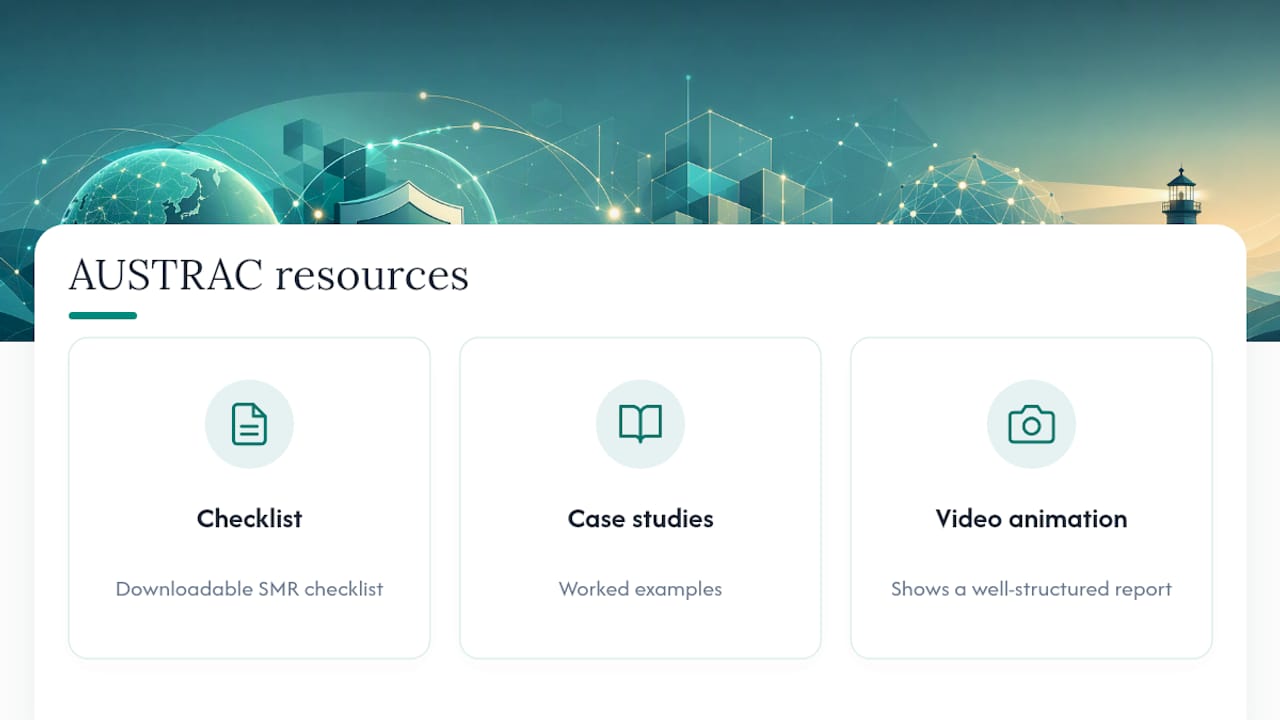
Beyond the reference guide itself, AUSTRAC publishes a downloadable SMR checklist to quality-assure your GFS text before submission, alongside case studies and a video animation showing what a well-structured report looks like in practice.
How AML Guard fits the SMR workflow
Every SMR decision your firm makes deserves the same evidentiary weight as the transaction it concerns. The reporting workflow captures the timestamp suspicion was formed, the reasoning behind the decision, and the outcome, all held in an 8-year tamper-evident audit trail. Guided GFS templates and validation checks encourage the plain, structured language AUSTRAC’s reference guide asks for, and REX CRM integration surfaces compliance status against a listing without ever exposing underlying CDD data.
Book a demo to see SMR workflows in action
Drafting a defensible GFS section under a 24 hour deadline is not the moment to be reconstructing your process from memory. AML Guard is built for the compliance officer who needs SMR drafting, retention, and reporting in one linked workflow, not a folder of templates and a shared drive.
The platform records the reasoning behind every SMR decision alongside the timestamp it was formed, so your 8-year audit trail is built automatically rather than assembled after the fact. Guided templates keep grounds for suspicion structured and case-sensitive from the first draft, and status indicators flow through to REX CRM without ever pushing CDD data across systems. Onboarding is guided rather than self-service: firms begin with a demo, and the platform is configured to their designated services and risk profile from there. If your firm handles real estate, conveyancing, legal, or trust and company work, book a demo to see how the reporting workflow handles a live grounds for suspicion draft from timestamp to lodgement.
Sources
- ANTI‑MONEY LAUNDERING AND COUNTER‑TERRORISM FINANCING ACT 2006 - SECT 41 Reports of suspicious matters
- Suspicious matter reports (SMRs) | AUSTRAC
- Legislation
Recommended
- Tranche 2 AML Australia: your compliance obligations explained
- Tranche 2 customer due diligence in Australia
- AML/CTF Program Documents for Tranche 2
- AML risk assessment template for Tranche 2 firms
See How AML Guard Works
Tranche 2 obligations are now in force.
Book a 20-minute demo to see how AML Guard supports your compliance from the moment your designated service begins.