Most property transactions involve individuals. But a meaningful proportion involve entities: companies, trusts, SMSFs, partnerships, or combinations. When your customer is an entity, identifying the entity itself is only the first step. You must also take reasonable measures to identify the natural persons who ultimately own or control it.
These natural persons are known as beneficial owners. Under Australia’s AML/CTF reforms, identifying and verifying beneficial owners is a core CDD obligation: and for many property professionals, it will be one of the most complex parts of compliance.
Last reviewed: March 2026
What Is a Beneficial Owner?
A beneficial owner is a natural person (an individual) who ultimately owns or controls a customer entity, or on whose behalf a transaction is conducted. AUSTRAC’s current guidance indicates that “owns” generally refers to 25% or more ownership (directly or indirectly), while “controls” refers to the ability to make decisions about the entity’s finances and operations.
Beneficial ownership identification is not about paperwork. It is about understanding who really controls the entity and the funds involved in the transaction.
When Do You Need to Identify Beneficial Owners?
Whenever your customer is an entity rather than a natural person, you must take reasonable measures to identify and verify the beneficial owners as part of your initial CDD. This applies to companies, trusts, SMSFs, partnerships, associations, and foreign equivalents.
How to Identify Beneficial Owners of a Trust or Company in a Property Transaction
The approach depends on the entity type. In all cases, the measures you take should be reasonable and proportionate to the ML/TF risk.
Companies
For Australian companies, you should take reasonable measures to identify the natural persons who hold a controlling interest, generally 25% or more of the company’s issued capital or voting rights. If no natural person meets this threshold, identify an alternative individual such as a senior managing official.
Trusts
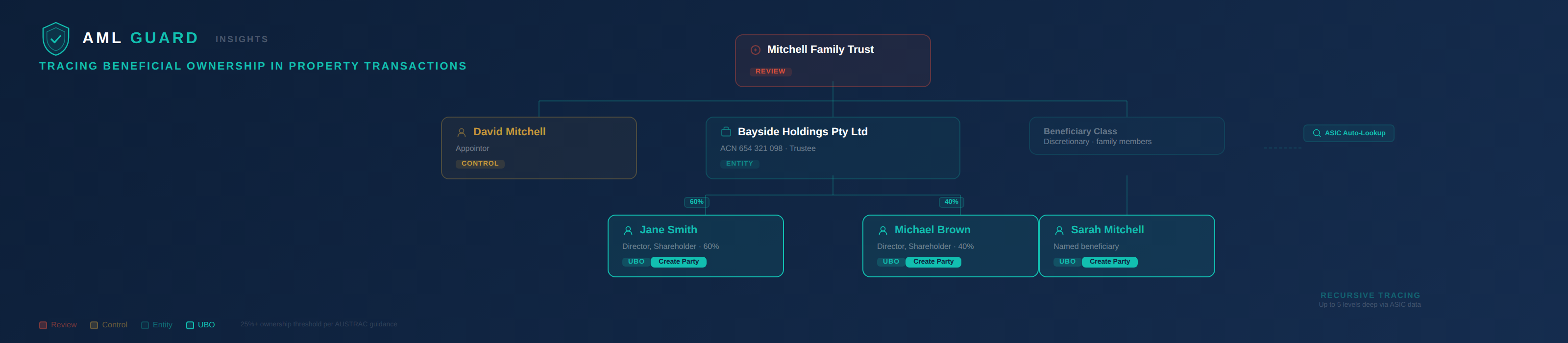
Your CDD procedures should address the relevant trust roles, controlling persons, and any other individuals the firm reasonably identifies as exercising effective control, with the measures taken scaled to the risk and complexity of the structure. For discretionary trusts, beneficiaries may be described as a class rather than named individually.
SMSFs
For SMSFs, firms will generally need procedures to identify the relevant members, trustees, or corporate-trustee directors and understand the fund structure, with measures scaled to the risk.
Partnerships
For partnerships, take reasonable measures to identify partners who hold a controlling interest (generally 25% or more). If no single partner meets the threshold, identify an alternative individual such as the managing partner.
What About Layered Structures?
Many entities involved in property transactions have layered ownership: a company owned by a trust, whose trustee is another company. The AML/CTF framework requires you to take reasonable measures, proportionate to the ML/TF risk, to trace through these layers to the natural persons who ultimately own or control the entity.
Multi-layered structures are among the highest-risk scenarios for money laundering in property. The more complex the structure, the more important it is to trace through it thoroughly and document the evidence. Automated ASIC company data lookups and visual ownership trees can significantly reduce time, cost, and error risk compared to manual tracing.
What If You Cannot Identify the Beneficial Owner?
If, after taking reasonable measures, you cannot identify a beneficial owner, your procedures should address the identification and verification of an alternative individual, such as a senior managing official, where appropriate. Document the steps you took, even if unsuccessful. AUSTRAC will assess whether you took reasonable measures, not whether you achieved a perfect result.
Foreign Entities and Overseas Structures
Where your customer is a foreign entity or has beneficial owners located overseas, the challenges are amplified. Your AML/CTF program should include specific procedures for foreign entities. These situations will often warrant enhanced CDD.
Practical Considerations for Real Estate Agents
- Property purchases by family trusts or discretionary trusts, extremely common in Australian property
- SMSF property purchases, subject to specific superannuation rules
- Purchases by companies, particularly where owned by other entities
- Off-the-plan and development site purchases, often through special-purpose vehicles
- Transactions involving foreign entities or persons, may involve overseas structures
Beneficial ownership identification is one of the areas where the quality of your compliance platform matters most. A platform that can trace through layered structures, present the results visually, and document the evidence can significantly reduce time and error risk.
See How AML Guard Works
Tranche 2 obligations commence 1 July 2026.
Book a 20-minute demo to see how AML Guard supports your compliance from the moment your designated service begins.
Related Reading
- Beneficial Ownership CDD for Trusts, SMSFs and Companies
- AML/CTF Compliance Checklist for Real Estate Agents
- What Is an AML/CTF Program?
- When Does AML Compliance Start?