
Enhanced customer due diligence (enhanced CDD, often shortened to EDD) in a property transaction means the agent escalates a higher-risk customer to the AML/CTF compliance officer. The officer collects and verifies more information, including source of funds and source of wealth where the Rules require it. A senior manager approves in writing before the service goes ahead, and the whole decision is recorded. Tranche 2 obligations for real estate commenced on 1 July 2026 and are in force, so these steps are now part of day-to-day agency practice. This article walks through worked property examples, each showing the trigger, the measures, the approver and the record.
We do not repeat the full list of triggers here. That is covered in our guide to enhanced due diligence triggers in Australia. This page shows what those triggers look like on a real file.
TL;DR
- Enhanced CDD is triggered by a high-risk customer, a foreign PEP, a suspicious matter report (SMR) where you keep acting, or a party present in, or an entity formed in, a FATF call-for-action jurisdiction. A domestic PEP triggers it only where the risk is high.
- AUSTRAC’s real estate starter kit includes a high-risk example: a foreign PEP buying an unfinanced property valued between $5 million and $5.5 million.
- In every example the file shows four things: the trigger, the measures taken, the person who approved and the record kept.
- Enhanced CDD does not mean refusing the customer, and an SMR does not require you to stop acting.
- Screening results and officer decisions belong in one case record, so the file can be produced when AUSTRAC asks.
Table of Contents
- The five triggers, as they arise in property
- Example 1: a foreign PEP buys an unfinanced luxury property
- Example 2: a domestic PEP, where risk is not high
- Example 3: layered ownership behind a company buyer
- Example 4: an SMR is lodged and you keep acting
- Example 5: a party present in a high-risk jurisdiction
- What the controls look like on a checklist
- Where agencies go wrong
- Our perspective
- Keeping enhanced CDD files in one place
- FAQ
- Sources
The five triggers, as they arise in property
AUSTRAC’s guidance says enhanced CDD applies when the customer’s ML/TF risk is high, when an SMR is required and you intend to keep providing the designated service, when the service involves an unusually complex or large transaction or has no apparent economic or legal purpose, and when the customer, a beneficial owner, a person on whose behalf the service is received or a person acting for the customer is a foreign PEP or is present in or formed in a jurisdiction the FATF has called for enhanced due diligence on (AUSTRAC enhanced CDD guidance).
In a property file those triggers usually look like this:
| Trigger | Typical property situation | Enhanced CDD outcome |
|---|---|---|
| High-risk customer | Risk factors on the onboarding and CDD forms add up to a high rating | Escalate, enhanced measures, senior manager approval |
| Foreign PEP | A buyer, seller or beneficial owner is a senior official of another country | Always enhanced CDD and senior manager approval (Rules 5-5) |
| Domestic PEP | A buyer is the parent of a state Member of Parliament | Enhanced CDD only where the risk is high |
| SMR and you keep acting | Suspicion forms mid-transaction and you continue brokering | Enhanced CDD before and while you continue |
| FATF call-for-action jurisdiction | A party is present in, or a company or trust is formed in, such a jurisdiction | Enhanced CDD and approval |
The examples below take each in turn. Example 1 draws directly on AUSTRAC’s published material. Examples 2 to 5 are illustrative scenarios built on the same triggers. They are not real cases and contain no figures beyond those AUSTRAC itself uses.
Example 1: a foreign PEP buys an unfinanced luxury property
This is the high-risk example AUSTRAC publishes in its real estate starter kit (examples of dealing with customers).
The facts. An agent is approached by an individual who wants to buy a luxury property valued between $5 million and $5.5 million. The buyer confirms they are purchasing for themselves, will not use a mortgage or other loan, and will not use a company or trust. They say they are a senior government official in a foreign country, and they offer a foreign passport from a low-risk country as identification.
The trigger. The agent assesses the customer on the initial customer due diligence form. Two factors appear: foreign PEP status, which AUSTRAC treats as a high-risk factor, and an unfinanced purchase of a property valued over A$1.5 million, which is a medium-risk factor. The rating is high. The agent must escalate to the AML/CTF compliance officer under the escalation and enhanced CDD policy.
The measures. The compliance officer completes enhanced CDD using the guided form. In AUSTRAC’s example the officer:
- documents the information from the identity document and compares the photo with the person;
- checks there are no concerns about the validity of the documents or the onboarding information;
- verifies the nature and purpose of the business relationship, to confirm the customer’s explanation of why they want the service is truthful;
- records the customer as a foreign PEP and a high-risk customer, then asks the customer for additional information, explaining that it is needed to meet the agency’s AML/CTF obligations;
- checks source of funds, source of wealth and adverse media;
- submits an SMR when suspicion forms.
Who approved. Because the customer is rated high risk, the compliance officer seeks written approval from the senior manager before the agency provides the designated service.
The record. The file holds the onboarding form, the risk rating and its reasons, the identity verification, the source of funds and wealth evidence, the adverse media result, any SMR reference and the written approval. The agency then monitors the customer for the rest of the relationship.
Note what the example does not say. It does not say the agent declines the buyer. It describes a controlled path to providing the service, with the right person approving it.
Example 2: a domestic PEP, where risk is not high
The same AUSTRAC page includes a medium-risk example. An individual bids successfully at auction on a property valued at $1.3 million. The person bidding is a representative of a married couple who will buy jointly, using a mortgage and a deposit paid to the agent after the auction. Both buyers are domestic PEPs because they are the parents of a State Member of Parliament. The representative is a buyer’s agent that is not enrolled with AUSTRAC.
The trigger. There is no automatic enhanced CDD here. AUSTRAC rates the two factors, domestic PEP status and the use of an unenrolled third-party agent, as medium. The overall rating is medium, so the agency applies standard initial CDD and keeps a close eye on the file.
The measures. The agency applies delayed CDD for the counterparty at auction, having judged there is low additional risk from the delay and adequate controls, including the ability to stop brokering if the buyers fall outside its risk appetite. Sanctions screening is done without delay. After exchange the agent verifies the representative and both buyers, confirms the representative’s authority to act, and completes the PEP check, which confirms the buyers are family members of a domestic PEP.
Who approved. The example does not require senior manager approval because the rating is medium.
The record. The agent documents all interactions to monitor behaviour for indicators of criminal activity or changes in ML/TF risk. Settlement completes within two months of exchange, and the business relationship ends.
The lesson is a practical one. A domestic PEP is a risk factor to weigh, not a switch that forces enhanced CDD. If other factors accumulate, such as an unexplained funding source or a complex structure, the rating can move to high and Example 1’s path applies.
Example 3: layered ownership behind a company buyer
This scenario is illustrative. A property investment company wants to buy an investment property. The company’s ownership runs through several layers, and the person who ultimately controls it is not obvious from the first documents.
The trigger. Layered ownership with no clear commercial reason raises the ML/TF risk. If the assessment lands at high, enhanced CDD applies. If a beneficial owner turns out to be a foreign PEP, it applies regardless of the rating.
The measures. The compliance officer works up the structure to identify each beneficial owner, verifies the identity of the people behind it, and asks for source of funds and source of wealth for the customer and for the beneficial owner. AUSTRAC’s own PEP guidance includes a comparable situation in which a purchaser acts through a company with multiple lines of layered ownership and the agent establishes source of funds and wealth for both the customer and the PEP (international organisation PEP example).
Who approved. Where the rating is high, the senior manager reviews the risk assessment and approves before the agency proceeds. In AUSTRAC’s example the practitioner also maintains records of all initial and enhanced CDD steps and the risk rating.
The record. Ownership chart, verification of each beneficial owner, wealth and funds evidence, rating rationale and approval. Our guide to customer due diligence for Tranche 2 firms sets out how initial and enhanced CDD fit together.
Example 4: an SMR is lodged and you keep acting
This scenario is illustrative. During a sale, a buyer’s explanation of where the deposit came from changes between conversations, and the funds arrive through a channel that does not match the stated purpose. The agent raises it with the compliance officer. Looking at the combination of indicators in context, the officer concludes that a suspicion has formed on reasonable grounds.
The trigger. An SMR is required and the agency intends to continue providing the designated service. That combination is itself an enhanced CDD trigger.
The measures. The SMR deadlines come first. AUSTRAC’s factsheet for Tranche 2 entities says SMRs are due within 24 hours of forming a suspicion for terrorism financing, and within 3 business days for other matters (AUSTRAC obligations factsheet). In parallel the officer applies enhanced measures: collecting and verifying more information, understanding the reason for the transactions, verifying source of funds or wealth, and monitoring more closely.
Who approved. The senior manager decides whether the agency continues acting, in light of the enhanced CDD results and the agency’s risk appetite. An SMR does not oblige you to stop acting. It obliges you to report and to manage the risk if you continue.
The record. The reasoning that led to the suspicion, the SMR reference, the enhanced measures, the approval and the monitoring plan. Staff must also manage tipping off. AUSTRAC expects policies to set out how tipping off obligations are handled during enhanced CDD, so the customer-facing agent should not say that a report has been made. For the reporting steps in more depth, see our guide to suspicious matter reports for Tranche 2 firms.
Example 5: a party present in a high-risk jurisdiction
This scenario is illustrative. A company formed in a jurisdiction that FATF identifies as subject to a call for action wants to buy a commercial property. Its sole director lives overseas and the agent has not met them.
The trigger. A company formed in, or a party physically present in, a jurisdiction the FATF has called for enhanced due diligence on is a statutory enhanced CDD trigger under section 32 of the Act, whatever the stated price or finance arrangements.
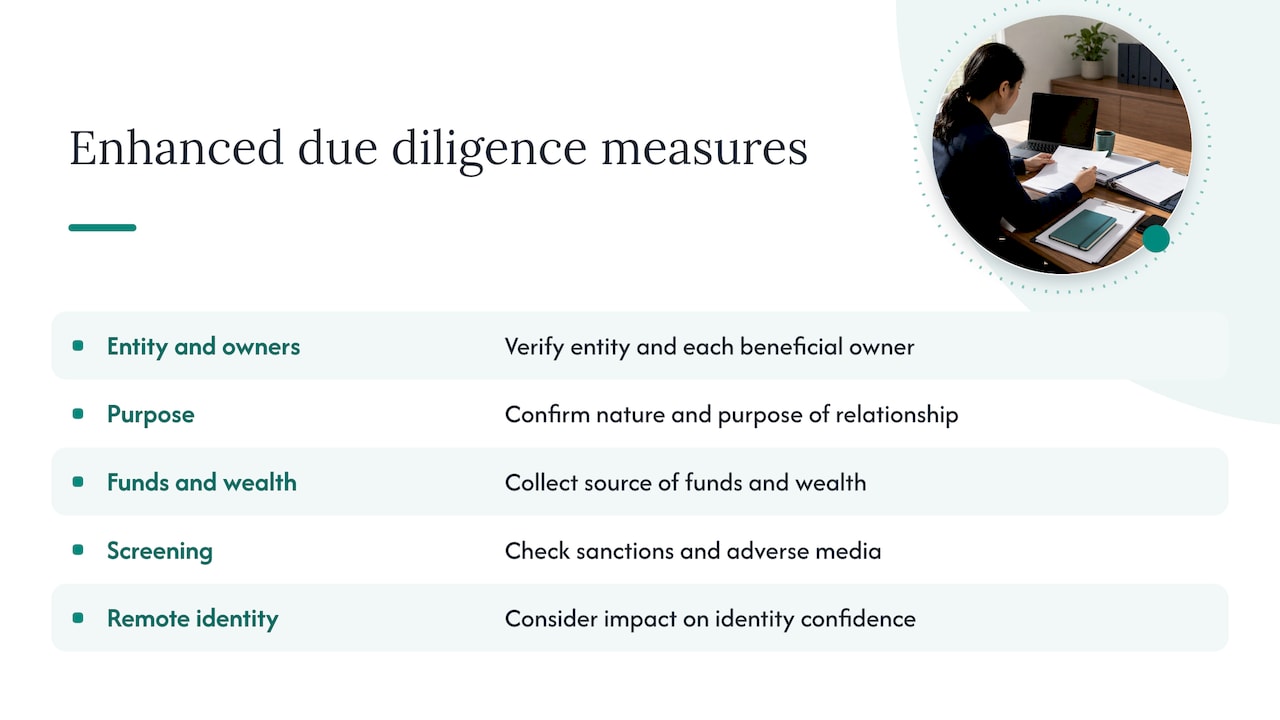
The measures. The officer verifies the entity and each beneficial owner, confirms the nature and purpose of the relationship, collects source of funds and wealth, screens for sanctions and adverse media, and considers how remote delivery affects identity confidence. AUSTRAC’s starter kit lists delivery channels that make it hard to establish identity as a high-risk factor in their own right (Step 2 of the starter kit).
Who approved. The senior manager approves before the service is provided, on the basis of the officer’s written assessment.
The record. Jurisdiction analysis, structure evidence, verification results, screening results and the decision, all with dates and the name of the person who decided.
What the controls look like on a checklist
Across the examples, the controls AUSTRAC lists for high-risk real estate customers stay the same: enhanced CDD, a source of funds and source of wealth check, an adverse media check, verification of the business relationship and senior manager approval (starter kit Step 2). The measures must be targeted to the customer’s specific risks, proportionate and effective, and they can include more in-depth monitoring and more frequent reviews.
A working checklist for a single high-risk file:
- Record the trigger and each risk factor that produced the rating.
- Escalate to the compliance officer and note the date and time.
- Verify identity, and the authority of anyone acting for the customer.
- Determine beneficial owners and screen every party for sanctions, PEP status and adverse media.
- Establish source of funds and, where relevant, source of wealth, with documents that fit the story.
- Decide whether a suspicion has formed, and lodge an SMR within the deadline if so.
- Obtain written senior manager approval before providing the service.
- Set the monitoring and review frequency, and record it.
AUSTRAC’s starter kit also lists red flags such as paying with more than A$50,000 in physical currency or using a virtual asset to pay for part or all of a property. Any of these can lift a customer to high risk. A single indicator may not on its own justify a suspicion, so the officer weighs the combination in context and documents the reasoning.
Where agencies go wrong
- Treating enhanced CDD as refusal. Each AUSTRAC example ends with the agency providing the service under controls, not turning the customer away.
- Approving verbally. The example requires written approval from the senior manager, and the approval should sit on the file.
- Collecting evidence without a rationale. A payslip or a share registry summary only helps if the file says what it proves.
- Scattering the record. Screening in one tool, notes in an inbox and approval in a chat thread is hard to produce on request.
- Forgetting ongoing monitoring. Enhanced CDD continues through the relationship, not only at onboarding.
Our perspective
Every example above ends the same way: a decision, a named approver and a record. The law does not ask for a perfect file on a customer who never raises a question. It asks you to show that when risk appeared, a competent person looked at it, applied proportionate measures and decided.
That is why we built AML Guard around the case record: one record holding each identity check, screening result and officer decision, with an officer approving each beneficial ownership determination. The platform automates the lookups and the record keeping. It does not automate the judgement, which stays with your people.
The same applies to your program. Our guided wizards produce the risk assessment, the AML/CTF program, a customer acceptance policy and the training manual, and can pre-fill from your risk assessment, so your escalation and enhanced CDD policy starts from the risk you have assessed. That is what a supervisor looks for, and a downloaded template cannot give it to you.
AML Guard
Keeping enhanced CDD files in one place
AML Guard is an Australian compliance platform built for Tranche 2 reporting entities, including real estate agencies, buyer’s agents and property developers. It keeps one case record holding each identity check, screening result and officer decision, with ACN-based beneficial ownership determination and an officer approving each one. AML Guard is not self-service; every firm starts with a demo. Book a demo, or see the pricing page for the subscription and per-check fees.
If your agency also manages rentals, our guide on whether AML/CTF applies to property management explains where the line sits.
FAQ
Does enhanced CDD mean we must refuse the customer?
No. Enhanced CDD is a set of additional measures, and in AUSTRAC’s high-risk example the agency provides the service after completing those measures and obtaining written senior manager approval. Refusal is a decision for your senior manager and compliance officer, based on whether the risk falls within your appetite.
Do we have to stop acting once we lodge an SMR?
No. An SMR obliges you to report within the deadline, and if you intend to keep providing the service, enhanced CDD applies. Do not tell the customer a report has been made, because tipping off is an offence.
Is a domestic PEP always an enhanced CDD case?
No. In AUSTRAC’s medium-risk example, domestic PEP buyers are one medium risk factor, and the file is handled with standard CDD and monitoring. Enhanced CDD applies to a domestic PEP only where the overall risk is high. A foreign PEP is different: enhanced CDD and senior manager approval always apply.
Who should approve a high-risk customer?
A senior manager. In AUSTRAC’s example the compliance officer seeks written approval before the agency provides the service, and the approval is kept on the customer’s file with the rest of the enhanced CDD record.
Sources
- AUSTRAC: Enhanced customer due diligence
- AUSTRAC: Real estate program starter kit, examples of dealing with customers
- AUSTRAC: Step 2, Use your real estate program
- AUSTRAC: International organisation PEP example
- AUSTRAC: AML/CTF obligations factsheet for Tranche 2 reporting entities
Recommended
- AML/CTF Compliance Checklist for Real Estate Agents
- Enhanced due diligence in Australia: triggers
- AML training real estate: what agencies must do
- Buyer due diligence for real estate agencies
See How AML Guard Works
Tranche 2 obligations are now in force.
Book a 20-minute demo to see how AML Guard supports your compliance from the moment your designated service begins.