
Property laundering typologies in Australia come down to a handful of repeatable patterns: funds structured into bank accounts and then used to buy or rapidly repay mortgages, properties bought through companies and trusts that hide the real owner, third parties paying on a buyer’s behalf, and prices that do not match value. Most of them rely on hiding who the customer really is, or whose money is behind the purchase. This guide sets out the main typologies, the red flags that go with them, and what each identity verification method (electronic checks, government-source checks and biometrics) does and does not prove.
TL;DR
- The recurring typologies in Australian property are structuring and rapid mortgage repayment, opaque company and trust ownership, third-party funding, unexplained pricing, and use of property as a base for crime.
- Identity verification answers “is this person real, and is this their document?”. It does not answer “where did the money come from?”, so it needs to sit alongside beneficial ownership and source-of-funds work.
- A government-source check can return a failed result for a genuine customer, for example when their credentials have been protected on the Credential Protection Register, so a failed result needs human review, not automatic refusal.
- Australia has no national identity card, so identity is built from documents, data sources and, where used, a biometric comparison.
- AML Guard keeps each identity check, screening result and officer decision in one case record.
Table of Contents
- Why property is the preferred asset for laundering
- The main property laundering typologies
- Red flags that point to a typology
- How identity is verified in Australia, and what each method proves
- Our perspective: verification is evidence, not a tick
- Putting identity checks to work in your agency
- See the checks in one record
- FAQ
- Sources
Why property is the preferred asset for laundering
Money laundering is commonly described in three stages: placement, layering and integration. Placement moves funds away from the crime that produced them, layering disguises the trail, and integration makes the money available again from what appear to be legitimate sources. Property can serve all three, and it is especially useful at the last stage: a house is high value, tangible and easy to explain to a bank or accountant.
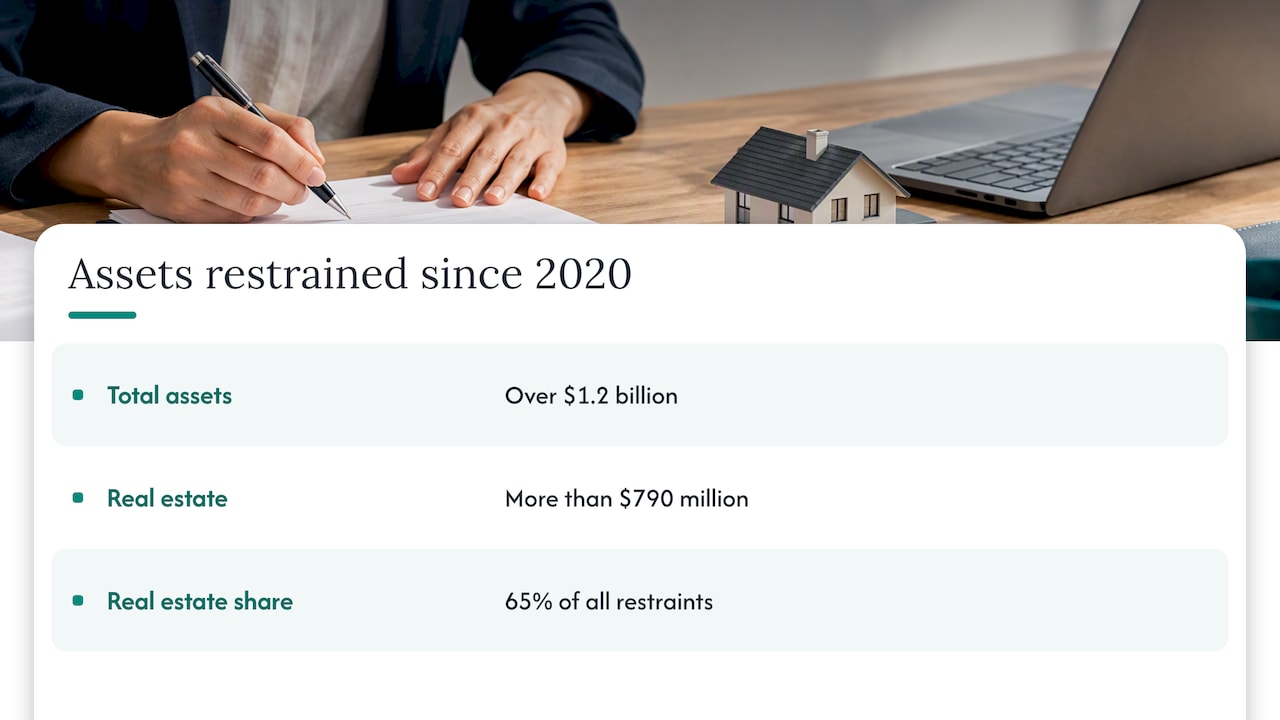
AUSTRAC’s national risk assessment points to persistent exploitation of high-value assets such as real estate alongside long-used channels like banks, remitters and casinos. The scale in enforcement figures is telling. The AUSTRAC CEO has noted that since 2020 the AFP has restrained over $1.2 billion in criminal assets, and that more than $790 million of this was residential and commercial real estate, 65% of all restraints.
Since 1 July 2026, real estate agents, buyers agents and property developers have been reporting entities for certain designated services under the AML/CTF Act 2006 (Cth) and the AML/CTF Rules 2025. AUSTRAC’s factsheet confirms that covered businesses need a tailored program with a risk assessment and policies to manage ML/TF/PF risks. Understanding typologies is how that risk assessment becomes specific to your agency rather than generic.
The main property laundering typologies
Structured cash and rapid mortgage repayment
This typology uses the banking system to place cash, then property to absorb it. AUSTRAC’s CEO has described a case in which a couple allegedly made 576 ATM deposits totalling more than $4 million, structured to stay under the $10,000 reporting threshold, and allegedly used the funds to purchase property or rapidly repay mortgages.
In August 2024 the AFP reported that it had restrained about $15.6 million in assets, including seven Queensland properties valued at about $12.96 million, after a man and a woman were charged with dealing in the proceeds of crime. It was alleged that funds were used to purchase or rapidly repay mortgages on the properties, and the matter was before the courts at the time.
For an agency, the relevant signal is rarely visible at the sales table, because the structuring happens at the bank. What you can see is a buyer who wants to settle quickly, has no financing history you can explain, or proposes to pay down a loan far faster than their stated income supports.
Opaque ownership through companies and trusts
When the buyer is a company or trust, the person you meet may not be the person who benefits. Layered structures, nominee directors and corporate trustees all lengthen the distance between the property and its real owner. The gold bullion GST fraud matter shows the end result: after a decade-long investigation in which, in the AFP’s words, investigators had to identify “complex ownership structures set up to hide the true beneficiaries”, the AFP obtained forfeiture orders over $8.7 million in assets, including four luxury Sydney homes valued at almost $7 million.
This is why beneficial ownership determination is part of customer due diligence rather than a separate exercise. In ownership terms, a stake is not the same as control: someone can hold few shares and still direct the entity. Our guide to Tranche 2 customer due diligence explains how the two are assessed.
Third-party funding and unusual payment methods
AUSTRAC’s real estate guidance lists unusual payment methods, private lenders, offshore banks and virtual assets, and promissory notes or bills of exchange among the indicators of suspicious activity in the sector. A deposit that arrives from someone who is not the buyer, with no stated relationship, is the simplest version: the named purchaser may be a front for the payer, which is why the payer’s identity and relationship to the buyer matter.
Pricing that does not match value
Valuation manipulation is the property version of trade-based money laundering. In trade-based laundering, value is moved by misdescribing the price of a good so that a payment looks legitimate. In property the same mechanism appears when a price is set above or below market for no commercial reason. AUSTRAC’s real estate indicators include a customer who offers to pay more than market value, or is happy to accept less, and back-to-back transactions with rapidly increasing values or purchase prices.
A sale at an inflated price to a related party lets one side extract value with a plausible paper trail. A sale well below market to a nominee lets value be passed on and later resold “clean”. Neither is proven by price alone, but an unexplained gap between price and evidence of value belongs in the risk assessment. The same applies to related-party transfers and quick back-to-back resales.
Property as a base for crime
Not every typology is about hiding money in a purchase. AUSTRAC notes that criminal networks can buy real estate to use as supply houses, where they grow, make or distribute illegal drugs, and that property can generate income and returns for criminals as it does for investors. Ordinary rental management is generally not a designated service (see our note on property management and AML/CTF), so for most agencies this typology shows at the sale: a buyer who has not inspected the property, or who keeps contact to messaging apps, is the kind of sign AUSTRAC lists.
Foreign officials and overseas proceeds
The laundering of corruption proceeds can also end in Australian property. In one AFP matter, a Victorian man was sentenced for false accounting that disguised $3.4 million in payments to Malaysian entities linked to officials or their agents, connected to a government-owned entity’s purchase of his property development. Where a buyer is offshore or politically exposed, see our guidance on overseas buyer AML checks and on enhanced due diligence triggers.
Red flags that point to a typology
AUSTRAC advises agencies to be alert to clients who avoid face-to-face meetings, are secretive or obstructive, try to avoid KYC processes, or ask for shortcuts and rapid transactions. Most of these are behavioural, which is why they are easy to miss in a busy campaign.
A workable way to organise them is by the typology they point toward:
| Red flag | Typology it suggests | First response |
|---|---|---|
| Deposit or settlement funds come from an unrelated third party | Third-party funding | Establish the payer’s identity and relationship; record the explanation |
| Buyer is a company or trust and cannot name who controls it | Opaque ownership | Identify and verify the beneficial owners as part of CDD |
| Insistence on settling fast, or paying out a loan early | Structuring and rapid repayment | Ask about source of funds; consider enhanced due diligence |
| Price well above or below comparable sales, with no explanation | Valuation manipulation | Document the pricing rationale; escalate if unexplained |
| Customer avoids meeting, or documents look altered | Identity fraud or nominee | Run document and biometric checks; escalate to the compliance officer |
| Buyer has not inspected the property and keeps contact to messaging apps | Nominee buyer, or property bought for criminal use | Ask why and record the answer; escalate to the compliance officer if it stays unexplained |
A flag is a reason to look closer, not a conclusion. When the look closer still leaves doubt, the suspicious matter reporting clock starts: 24 hours for terrorism financing, or 3 business days for other matters, with reports of physical currency transactions of A$10,000 or more due within 10 business days. Our overview of SMRs, TTRs and annual reports covers the workflow.
How identity is verified in Australia, and what each method proves
Identity checks matter in every typology above because each depends on a person who may be false, borrowed or hidden. Australia has no national identity card, so there is no single document that settles the question. Verification is assembled from several pieces of evidence, and each proves something different.
Electronic checks against reliable and independent sources
An electronic check compares what a customer tells you (name, date of birth, address) against data held by sources that are reliable and independent of the customer. Reliable means the source is credible and the information is accurate; independent means the customer did not supply it. The check proves that a person with these details exists and that the details are consistent across sources.
What it does not prove is that the person in front of you is that person. Biographical details can be stolen and are easy to buy or guess, so electronic data matching on its own is weakest against exactly the impersonation and nominee risks described above.
Australian government sources and the Document Verification Service
The Document Verification Service (DVS) is administered by the Attorney-General’s Department and lets an organisation check whether the details on an identity document match the record held by the agency that issued it, such as a driver licence, passport or Medicare card. Every organisation that uses it needs a participation agreement, either directly or through an approved provider, so access depends on how your technology is set up.
A DVS match proves that the document is genuine and current as issued: it was not forged, and the number and details correspond with the issuer’s record. That is a stronger statement than a database match on a name and address, because it ties the check to a government-issued credential.
It still does not prove that the person holding the document is its rightful owner. A real licence, stolen or borrowed, will match.
The Credential Protection Register: when a genuine customer fails
The Credential Protection Register lets a person who has had their identity credentials compromised, for example after a data breach or theft, ask that those documents be blocked from verification. When a protected credential is run through the DVS, it does not return a match, even though the document is real and the person holding it is its rightful owner.
The practical result is a false negative: a legitimate buyer, perhaps one who acted responsibly after a breach, fails a check that a fraudster using the same details would also fail. The failure carries no information about money laundering risk.
This is why a failed government-source check should never be treated as a verdict. Three habits help:
- Do not tell the customer they are suspected. A failure may be benign, and tipping-off considerations apply where a suspicion has actually formed.
- Offer an alternative route. A different document, or a biometric check, can establish identity without relying on the protected credential.
- Record the reason and the outcome. The audit trail should show the failure, the alternative evidence and who approved the decision.
Biometric checks and liveness
Biometric verification captures an image of the customer’s face and compares it with the photo on their identity document. Liveness detection checks that the face is a live person in the moment, not a photograph, video or mask. Together, they prove that the person presenting the document is the person pictured on it, and is present now.
That closes the gap the other methods leave open. Combined with a government-source match on the document, the record shows three things: the details are consistent across independent sources, the document is genuine, and the person is its holder. For customers who avoid meeting face to face, which AUSTRAC lists as a red flag, this is one way to verify identity without an in-person appointment, though the reason for avoiding a meeting still deserves a question.
Biometrics are not infallible and need a fallback for customers who cannot or will not use them, with an officer deciding what evidence is sufficient.
What none of these methods prove
Identity verification establishes who. It does not establish:
- who ultimately owns or controls a company or trust;
- where the purchase funds came from;
- whether the price is commercially explicable;
- whether the customer is a sanctioned person or politically exposed.
Those questions are answered by beneficial ownership determination, source-of-funds enquiries, valuation evidence, and sanctions, PEP and adverse media screening. A property laundering typology usually passes through several of these gaps at once, which is why the checks need to be joined together in a single record.
Our perspective: verification is evidence, not a tick
We built AML Guard for Australian reporting entities, and our view is that an identity check is only as useful as the record around it. A pass that sits in one system, a beneficial ownership search in another and a risk rating in a spreadsheet leaves the gaps that laundering depends on.
So in AML Guard, each identity check, screening result and officer decision sits in one case record. For companies, beneficial ownership is determined from the ACN, and an officer approves each determination. Guided wizards produce the risk assessment, the AML/CTF program, a customer acceptance policy and the training manual, and can pre-fill from your risk assessment, so the typologies you name in the assessment carry into the program.
The platform automates the lookups and the record keeping, not the judgement. A Credential Protection Register failure, an unusual price or a third-party payer are decisions for a person who knows the matter, and the case record shows what that person saw and decided.
Putting identity checks to work in your agency
To turn typologies into practice, a Tranche 2 agency can work through this sequence:
- Map your services. Identify which of your activities are designated services and which typologies apply to each (sales, buyers agent work and development sales; ordinary rental management is generally not one).
- Write the risk into your assessment. Name the typologies, customer types and delivery channels that matter to you, and tie policies to them.
- Choose verification methods by risk. Standard customers may need an electronic or government-source check plus biometrics; higher-risk customers need enhanced due diligence, which may include source-of-funds enquiries and senior manager approval.
- Set the escalation path. Decide who reviews failed checks, who approves exceptions, and who files suspicious matter reports.
- Train and re-test. Staff should recognise red flags and know the failed-check procedure. Our note on AML training for real estate sets out what agencies must do, and ongoing monitoring keeps customer records current.
- Keep the records. Keep accurate and complete records, generally for 7 years, as the AUSTRAC factsheet sets out.
For a fuller view of the program documents, see our AML/CTF compliance checklist for real estate agents.
See the checks in one record
If you want to see identity checks, screening results and officer decisions held together in one case record, book a demo. AML Guard is not self-service; every firm starts with a demo. The AML Guard features page walks through each step, and the pricing page explains the subscription and per-check structure.
FAQ
What are the most common property laundering typologies in Australia?
AUSTRAC and the AFP’s cases point to structured cash deposits followed by buying or rapidly repaying mortgages, ownership hidden behind companies and trusts, and third parties funding purchases. Valuation manipulation and using property as a base for crime, such as drug supply, also feature. Most real cases combine several patterns.
Is trade-based money laundering relevant to real estate?
The underlying idea is relevant, because value is moved by misstating a price. In property, it shows up as sales well above or below market for no commercial reason, or as manipulated valuations. Price alone is not proof, so the practical response is to document why the price makes sense and escalate when nobody can explain it.
Why would a genuine customer fail a government-source identity check?
One cause is the Credential Protection Register, where someone whose credentials were compromised has asked for them to be blocked from verification, so a real document returns no match. Data entry errors and out-of-date records can also cause failures. Treat a failure as a prompt to collect other evidence, such as another document or a biometric check, and record the decision.
Does Australia have a national identity card?
No. Identity is established by combining documents such as passports and driver licences, data held by reliable and independent sources, and where used, a biometric comparison of the customer’s face with their document photo. That is why each method should be understood by what it proves rather than treated as interchangeable.
Sources
- AUSTRAC: Money Laundering in Australia national risk assessment
- AUSTRAC: risk insights and indicators of suspicious activity for the real estate sector
- AUSTRAC: AML/CTF obligations factsheet for tranche 2 reporting entities
- AUSTRAC CEO speaking notes, Integrity Insight Financial Crime Summit 2025
- AUSTRAC CEO speech, Real Estate Institute of Queensland conference
- AFP: $15.6 million in assets restrained by AFP-led taskforce
- AFP: gold bullion fraudsters stripped of $8.7 million in assets
- AFP: Victorian man sentenced for false accounting over $3.4 million in payments
Recommended
- Liveness detection for Australian AML checks
- Verifying identity remotely under Tranche 2
- KYC document capture that holds up under audit
- Acceptable ID documents for Tranche 2 firms
See How AML Guard Works
Tranche 2 obligations are now in force.
Book a 20-minute demo to see how AML Guard supports your compliance from the moment your designated service begins.