
“Counterparty due diligence” is a commercial phrase, and the AML/CTF Act does not use it. The Act speaks of customers, and your obligations run to your customers. The other side of a deal becomes your customer only where the Act or the AML/CTF Rules 2025 make it so. In real estate that is the usual position: an agent acting for the seller also has the buyer as a customer, and a buyer’s agent has the seller as a customer. This guide explains where the line sits, what you may delay, what to collect from a party you have no relationship with, and what to record when they will not cooperate.
TL;DR
- Your duties are to customers, not to “counterparties”. The other party in a property sale is your customer where the regime says so, and in a brokered sale it does.
- Under Rules section 6-32, CDD on the party you do not act for may be delayed to the earlier of 28 days after exchange of contracts or 3 days before the initially agreed settlement day, if the conditions are met.
- A credit check or trade-finance counterparty check does not satisfy the Act. Identity, beneficial ownership and risk assessment still have to be done and recorded.
- If the other party will not cooperate, record each request, the response and your risk reassessment, and consider whether a suspicious matter report is required.
Table of Contents
- Customer, not counterparty: why the word matters
- Who is a customer in a property transaction
- What you can delay, and the conditions
- What to collect on a party you do not act for
- How to get the information when you have no relationship
- When the other party will not cooperate
- Why a commercial counterparty check is not enough
- Records you must keep
- Our perspective
- How AML Guard handles the other party
- FAQ
- Sources
Customer, not counterparty: why the word matters
In commercial deals, a counterparty is whoever sits across the table. Financial institutions and trade-finance teams run counterparty checks on credit standing, solvency and reputation. Those checks answer a commercial question: will this party perform?
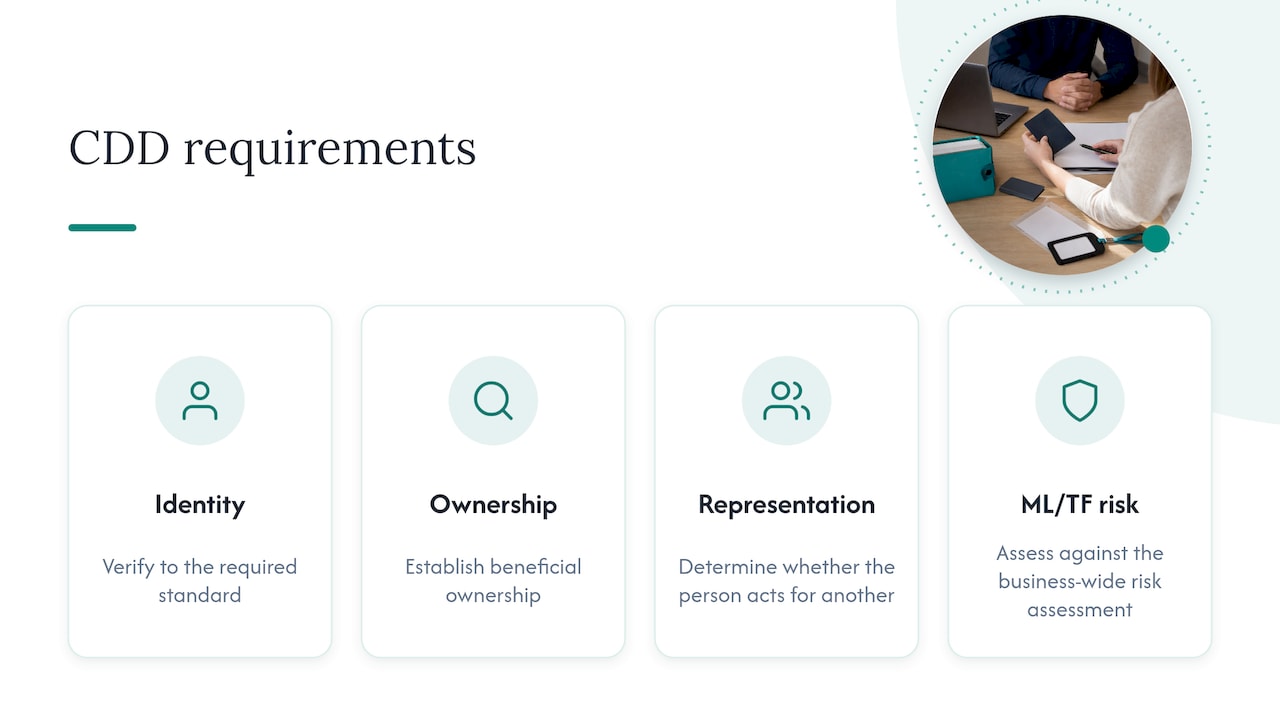
The AML/CTF regime asks a different one. Customer due diligence involves establishing who your customer is, determining whether they act on behalf of another person, and identifying, assessing and managing the money laundering, terrorism financing and proliferation financing risk they present. The duty attaches to a person to whom you provide, or propose to provide, a designated service.
That gives you a practical test for any party in a transaction:
- Are you providing a designated service to them, or on their behalf?
- Does the Act or the Rules specifically treat them as your customer in this type of transaction?
- If neither applies, you owe them no CDD, though you may still choose to look at them as part of your risk assessment of the deal.
The same discipline works in reverse. Calling someone a counterparty can lead an agency to assume it has no obligations to them, or to assume that a commercial check has covered the field. Both assumptions are wrong in real estate.
Who is a customer in a property transaction
AUSTRAC’s guidance on real estate designated services is clear that an agency brokering a sale, purchase or transfer has both the seller (transferor) and the buyer (transferee) as customers. The Tranche 2 obligations for real estate commenced on 1 July 2026 and are in force, so this applies to every such transaction you now handle.
| Your role | Party you act for | Other party who is also your customer |
|---|---|---|
| Selling agent | Seller or transferor | Buyer or transferee |
| Buyer’s agent | Buyer or transferee | Seller or transferor |
| Property developer selling directly | Not applicable | Each buyer you sell to |
The developer row is a reminder that the regime follows the designated service, not the label on the party. If you are unsure how a particular arrangement is characterised, read the designated services page and take advice from a compliance specialist or lawyer.
Why the party you do not act for is easy to overlook
The party you act for signs your agency agreement, attends your office and is in your CRM from day one. The other side may appear for the first time at the offer stage, represented by someone else, possibly through a company or trustee, possibly overseas. Because you have no engagement with them, the temptation is to leave the checks to their conveyancer. The Act does not allow that on its own: your obligation to your customer remains yours, unless you meet the conditions for reliance on another reporting entity’s CDD.
What you can delay, and the conditions
The Rules recognise that an agent may not be able to complete CDD on the other party before it has even met them. Section 6-32 therefore allows delayed initial CDD for the party you are not acting for. AUSTRAC’s delayed initial CDD page sets out the position:
- Party you act for: you must complete initial CDD before you start providing them with a designated service.
- Party you do not act for: you may complete initial CDD up to 28 days after the exchange of contracts, or at least 3 days before the initially agreed day for settlement, whichever is earliest.
A worked example makes the timing concrete. Contracts exchange on a Monday and settlement is set for 42 days later. Twenty-eight days after exchange falls 14 days before settlement, while 3 days before settlement falls 39 days after exchange. The earlier date is the 28-day mark, so that is your deadline. If settlement were instead set for 21 days after exchange, the settlement-based date would come first and you would need to finish CDD on the buyer at least 3 days before that day, that is, 18 days after exchange.
The conditions that come with the delay
Delay is not automatic. Under section 29 of the Act, before you start providing the designated service you must determine on reasonable grounds that delaying CDD is essential to avoid interrupting the ordinary course of business, and that the additional ML/TF risk is low. You must also have policies to complete CDD as soon as reasonably practicable and within the period, and to mitigate and manage the risks of the delay. Your program should therefore:
- Define when delay is permitted and who may authorise it.
- Require a recorded decision, with reasons, on each transaction where you delay.
- Set an internal trigger that stops the delay if red flags appear, such as a buyer who is evasive, a payment source that does not fit the buyer’s profile or an unexplained overseas element.
AUSTRAC’s delayed CDD guidance notes that civil penalties may apply if you do not verify know-your-customer information within the required timeframes. Treat the 28-day and 3-day marks as outer limits rather than targets, with reminders well before them, because your policies have to aim to finish as soon as reasonably practicable.
Staging verification around a project milestone is a familiar pattern in other industries as well, for example in subcontractor onboarding checks, where the work proceeds while the paperwork is completed on a defined timetable. The difference in real estate is that the timetable and the risk test are fixed by the Rules.
What to collect on a party you do not act for
Initial CDD generally involves collecting and verifying know-your-customer information, and what you collect differs by customer type and ML/TF risk. For the other side of a sale, build a standard request around three groups of information.
Who they are
- Individuals: enough to tell them apart from anyone with a similar name. AUSTRAC’s examples for individuals are full name, any other names, date of birth, residential address and a unique identifier such as a passport or driver licence number, with full name and date of birth verified from a government-issued photographic document or other reliable and independent data. Where there is a foreign element, note nationality and any indicators that the person may be a foreign politically exposed person. AUSTRAC states that foreign PEPs must always be treated as high risk.
- Companies: the full name, ACN, registered office, and the people who own or control the company. Beneficial ownership is determined by ownership and control: ownership is a stake, control is influence, and both must be tested.
- Trusts and SMSFs: the trust itself, its trustees and their authority to act, the beneficiaries or each class of beneficiaries, and the individuals who control it, such as appointors, settlors and protectors. Where a trustee is a company, AUSTRAC’s trust guidance includes that company’s own beneficial owners.
Whether they act for someone else
Ask directly whether the buyer is acting on behalf of another person, and record the answer. Nominee arrangements, family funding and undisclosed principals are the typical ways a buyer’s identity becomes obscured.
The nature of the transaction and the money
Record the purpose of the purchase, the expected source of funds and the relationship between the buyer and the funding. For higher-risk customers, enhanced CDD can involve verifying source of funds and source of wealth and conducting background checks such as adverse media searches. Where the buyer is overseas, see our guide to overseas buyer AML checks.
How to get the information when you have no relationship
The practical problem is access. You hold no engagement letter with the other party and they have no reason to deal with you. These approaches work in practice.
- Ask early and through the right channel. Include a CDD request in the offer or contract-preparation stage, addressed to the other party or their representative, so the request does not first arrive in the final weeks.
- Use a secure upload, not an email attachment. Identity documents should not travel by ordinary email. A secure upload or verification link lets the person provide documents from their own device.
- Explain why. A short plain-English note that agents are legally required to verify both parties to a sale usually helps.
- Use their representative where the Rules allow. A solicitor or conveyancer may be a reporting entity with its own CDD on the same person. Reliance on another entity’s CDD is governed by sections 37A and 38 of the Act and has conditions. It is not a casual shortcut, and you should record the basis for any reliance.
- Fix a timetable. Work back from the earlier of the two dates in the Rules and set your own internal chase dates well before it.
For the equivalent process on buyers, see our guide to buyer due diligence for real estate agencies.
When the other party will not cooperate
Some parties will delay, ignore requests or refuse. Your obligation is then to manage the risk, and to evidence that you did.
Record, for every such case:
- the date and method of each request and the information sought;
- the response, including any reason given for refusing;
- the steps you took to verify through other means;
- your reassessment of the customer’s risk rating in light of the refusal, with reasoning;
- the decision you took, who took it and when, and whether a suspicious matter report was considered.
A refusal to provide identity information, with no good explanation, is itself a risk indicator. Section 30 of the Act requires you to monitor for unusual transactions and behaviours that may give rise to a suspicious matter reporting obligation, and a party who will not identify themselves can be exactly that. If you cannot complete CDD within the allowed time, your program should say what happens next, including whether you can continue to provide the designated service, and when escalation to your AML/CTF compliance officer or a suspicious matter report is required. Take advice from a compliance specialist or lawyer on any case where you are unsure whether a report is required.
Do not close the file with a note that the party was “a counterparty, not a customer”. If they are a customer under the Rules, that note will not survive a supervisor’s review.
Why a commercial counterparty check is not enough
Credit reports, solvency searches, trade-finance counterparty checks and commercial reference checks are useful business tools. None of them satisfies the Act. They do not necessarily verify identity to the standard required, establish beneficial ownership, determine whether the person acts for another, or assess ML/TF risk against your business-wide risk assessment.
You can still use them as inputs. A clean credit profile may support a lower risk rating, and an adverse finding may justify enhanced CDD. But the CDD record has to stand on its own, built from KYC information collected and verified for the purposes of the AML/CTF program.
Records you must keep
Records showing compliance with CDD obligations, including the information collected, the risk assessment and the decision-making, must be retained for seven years from the end of the business relationship or the completion of the occasional transaction. Records must be in English or readily convertible into English. Our guide to AML record keeping and the seven-year clocks explains how each clock starts.
For the other party in a sale, make sure the file shows:
- the verification method and the documents or data sources used;
- the date you relied on the delay provision, the reasoning for it and the date CDD was completed;
- the beneficial ownership determination for any company or trustee;
- the risk rating and the reasoning behind it;
- all correspondence about non-cooperation.
Agencies that run many transactions at once can scale checks to each customer’s risk, with fewer steps for low-to-medium-risk customers and more for higher-risk customers, and build tailored customer forms into existing processes.
Our perspective
We built AML Guard for Australian Tranche 2 reporting entities, and a question agencies often raise is how to deal with the person on the other side of the sale. Our view is that the problem is rarely the rule. It is the workflow: the seller’s side is onboarded properly, the buyer’s side is left to chase-up emails, and the 28-day mark arrives with half a file.
We think the answer is to treat the other party as a customer from the offer stage, and to track the deadline from the day contracts exchange. Software can automate the lookups and the record keeping, but not the judgement.
How AML Guard handles the other party
In AML Guard, each identity check, screening result and officer decision sits in one case record, so the file for the other party shows what was collected, when, and who decided. For companies, beneficial ownership is determined from the ACN, and an officer approves each determination. Guided wizards produce the risk assessment, the AML/CTF program, a customer acceptance policy and the training manual, and can pre-fill from your risk assessment, so the delay policy your staff follow is the one your program sets out.
AML Guard is not self-service; every firm starts with a demo. Book a demo to walk through a real transaction, or see AML Guard’s pricing.
FAQ
Is the buyer my customer if I only act for the seller?
Yes. An agency brokering a sale has both the seller and the buyer as customers. The difference is timing: you may delay initial CDD on the buyer, within the Rules section 6-32 limits, but not on the seller you act for.
How long can I delay CDD on the other party?
Up to 28 days after exchange of contracts, or at least 3 days before the initially agreed settlement day, whichever is earliest. You must first determine on reasonable grounds that delay is essential to avoid interrupting ordinary business and that the added ML/TF risk is low. You also need policies to complete CDD as soon as reasonably practicable within that period.
Does a credit check on the buyer satisfy my AML/CTF obligations?
No. A credit or trade-finance counterparty check answers a commercial question. CDD requires verified identity, a beneficial ownership determination where relevant, and a recorded ML/TF risk assessment.
What if the other party refuses to provide identification?
Record every request and response, reassess the customer’s risk and escalate to your compliance officer. Consider whether a suspicious matter report is required, and take advice from a compliance specialist or lawyer where unsure. Do not treat the refusal as a reason to leave the file blank.
Sources
- Overview of customer due diligence, AUSTRAC
- Real estate designated services, AUSTRAC
- Delayed initial customer due diligence, AUSTRAC
- Risk insights and indicators of suspicious activity for the real estate sector, AUSTRAC
- Real estate program starter kit: examples of dealing with customers, AUSTRAC
- AML/CTF obligations factsheet for tranche 2 reporting entities, AUSTRAC
- Step 2: Use your real estate program, AUSTRAC
- Anti-Money Laundering and Counter-Terrorism Financing Act 2006 (Cth)
Recommended
- AML/CTF Compliance Checklist for Real Estate Agents: What You Need Before 1 July 2026
- Tranche 2 customer due diligence in Australia
- Enhanced due diligence in Australia: triggers
- CDD reliance checklist for Tranche 2 firms
See How AML Guard Works
Tranche 2 obligations are now in force.
Book a 20-minute demo to see how AML Guard supports your compliance from the moment your designated service begins.