
Charging clients for KYC costs is permitted, but only when the fee is disclosed before it is incurred and presented in a way that meets Australian Consumer Law’s single-price requirements. The safest approaches are a per-check pass-through, a capped disbursement, or letting the transaction party pay directly through a verification link. Your agency agreement, not general goodwill, is what makes any of these defensible.
TL;DR:
- Charging clients for KYC verification is legal if the fee is disclosed upfront and included in a single, all-inclusive price per Australian Consumer Law.
- The actual cost of verification varies significantly between automated checks, manual reviews, and high-touch procedures, with one overseas survey putting manual commercial reviews around US$2,598 per client, a directional benchmark rather than a local price.
- Proper documentation is critical; a clear written agreement and client consent before the check is what you rely on if the fee is later challenged.
- Four fee models are common: passing through exact vendor costs, capping disbursements, spreading charges via subscriptions, or shifting costs to transaction parties through payment links.
- A client-pays option using secure links with audit trails simplifies proof of consent and aligns with legal requirements, but operational systems must be carefully managed.
Table of Contents
- How to charge clients for KYC: what the rules actually require
- How much does KYC actually cost, and what drives the price?
- What legal rules govern charging for KYC services?
- How do you draft a client agreement clause for KYC fees?
- What are the common fee models for billing KYC costs?
- How should GST appear on KYC invoices?
- When should you not charge clients for KYC?
- How AML Guard operationalises a disclosed client-pays option
- What compliance officers get wrong about billing for KYC
- Put a disclosed client-pays option to work
- Sources
- FAQ
How to charge clients for KYC: what the rules actually require
Charging clients for KYC is not a grey area once you separate the two questions buried inside it. The first question is whether you must perform customer due diligence at all. The second is whether you may recover that cost from the client. AUSTRAC’s customer due diligence guidance answers the first question under the Anti-Money Laundering and Counter-Terrorism Financing Act 2006 (Cth). It says nothing about billing. That second question sits with contract law and consumer protection rules, and it is where most disputes actually happen.
The standard industry term for what you are billing is a disbursement, a cost incurred on a client’s behalf and passed through, as distinct from a professional fee for your own time. Getting that distinction right in your paperwork is what separates a legitimate KYC compliance charge from a fee a client can successfully challenge.
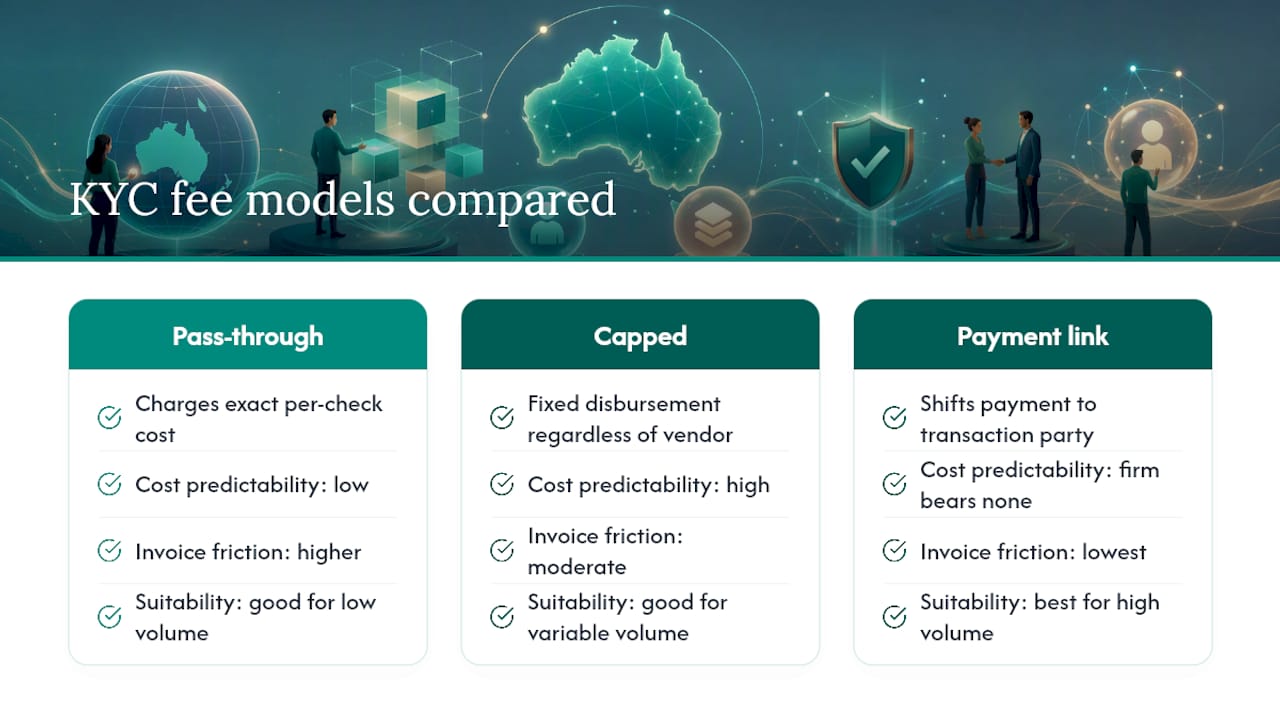
Three models dominate current practice: passing through the exact per-check cost, capping the disbursement at a fixed figure regardless of the vendor’s actual charge, or shifting payment to the transaction party entirely through a payment link. Each has a place, and which one suits your firm usually comes down to transaction volume and how much billing friction you can tolerate.
How much does KYC actually cost, and what drives the price?
Verification pricing splits sharply between automated checks and manual review, and that split is exactly why a flat “KYC fee” rarely makes sense.
At the automated end, database lookups, document verification, and biometric liveness checks are typically priced per check, with cost falling as volume rises. Vendors commonly bundle these into tiers rather than charging a single flat rate, because the underlying data and biometric processing carry different costs depending on the check type and how the contract is structured.
- Database-only identity checks sit at the cheapest end of the pricing band.
- Document verification (passport, licence) costs more because it involves image processing and forgery detection.
- Biometric liveness checks are the most expensive per-check item, since they combine a live capture with a matching algorithm.
- Volume tiers and approved-only billing models change the blended cost significantly once you factor in retries and failed attempts.
Statistic to note: high-touch manual reviews for commercial clients sit in an entirely different cost bracket. One widely cited industry survey found the average cost of a commercial KYC review runs around US$2,598 per client, driven by analyst time on complex ownership structures rather than the verification check itself. Treat that figure as a directional benchmark from an overseas market, not a local price you can quote.
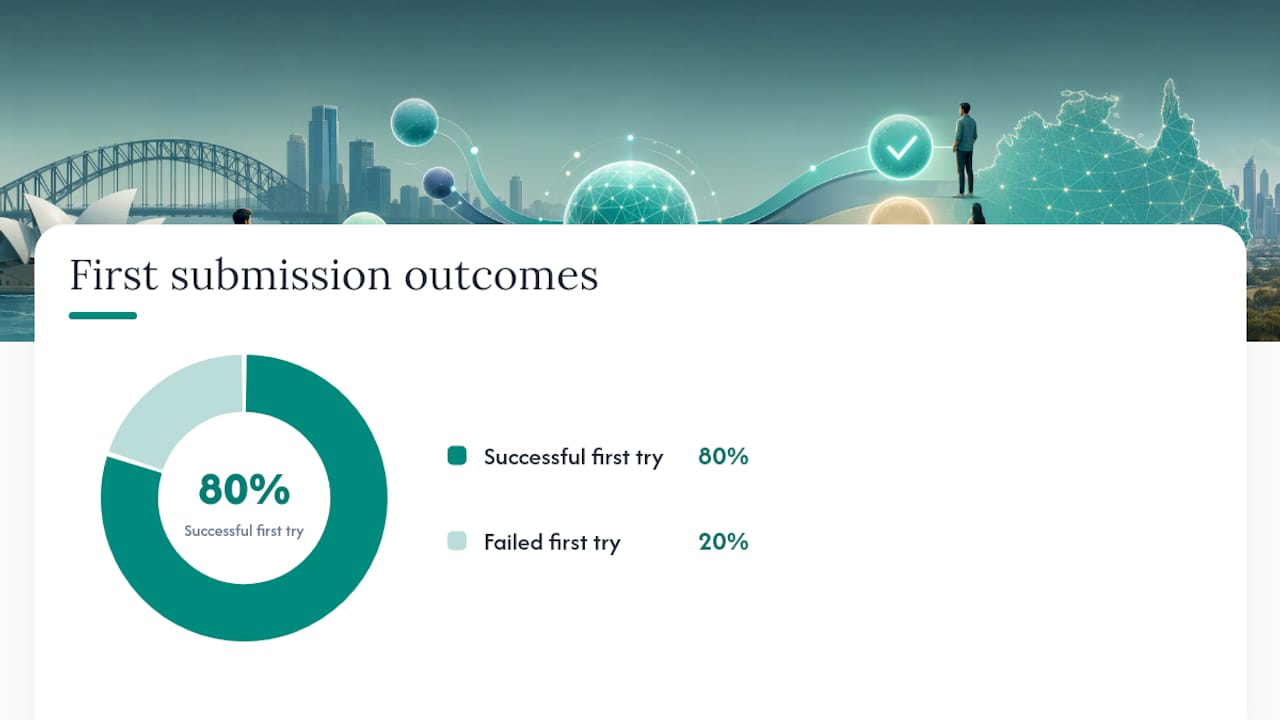
To model your own cost per approved client, divide your total vendor spend by the number of successful verifications, not the number of attempts. If 20% of checks fail on first submission and need a retry, your real cost per approved client can run well above the advertised per-check price, a detail worth building into any pricing model comparison you run internally.
What legal rules govern charging for KYC services?
Two separate legal regimes apply here, and conflating them is the most common mistake compliance officers make.
The AML/CTF Act 2006 (Cth) and AUSTRAC’s guidance govern whether you must collect customer due diligence and to what standard. They say nothing about who ultimately foots the bill. If your firm relies on a third party or a vendor to perform parts of that verification, AUSTRAC’s guidance on reliance under customer due diligence arrangements sets out what documentation that reliance requires, which matters if you are billing for a check someone else actually performed.
The billing question sits with Australian Consumer Law. Its single-price rule means any price you display or quote to a consumer must include GST and all unavoidable charges rolled into the one figure, not itemised as a surprise add-on later. A verification fee that a client cannot avoid if they want your service counts as unavoidable, and disbursements of that kind must be disclosed before they are incurred, not on the final invoice.
A fee introduced after the work has already started, with no prior mention in the agreement, is the exact scenario the single-price rule exists to prevent. Disclosure timing, not the existence of the fee itself, is usually what determines whether a charge holds up.
Whether a specific fee is lawful in your circumstances depends on your state’s agency legislation and the wording of your own agreement, so treat the following as a working checklist rather than a legal verdict:
- Check your agency agreement already contemplates disbursements of this kind.
- Use plain wording that names the fee as a verification or identity check cost, not a vague “admin fee.”
- Show GST inclusively wherever the figure faces a consumer.
- Get the client’s consent in writing before the check is run, not after.
How do you draft a client agreement clause for KYC fees?
A defensible client-pays clause lives in one of three places: the body of your agency agreement, a fees schedule attached to it, or a standalone cost disclosure addendum signed alongside the main contract. Any of the three works, provided the client sees it before the check happens.
The clause itself needs five components to hold up under scrutiny:
- What the fee covers. Name the specific check type (identity verification, document check, enhanced due diligence) rather than a generic “compliance fee.”
- Who pays. State plainly whether the client, the transaction party, or the firm bears the cost, and under what circumstance that changes.
- GST treatment. Confirm whether the quoted figure is GST-inclusive, and say so explicitly rather than leaving it implied.
- Timing and refunds. Specify when the fee is charged and what happens if the transaction falls through before the check is completed.
- Evidence of payment. Reference that a receipt from the verification vendor will be attached to the client’s file.
Operationally, four steps protect you if a client later disputes the charge: notify the client of the fee before the check runs, record their acceptance in writing, attach the vendor receipt to the client record, and keep that trail alongside your CDD evidence.
Pro Tip: Never rely on a verbal mention of the fee during an initial meeting. Put it in writing in the same document the client signs to engage your services, even if that means a short addendum rather than rewriting the whole agreement.
What are the common fee models for billing KYC costs?
Four models cover almost every practical scenario compliance officers face, and each suits a different transaction profile.
Per-check pass-through bills the exact vendor cost with no margin. This model is the most transparent but creates the most line items on an invoice.
Capped disbursement sets a fixed dollar figure regardless of the actual vendor cost, useful when check types vary between clients but you want one predictable number in your fee schedule. A cap is fair when it is set close to your typical actual cost, not padded as a hidden margin.
Subscription credit or amortisation spreads your platform’s subscription cost across the transactions it supports that month, rather than billing per check at all. This suits high-volume firms where itemising every check would clutter every invoice.
Transaction-party pays shifts the cost entirely to the buyer or seller in the transaction, usually through a secure payment link sent directly to them. The evidentiary chain matters here: keep the payment confirmation and credit it against your own subscription cost, so the paper trail shows the fee was paid and by whom.
- Per-check pass-through suits low-volume firms wanting full transparency.
- Capped disbursement suits firms with predictable, similar-sized transactions.
- Subscription credit suits high-volume firms billing many transactions monthly.
- Transaction-party pays suits deals where the buyer or seller has a direct stake in the outcome.
How should GST appear on KYC invoices?
Any price a consumer sees must include GST and all unavoidable charges in the one figure, per the single-price rule discussed earlier. That means a verification fee quoted to a client should show as one GST-inclusive number, not a base figure with GST bolted on as a surprise line.
Business-to-business invoicing has more flexibility. When you are invoicing another business rather than a consumer, you can show the GST component as a separate line, since that audience is used to reconciling GST for their own reporting. The rule that matters for consumer-facing documentation is simply this: no surprises at the bottom of the page.
- Show a single GST-inclusive figure on anything a consumer sees before or during the transaction.
- Separate the GST line on B2B invoices where the recipient will claim an input tax credit.
- Keep vendor receipts, written client consent, and CDD evidence filed together.
- Retain that file for seven years under the Act’s record-keeping minimum; platforms with an 8-year audit trail exceed that floor.
When should you not charge clients for KYC?
Passing on verification costs is not always the right call, even when it is legally available to you.
- Consumer transactions where state agency rules make itemised disbursements impractical or reputationally risky.
- Low-value or low-risk clients where a risk-based approach to verification means the check itself should be lighter, not more expensive to bill.
- Repeat clients where re-billing for a check already on file damages the relationship more than the fee is worth.
Pro Tip: If a check is genuinely low-risk, the better fix is often reducing the check’s intensity through risk-based triage, consistent with FATF’s recommendations on proportionate due diligence, which carry no force in Australia but point the same way, rather than finding a way to bill for an unnecessarily thorough one. Absorbing the cost, folding it into your standard service fee, or offering a clear opt-in transaction-party-pays link are all reasonable alternatives to a mandatory line-item charge.
How AML Guard operationalises a disclosed client-pays option
Every drafting step above still needs a system behind it, because a clause is only as good as the paper trail proving it was followed. A client-pays option can let the transaction party fund their own verification through a secure payment link, with the check credited back against the firm’s subscription rather than billed twice.
- Each check can be recorded per transaction, providing a receipt trail a client-pays clause requires.
- A compliance officer can approve each determination before customer due diligence proceeds, so billing does not run ahead of a human decision.
- Payment links can route the fee directly to the transaction party when that model suits the deal.
- Status indicators can sync to CRM systems without pushing CDD data itself, so billing evidence can sit inside a tamper-evident audit trail without disrupting firm systems.
Commercial terms and GST treatment on the platform side are firm-specific; check the pricing page directly, and have your own lawyer confirm clause wording against your state’s agency legislation before you roll out a new fee.
What compliance officers get wrong about billing for KYC
Most guidance on this topic treats it as a pricing question when it is really a documentation question. The fee amount matters far less than whether the client saw it coming, in writing, before the check ran. That single fact decides most disputes we have seen discussed in industry commentary, not the size of the charge or which vendor you use.
The conventional advice, “just pass the cost through,” skips the part that actually protects you: matching the disclosure timing to Australian Consumer Law’s single-price rule, and matching the clause to your own agency agreement rather than a template pulled from another state’s legislation. A capped disbursement clause copied from a colleague in another jurisdiction is not a shortcut. It is a liability waiting for the first client who reads their invoice closely.
If you take one thing from this, prioritise the paper trail over the pricing model. Get the disclosure right, get the client’s written acceptance before the check runs, and the choice between per-check billing and a transaction-party-pays link becomes a commercial preference rather than a legal risk.
Put a disclosed client-pays option to work
There are other ways to handle KYC billing, from manual disbursement clauses to spreadsheet-tracked pass-through fees, but most of them fall over at the same point: proving the client agreed before the check ran and that the money paid matches the check performed. AML Guard closes that gap by giving the transaction party a direct payment link for their own verification, with every check logged, approved by a compliance officer, and credited back against your subscription automatically.
That means less manual reconciliation between your fee schedule and your vendor invoices, and a tamper-evident audit trail that shows exactly when the client consented and what they paid for. If you are drafting a client-pays clause and want the operational side to match it, book a demo through the AML Guard platform to see how the client-pays option and audit trail fit your existing agency workflow.
This article is general information, not a substitute for advice from a qualified financial advisor. Consult a qualified financial professional about your own circumstances before acting on anything here.
Sources
FAQ
How much does a KYC check cost?
A single automated check, such as a database lookup or document verification, is priced per check by the vendor and falls with volume, whereas biometric liveness checks sit at the higher end of that per-check band.
What is KYC required for customers?
KYC, or customer due diligence, is required for designated services under the AML/CTF Act 2006 (Cth), and AUSTRAC’s guidance sets out the identity verification and screening steps reporting entities must complete before providing that service.
Can I legally charge my clients for KYC verification costs?
Yes, provided the fee is disclosed before it is incurred and presented consistently with Australian Consumer Law’s single-price rule; whether a specific fee is lawful still depends on your state’s agency legislation and your own agreement.
What is the safest way to bill a client for a verification fee?
A written disclosure in the agency agreement or a signed cost addendum, paired with a documented client acceptance before the check runs, is the safest approach, and a transaction-party-pays link like the one AML Guard offers removes the billing step from your invoice entirely.
Recommended
- AML Compliance Pricing in Australia: 2026 Comparison
- Tranche 2 customer due diligence in Australia
- AML/CTF Compliance Checklist for Real Estate Agents: What You Need Before 1 July 2026
- The Client Intake Portal: How Smart Agencies Onboard Clients for AML
See How AML Guard Works
Tranche 2 obligations are now in force.
Book a 20-minute demo to see how AML Guard supports your compliance from the moment your designated service begins.