
Whether your business is in the Tranche 2 scope depends on the designated services you provide, not on your job title or industry label. If you provide a designated service listed in section 6 of the Anti-Money Laundering and Counter-Terrorism Financing Act 2006 (Cth) with a geographical link to Australia, you are a reporting entity under AUSTRAC’s supervision. The obligations commenced on 1 July 2026 and are in force now. This guide sets out the services that matter most for real estate, legal, accounting and trust and company service work, the exclusions the Act states, and how to test your own business against them.
TL;DR
- “Tranche 2” is shorthand for the second stage of reform. The Act itself regulates designated services, and those services decide whether you are covered.
- Real estate is captured by Table 5: brokering sales for a buyer or seller, and selling real estate as a business without an independent agent.
- Table 6, items 1 to 9, covers property and entity transfers, client money, financing, shelf companies, creating or restructuring entities, nominee roles and registered office addresses.
- Dealing in precious metals, stones or products is captured under Table 2, item 2, at $10,000 or more in physical currency or virtual assets.
- The Act states exclusions, including court-ordered transfers, barristers acting on a solicitor’s instructions and the item 3 carve-outs.
Table of Contents
- What “Tranche 2” means and why the term does not decide scope
- How to test your business against section 6
- Real estate: Table 5 designated services
- Legal, accounting and trust and company services: Table 6
- Precious metals, stones and products: Table 2, item 2
- What the Act excludes
- What changes once you are in scope
- Our perspective: scope is a record, not a one-off decision
- See how the platform handles scope and CDD
- FAQ
- Sources
What “Tranche 2” means and why the term does not decide scope
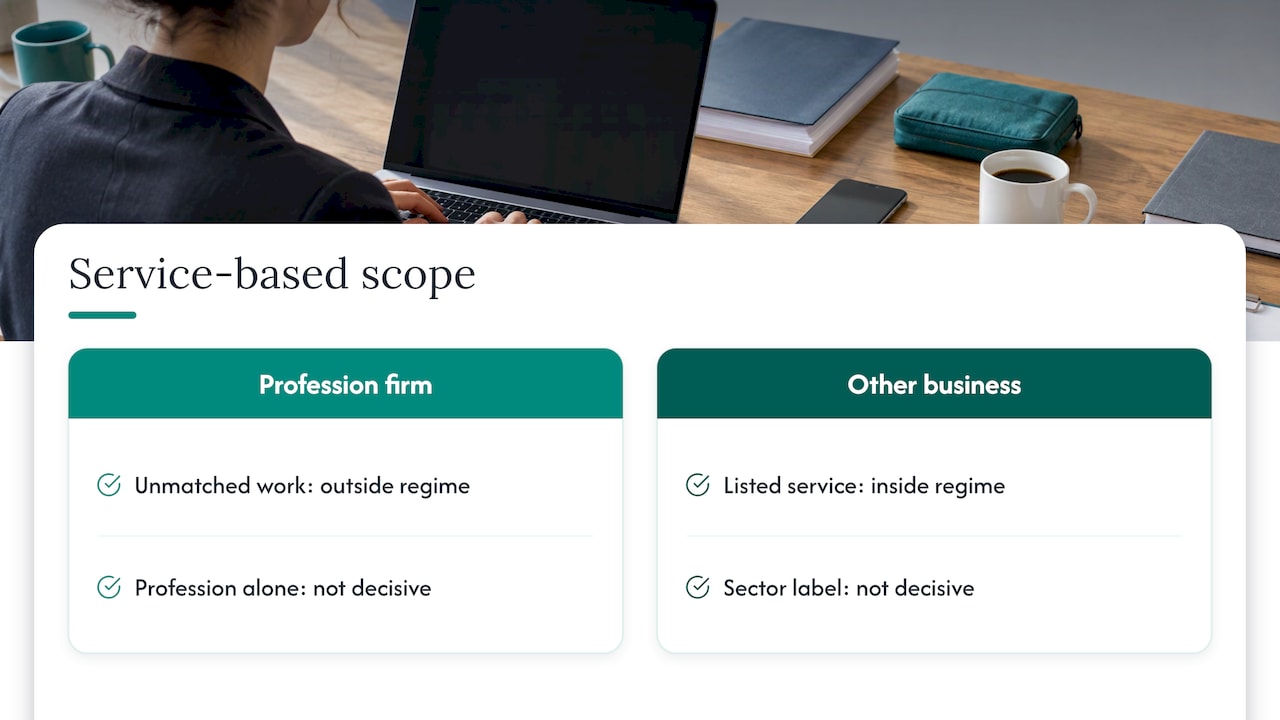
AUSTRAC’s factsheet for Tranche 2 reporting entities describes the reform as extending AML/CTF obligations, from 1 July 2026, to certain services typically provided by lawyers, conveyancers, real estate businesses, accountants, trust and company service providers, and dealers in precious metals, stones and products. The word “typically” matters. The Act does not name professions as regulated. It lists services, and a business that provides one of them is a reporting entity, which the Act defines as a person who provides a designated service, or the lead entity of a reporting group.
This has two practical consequences. A firm with a regulated profession can sit partly outside the regime if none of its work matches a listed service. A business that does not think of itself as a real estate, legal or accounting firm can be inside the regime if it carries out one of those services in the course of a business. “Tranche 2” is a convenient label for the sectors, and our overview of the sectors and obligations lists them in one place. The test for your own business is always the service.
How to test your business against section 6
Work through the same sequence for each line of your business.
- List what you actually do for customers. Write down each service, not each job title. A principal, a sales agent, a paralegal and a bookkeeper may all be part of one designated service.
- Match each service to a table item in section 6. The tables below show the items most relevant to Tranche 2 sectors.
- Check it is provided in the course of carrying on a business. A one-off private transaction is a different question from a business activity.
- Check the geographical link to Australia. AUSTRAC states that obligations apply where a designated service has a geographical link to Australia.
- Read the exclusions. Some transactions that look captured are carved out in the Act.
- Confirm with AUSTRAC’s tool. AUSTRAC publishes a “Check if you may be regulated” tool on its website. Use it with your list of services in front of you and keep a record of the result with your risk assessment.
Real estate: Table 5 designated services
AUSTRAC’s page on real estate designated services identifies two core services, both found in Table 5 of section 6.
Item 1: brokering a sale, purchase or transfer
Brokering the sale, purchase or transfer of real estate for a buyer, seller, transferee or transferor, in the course of carrying on a business, is a designated service under Table 5 item 1. In a brokered sale, both the seller and the buyer are customers of the service. That is a significant change from how most agencies think about their client, because the buyer on the other side of the contract is also someone you must identify and assess. AUSTRAC’s examples include both seller’s agency and buyer’s agency work, so selling agents and buyers agents are both in scope.
Item 2: selling real estate as a business without an independent agent
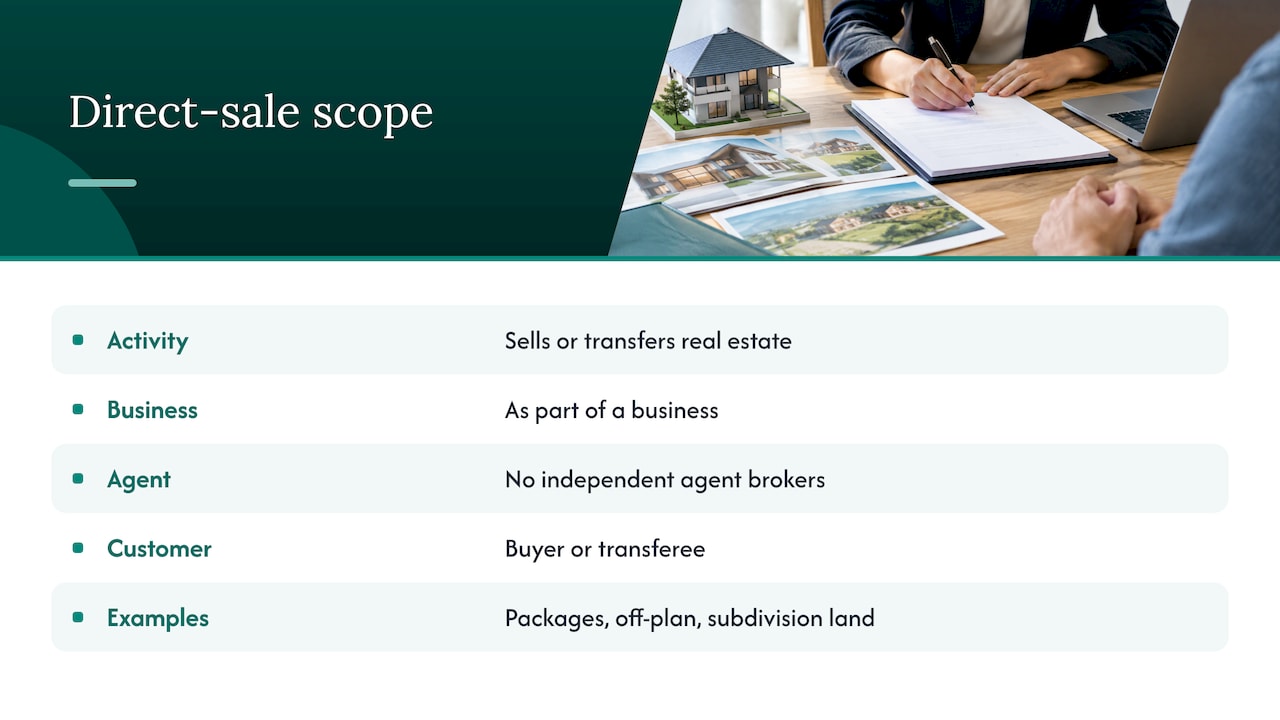
The second service applies where a business sells or transfers real estate as part of its business and an independent real estate agent does not broker the transaction. The buyer or transferee is the customer. AUSTRAC’s examples include developers selling house-and-land packages, off-the-plan apartments and subdivision land directly. AUSTRAC also states that item 2 can apply when a developer or other business uses its own in-house agents, sales employees or marketing employees instead of an external agency. A developer with an in-house sales team therefore cannot assume it sits outside the regime because it does not call itself an agency.
When the service starts, and what stays outside
For brokering, the point at which the service starts depends on whether you act for the seller or the buyer. For direct sales it starts when there is a commitment to sell or transfer, typically on entering an agreement. AUSTRAC states that incidental business sales and private residential sales are not captured. Property management is a separate question that turns on the activities involved, and we deal with it in our guide on property management and AML/CTF.
Legal, accounting and trust and company services: Table 6
Table 6 of section 6 covers the services lawyers, conveyancers, accountants and trust and company service providers commonly provide. Items 1 to 9 capture the following types of work when provided in the course of a business.
| Type of service (Table 6, items 1 to 9) | Typical examples |
|---|---|
| Assisting with property and entity transfers | Conveyancing, settlement work, transfers of interests in companies or trusts |
| Handling client money | Receiving, holding or disbursing funds for a client in connection with a transaction |
| Financing | Assisting with equity or debt financing for a company, trust or similar structure |
| Shelf companies | Selling or providing a pre-registered company |
| Creating or restructuring entities | Setting up or changing a company, trust or similar structure |
| Nominee roles | Acting as, or arranging for another person to act as, a director, secretary, partner or trustee on another person’s behalf, or a nominee shareholder |
| Registered office addresses | Providing a registered office or business address for an entity |
The consequence is that a practice’s regulated work is narrower than the whole practice. A law firm that only litigates may have little or no designated service work, while the same firm’s conveyancing or entity-structuring team clearly does. An accounting practice that prepares tax returns may be outside Table 6 until it also sets up a company for a client or acts as a nominee. We expand on legal practices in our Tranche 2 guide for law firms.
Precious metals, stones and products: Table 2, item 2
Dealers are captured by Table 2, item 2. The designated service is buying or selling precious metals, precious stones or precious products in the course of carrying on a business, where the purchase involves physical currency or virtual assets totalling $10,000 or more, whether in one transaction or in several that are linked or appear to be linked. A sale paid only by bank transfer or card is not this designated service, so the payment method and the amount are the two facts to record for each sale. A dealer who takes large cash or virtual asset payments only occasionally is still providing the designated service each time it does so.
What the Act excludes
The Act states several exclusions, and each one is narrow.
- Court-ordered transfers. Table 6 items 1 and 2 do not apply where the transfer of real estate, or of a body corporate or a legal arrangement such as a trust, is made under, or results from, an order of a court or tribunal.
- Barristers on a solicitor’s instructions. Section 6(6B) excludes a barrister acting on the instructions of a solicitor. A barrister who is instructed directly by a client is a different situation and should be assessed on the facts.
- The item 3 carve-outs. Section 6(5C) sets out carve-outs from item 3, the item covering the handling of client money. Read the subsection text for the exact conditions before relying on it.
Exclusions apply to the transaction or service described, not to the whole firm. Record the reasoning when you rely on one, because a supervisor will ask how you reached the conclusion. The wording is in the compiled Act.
What changes once you are in scope
A reporting entity must enrol with AUSTRAC, develop and maintain an AML/CTF program, appoint a compliance officer, conduct initial and ongoing customer due diligence, report suspicious matters and specified threshold transactions, and make and keep records, according to the AUSTRAC factsheet. The program comprises a risk assessment and policies, procedures, systems and controls tailored to the nature, size and complexity of the business.
The Act requires the risk assessment to identify and assess money laundering, terrorism financing and proliferation financing risks reasonably faced in providing designated services. The policies must then manage and mitigate those risks. Scope feeds directly into this work, because the services you identified are what the risk assessment covers.
Two practical points for real estate. AUSTRAC’s latest guidance updates record the delayed CDD timeframe for counterparties in its conveyancing and real estate starter kits: 28 days after exchange of contracts, or 3 days prior to settlement. They also describe a deemed customer due diligence measure for real estate agents where genuine attempts at counterparty CDD have been unsuccessful, with the steps taken recorded. On privacy, the OAIC states that reporting entities must only collect personal information reasonably necessary and that the AML/CTF regime does not require copies of full identity documents to be kept. Our customer due diligence guide walks through the process step by step.
Our perspective: scope is a record, not a one-off decision
We see the same mistake in agencies and firms that start with a job title. They ask whether they are “a Tranche 2 business” and stop there. The Act asks a different question: which designated services, in which parts of the business, with which customers.
That is why we build our platform around the service. AML Guard’s guided wizards produce the business-wide risk assessment, the AML/CTF program, a customer acceptance policy and the training manual, and can pre-fill from your risk assessment, so the documents start from the services and risks you assessed. A downloaded template cannot do this, because it has no knowledge of what you actually provide.
We also keep the officer in charge of judgement. Beneficial ownership determination runs from a company’s ACN, with an officer approving each one, and AML Guard keeps one case record holding each identity check, screening result and officer decision. The lookups and the record keeping are automated. The decision about scope and risk is not.
The same discipline applies to evidence. When a supervisor asks why a service was treated as in scope, or why an exclusion applied, the answer should be on file, dated and attributable. Write the reasoning down when you reach it, and keep it with your risk assessment.
AML Guard
See how the platform handles scope and CDD
AML Guard is an Australian AML/CTF compliance platform built for real estate agencies, buyers agents, developers, conveyancers, law firms, accounting practices and trust and company service providers. Its guided wizards produce the risk assessment, the AML/CTF program, a customer acceptance policy and the training manual, and each customer’s identity checks, screening results and officer decisions sit in one case record. AML Guard is not self-service; every firm starts with a demo. You can book a demo or review the platform features and pricing structure.
FAQ
Does “Tranche 2” appear in the Act?
No. It is shorthand for the extension of the regime to additional sectors. The Act regulates designated services listed in section 6, and your obligations follow from providing one.
Is a real estate agency always in scope?
Only if it provides a designated service, and AUSTRAC states that brokering sales for buyers or sellers and certain direct sales qualify. Incidental business sales and private residential sales are not captured. Use AUSTRAC’s “Check if you may be regulated” tool and keep the result on file.
Are both the buyer and the seller customers?
In a brokered sale under Table 5, yes. Both sides are customers of the brokering service, so you have customer due diligence obligations for each, subject to the timing and deemed CDD provisions in AUSTRAC’s guidance.
Does a barrister fall within scope?
Section 6(6B) excludes a barrister acting on a solicitor’s instructions. If the work does not fit that exclusion, assess it against the designated services directly and record your reasoning.
Does a dealer in gold or jewellery need to comply?
If a purchase of precious metals, stones or products involves $10,000 or more in physical currency or virtual assets, in one transaction or in linked transactions, it falls under Table 2, item 2. A sale below that amount, or paid only by bank transfer or card, is not this designated service.
Sources
- AML/CTF obligations factsheet for Tranche 2 reporting entities, AUSTRAC
- Real estate designated services, AUSTRAC
- Anti-Money Laundering and Counter-Terrorism Financing Act 2006 (Cth), legislation.gov.au
- Latest guidance updates, AUSTRAC
- Know your privacy obligations under the AML/CTF Act, OAIC
Recommended
- Tranche 2 AML/CTF for Australian law firms
- AML/CTF Rules 2025: A Tranche 2 Reading Guide
- TCSP AML in Australia: which services count
- Tranche 2 AML Australia: your compliance obligations explained
See How AML Guard Works
Tranche 2 obligations are now in force.
Book a 20-minute demo to see how AML Guard supports your compliance from the moment your designated service begins.