
There are no “AML/CTF Rules 2026”. The instrument that applies to your business is the Anti-Money Laundering and Counter-Terrorism Financing Rules 2025 (F2025L01026), and the Rules have been amended since they were made, so always read the current text. The year 2026 matters for one reason: the obligations started for Tranche 2 firms, including real estate agents, buyers agents and property developers, on 1 July 2026, and they are in force now. The Act sets the duty; the Rules set the detail. This guide shows how the Rules are organised and which Parts a Tranche 2 firm works with day to day.
TL;DR
- The instrument is the AML/CTF Rules 2025, made under the AML/CTF Act 2006 (Cth). Tranche 2 obligations commenced on 1 July 2026.
- The Rules have 12 Parts, and sections are numbered by Part: section 6-32 sits in Part 6.
- Tranche 2 firms mainly use Part 3 (enrolment), Part 5 (AML/CTF programs), Part 6 (customer due diligence) and Part 9 (reporting).
- Your program starts with a business-wide risk assessment, and your policies must follow from it.
- Read the live text on the Federal Register of Legislation rather than a summary, because amendments change the detail.
Table of Contents
- Which law and which instrument apply
- How to read the Rules: Parts and section numbers
- The Parts a Tranche 2 firm uses
- From the Rules to a working program
- Enforcement and what it means for agency owners
- Putting the Rules to work with AML Guard
- FAQ
- Sources
Which law and which instrument apply
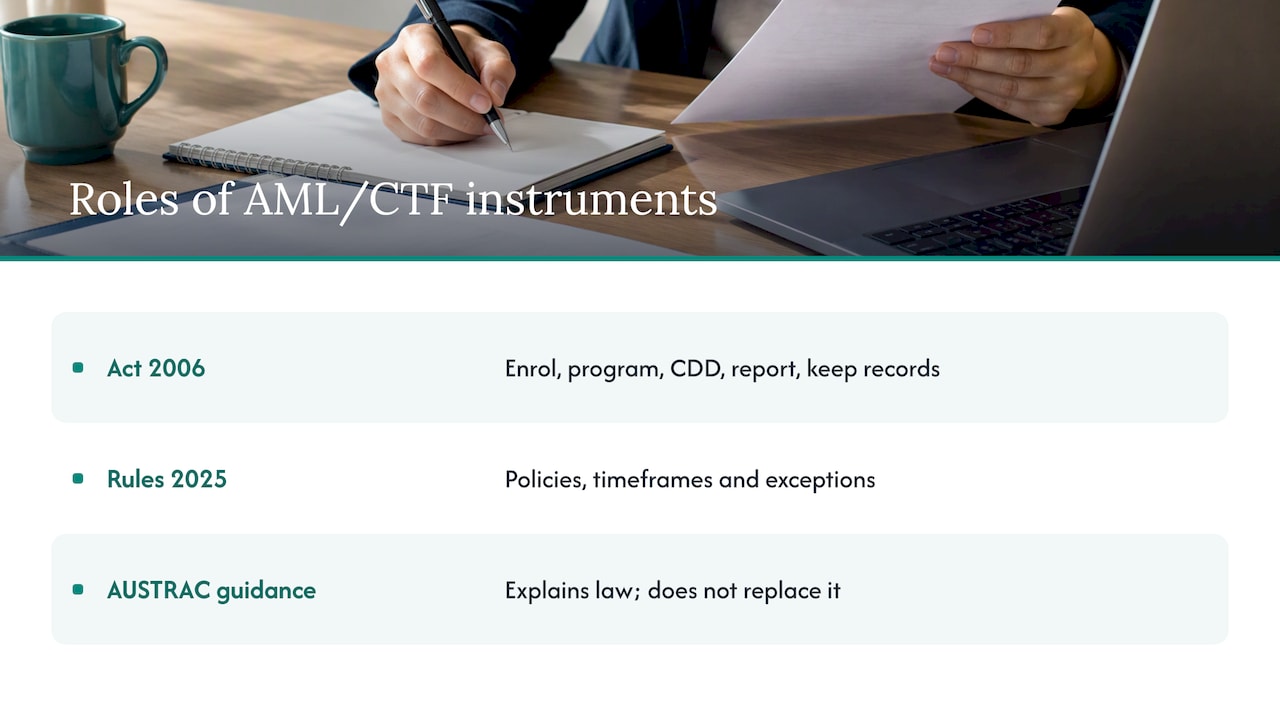
Two documents carry the obligations. The Anti-Money Laundering and Counter-Terrorism Financing Act 2006 is the primary legislation. It states what a reporting entity must do: enrol, maintain a program, carry out customer due diligence, report and keep records. The Rules 2025 fill in the detail, such as what a policy must say about a particular situation, which timeframes apply and which exceptions exist.
AUSTRAC is the regulator and publishes guidance, but guidance explains the law and does not replace it. When a guide, a template or a vendor says “the Rules require”, the safe habit is to find the section number and read it in the legislation.
For real estate, AUSTRAC states that real estate agents, buyers agents and property developers are covered when they broker the sale, purchase or transfer of real estate as part of a business. That includes developers selling house and land packages, off-the-plan apartments or blocks in new subdivisions without an independent agent. The designated service applies whether the agent acts for the buyer, seller, transferee or transferor. Leasehold interests of more than 30 years, excluding options for renewal or extension, count as real estate transactions for these purposes. If you are unsure whether your property management work is caught, our guide on whether AML/CTF applies to property management sets out the questions to ask.
How to read the Rules: Parts and section numbers
The Rules are divided into 12 Parts. Each section number begins with its Part number, then a hyphen, then the section’s position in that Part. So 6-32 is the 32nd-numbered section in Part 6, and 5-20 is in Part 5. Once you know that, a citation tells you where to look without searching.
Parts are split into Divisions, and the Divisions group related sections. In Part 5, for example, Division 8 is headed AML/CTF policies related to real estate transactions and contains section 5-20, which deals with policies relating to customer due diligence for real estate transactions. The contents list at the front of the live text is the fastest way to find a section. Use it before you rely on anyone’s summary, including ours.
A practical reading order for a Tranche 2 firm:
- Find the section in the Act that creates the duty.
- Find the Rules section, by Part, that gives the detail.
- Check AUSTRAC’s guidance for how it expects the duty to be met.
- Record in your own policies how your firm does it.
The Parts a Tranche 2 firm uses
Part 3: enrolment
Enrolment on the AUSTRAC Reporting Entities Roll comes first, because the other obligations hang off being a reporting entity. AUSTRAC’s enrolment guidance says you must apply to enrol no later than 28 days after the day you start providing a designated service, so a business providing designated services from 1 July 2026 had until 29 July to apply. A firm that has not yet enrolled should act immediately; our note on what to do if you missed the enrolment deadline covers the practical steps.
Part 5: AML/CTF programs
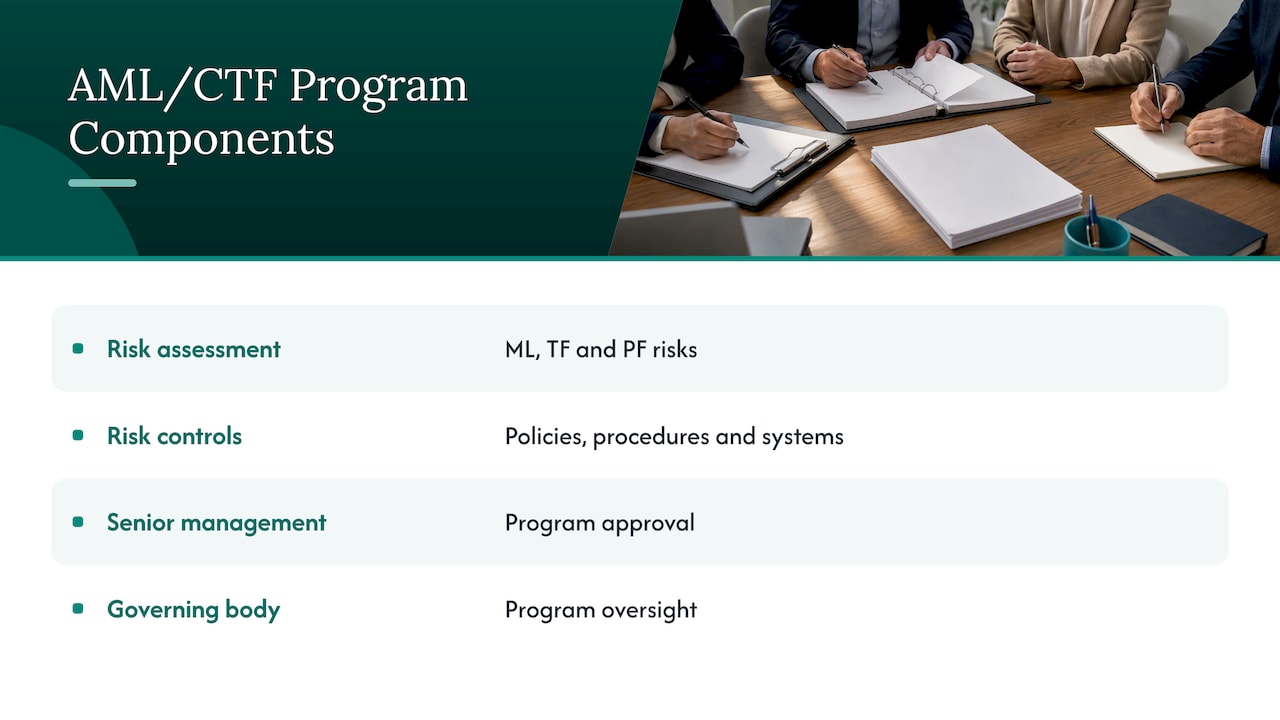
Part 5 is where your documented program lives. AUSTRAC’s factsheet states that the program consists of a risk assessment covering money laundering, terrorism financing and proliferation financing, together with policies, procedures and systems to mitigate those risks. The program must be approved by senior management and overseen by the governing body, so the principal of a small agency cannot treat it as a task for a junior.
For real estate, section 5-20 is the one to find early. It sits in its own Division on real estate transactions, and it deals with the policies a firm needs for customer due diligence in those transactions. Read it in full in the live text, then check that your policies say what it requires in your firm’s own terms.
The Department of Home Affairs describes the regime as a risk-based approach, in which reporting entities design and implement measures commensurate with the money laundering and terrorism financing risk they face. In practice, that means a boutique buyers agent and a multi-office agency can reach different programs from the same Rules, provided each is grounded in its own risk assessment. Our guides on what an AML/CTF program is and on AML risk assessment for real estate agencies go into the content.
Part 6: customer due diligence
Part 6 is the longest working part for most agents. Its first Division covers initial customer due diligence. The factsheet confirms the general shape: initial CDD is done before providing the designated service in most cases, followed by ongoing due diligence, with enhanced measures applied when risk is high.
Three sections in Part 6 are worth locating in the live text:
- Section 6-16, simplified CDD. Read the section to see the conditions on which a firm may do less, and what your policies must say before you rely on it.
- Section 6-23, politically exposed persons. Read it for the steps expected when a customer or related person is a PEP.
- Section 6-32, delayed initial CDD for real estate transactions. This is the real estate-specific timing rule.
We name sections 6-16 and 6-23 so you know where to look, and we leave their detail to the legislation itself, because the wording matters and the Rules can be amended.
Section 6-32 is headed delayed initial customer due diligence for real estate transactions. In real estate, AUSTRAC’s delayed CDD guidance lets an agent delay initial CDD on the party they do not act for until 28 days after the exchange of contracts or 3 days before the initially agreed settlement day, whichever is earlier, where the conditions in section 29 of the Act are met. The delay is a timing concession, not an exemption. A firm that uses it needs a clear process that tracks the date for each matter, and a record of what was done and when.
AUSTRAC also publishes updates to its guidance on technical points, such as initial CDD for a government body. In 2026, for example, it updated the real estate starter kit’s customer due diligence forms to reflect the 28-day delayed CDD timeframe and to record the steps taken when a counterparty will not cooperate during CDD. Check the page periodically, since it changes. For the end-to-end picture, see our overview of Tranche 2 customer due diligence in Australia.
Part 9: reporting
Part 9 deals with reporting to AUSTRAC. Two report types matter to most Tranche 2 firms, and the factsheet gives their timeframes:
| Report | When it is due |
|---|---|
| Suspicious matter report (terrorism financing) | Within 24 hours |
| Suspicious matter report (other matters) | Within 3 business days |
| Threshold transaction report (physical currency of A$10,000 or more) | Within 10 business days |
These timeframes are from AUSTRAC’s obligations factsheet for Tranche 2 reporting entities. Property settlements rarely involve physical cash, but a deposit or a payment offered in cash is exactly the situation your staff must recognise and escalate. Suspicion can arise at any stage, and a staff member who does not know who to tell is a gap in the program.
From the Rules to a working program
Reading the Rules is the beginning. A supervisor will want to see that your documents agree with each other and with how the firm actually operates. The usual sequence is:
- Assess risk. Look at your customers, the services you provide, how you deal with clients (in person or remotely), the delivery channels and the geography involved. Record the reasoning, not only the rating.
- Write policies from that assessment. Each control should trace back to a risk it addresses. Include the real estate-specific policies Part 5 calls for.
- Plan the work. Give each task that remains an owner and a date.
- Train the people. The training manual should teach the policies as written. Our note on AML training for real estate covers what agencies must do.
- Keep records. Agencies must make and keep accurate, complete records of the program and compliance activity, with most records retained for 7 years.
- Review. Keep the program current as the business, the risks and the Rules change.
The weak point in many first programs is inconsistency: a risk assessment that says one thing, policies that say another and a training deck copied from somewhere else. Firms building this oversight into their routine can borrow ideas from AI-assisted pre-audit gap analysis, which shows how a regular pre-audit review can flag compliance drift before a supervisor does.
For a printable list of tasks, our AML/CTF compliance checklist for real estate agents is a useful companion to the Rules themselves.
Enforcement and what it means for agency owners
AUSTRAC supervises compliance, and it says that understanding and meeting your obligations is essential to protect your business from misuse by criminals. The Act provides for civil and criminal consequences for non-compliance. For current penalty amounts and the enforcement actions AUSTRAC has taken, go to the Act and AUSTRAC’s own pages, because amounts are set by the legislation and can change. The practical point for an owner is that the strongest position is a program that is documented, approved by senior management, followed by staff and evidenced in the records.
Our perspective
We built AML Guard for Australian Tranche 2 reporting entities, not as an adaptation of banking tools. When we read the Rules 2025 alongside the Act, the pattern we see is that supervisors examine whether the pieces of a program agree with one another: the risk assessment, the policies and the training.
That is why AML Guard’s guided wizards produce the risk assessment, the AML/CTF program, a customer acceptance policy and the training manual, and can pre-fill from your risk assessment. A downloaded template starts with no knowledge of your risk assessment.
We also believe judgement must stay with your people. The platform automates lookups and record keeping, not decisions: for companies, beneficial ownership is determined from the ACN, and an officer approves each determination.
AML Guard
Putting the Rules to work with AML Guard
If you want your risk assessment, program, customer acceptance policy and training manual built with guided wizards, AML Guard produces them, then supports the CDD work the Rules describe: one case record holding each identity check, screening result and officer decision, and ACN-based beneficial ownership determination with an officer approving each one. AML Guard is not self-service; every firm starts with a demo. Book a demo, or see the pricing page for the subscription and per-check fees.
FAQ
Are there AML/CTF Rules 2026?
Not as a replacement set. The main instrument is the Anti-Money Laundering and Counter-Terrorism Financing Rules 2025 (F2025L01026). The year 2026 is when obligations started for Tranche 2 firms, on 1 July 2026. There are also AML/CTF Transitional Rules 2026, made under the 2024 Amendment Act, which deal with moving to the new regime, such as staggered deadlines for first independent evaluations. Read the current text on the Federal Register of Legislation, as the Rules have been amended since they were made.
What does a section number like 6-32 mean?
The first number is the Part and the second is the section within it. Section 6-32 is therefore in Part 6, customer due diligence, and it deals with delayed initial CDD for real estate transactions. The contents list in the live text shows every Part and Division.
Which Parts of the Rules does a real estate agency use most?
Most agencies work mainly with Part 3 (enrolment), Part 5 (AML/CTF programs), Part 6 (customer due diligence) and Part 9 (reporting). Part 5 includes policies for real estate transactions, and Part 6 includes the delayed CDD rule for those transactions.
Is the AML/CTF Act or the Rules the main source of the obligations?
Both. The Act creates the duties and the Rules supply the detail. You need to read the Rules section that sits under each duty, then check AUSTRAC’s guidance for how it expects the duty to be met.
Sources
- Anti-Money Laundering and Counter-Terrorism Financing Rules 2025 (F2025L01026)
- Anti-Money Laundering and Counter-Terrorism Financing Act 2006
- Real estate designated services, AUSTRAC
- Enrol with us: overview, AUSTRAC
- AML/CTF obligations factsheet for Tranche 2 reporting entities, AUSTRAC
- Delayed initial customer due diligence, AUSTRAC
- Latest guidance updates, AUSTRAC
- Your obligations, AUSTRAC
- What it means to be regulated under the AML/CTF regime, Department of Home Affairs
- Anti-Money Laundering and Counter-Terrorism Financing Transitional Rules 2026
Recommended
- Tranche 2 AML/CTF for Australian law firms
- AML/CTF policy template for Tranche 2 firms
- AML/CTF Staff Training for Tranche 2
- AML/CTF Program Documents for Tranche 2
See How AML Guard Works
Tranche 2 obligations are now in force.
Book a 20-minute demo to see how AML Guard supports your compliance from the moment your designated service begins.