

Buyer’s agents are reporting entities under Tranche 2 of Australia’s AML/CTF regime, regulated by AUSTRAC under the Anti-Money Laundering and Counter-Terrorism Financing Act 2006 (Cth) and the AML/CTF Rules 2025. If you broker property purchases, your AML/CTF program (a risk assessment and policies) has to be in place before you provide a designated service, and you must enrol with AUSTRAC within 28 days of starting.
TL;DR:
- Buyer’s agents need an AML/CTF program in place before providing a designated service, and must enrol with AUSTRAC within 28 days of starting.
- Customer due diligence on the buyer client comes before the service starts; CDD on the seller can wait until the earlier of 28 days after exchange or 3 days before the initially agreed settlement day, if the conditions for delay are met.
- Where the client buys through a company, trust or SMSF, you identify its beneficial owners; complex, layered or offshore structures call for closer review.
- Screen for politically exposed persons and sanctions at the start and again as the transaction moves; enhanced CDD, including source of funds and wealth where relevant, applies for a high-risk client, a foreign PEP or a FATF call-for-action jurisdiction.
- Non-compliance can lead to regulatory action, reputational damage and disrupted transactions, so the procedures have to be ones staff actually follow day to day.
Table of Contents
- Quick compliance checklist for buyer’s agents
- Who is covered and when a buyer’s agent starts providing a designated service
- Customer due diligence rules that matter to buyer’s agents
- Beneficial ownership and how checks apply to companies, trusts and SMSFs
- PEPs, source of funds and sanctions: triggers for escalation
- Program requirements: risk assessment, policies, training and recordkeeping
- Practical implementation: intake, verification and a platform-assisted workflow
- Guidance on how buyer’s agents should manage suspicious matter reporting
- Interaction between buyer’s agents and real estate lawyers regarding AML compliance
- Potential penalties and consequences for non-compliance
- Best practices for ongoing customer transaction monitoring
- Publisher perspective: compliance without losing deal momentum
- How AML Guard helps buyer’s agents meet Tranche 2 obligations
- FAQ
- Sources
Quick compliance checklist for buyer’s agents
The obligations are easier to meet in order than all at once. A workable sequence:
- Work through AUSTRAC’s real estate program starter kit as your baseline, and enrol with AUSTRAC within 28 days of starting to provide a designated service.
- Complete a business-wide risk assessment of money laundering, terrorism financing and proliferation financing before writing any policy.
- Build linked AML/CTF policies, customer due diligence forms and escalation workflows from that risk assessment.
- Appoint an AML/CTF compliance officer, schedule staff training and set recordkeeping practices that meet the seven-year legal minimum.
For a longer walk-through of readiness steps, see our AML/CTF compliance checklist for real estate agents.
Who is covered and when a buyer’s agent starts providing a designated service
Brokering the sale, purchase or transfer of real estate is a designated service, and AUSTRAC’s real estate guidance says a buyer’s agent starts providing it to the buyer when an agreement to find or identify a property is signed. From that point, AML/CTF obligations attach to the engagement, not just to the eventual settlement.
A buyer’s agent transaction has two customers, not one:
- The buyer, who engages the agent directly and whose identity and ownership structure must ordinarily be verified before the service starts.
- The seller, to whom the buyer’s agent starts providing the service when it is reasonably expected that the transaction will proceed, typically when the offer is accepted and the contract is signed, even though the seller never instructed the buyer’s agent.
That second point catches many agents out. A selling agent reads the same transaction from the opposite side, and our explainer on buyer due diligence for real estate agencies sets out that perspective.
Customer due diligence rules that matter to buyer’s agents
Initial customer due diligence (CDD) on the buyer client is ordinarily complete before any service begins: you need to know who you are acting for before you start finding them a property. The seller side is different. Section 29 of the Act and section 6-32 of the Rules let a buyer’s agent start providing the service to the seller before CDD on the seller is complete, as AUSTRAC’s delayed CDD guidance explains.
- Delayed initial CDD on the seller must be completed by the earlier of 28 days after exchange of contracts and 3 days before the initially agreed day for settlement (Rules 6-32(2) and (4)).
- Delay is available only where you determine on reasonable grounds that it is essential to avoid interrupting the ordinary course of business and that any additional risk is low, and your policies say how CDD will be completed in time. A seller who presents higher risk is not a candidate.
- Enhanced CDD applies where the customer’s ML/TF risk is high, a foreign PEP is involved, a party is in or formed in a FATF call-for-action jurisdiction, or you have a suspicious matter reporting obligation and continue to act. A domestic PEP calls for it only where the risk is high.
- Practical verification for either party typically combines government-issued photo identification, address confirmation and, where a company or trust is involved, a search of the relevant register, such as ASIC for a company.
Our detailed walk-through of customer due diligence in Australia covers the forms and verification sequencing in full.
Beneficial ownership and how checks apply to companies, trusts and SMSFs
Buyers increasingly purchase through a company, trust or self-managed super fund rather than in their own name, and each structure needs its own beneficial ownership path.
- A company resolves on its own Australian Company Number (ACN): an ASIC search gives its officeholders and shareholders, the starting point for identifying the individuals who ultimately own or control it.
- A trust or SMSF with a corporate trustee is reached through that company, which runs its own beneficial ownership determination on its own ACN; individual trustees are verified as individuals.
- Deed review for a trust is a task for your compliance officer, not an automated lookup, because trust deeds vary widely in how they name beneficiaries and controllers.
- Simplified CDD is available only where the customer’s risk is low, no enhanced CDD trigger applies and the Rules’ requirements are met (section 31); anything unusual, layered or offshore should go to your compliance officer before CDD is treated as complete.
- Document the reasoning behind every beneficial ownership determination and keep that evidence with the client file, not just the conclusion.
Our guide to beneficial ownership in property transactions walks through each structure in more depth.
PEPs, source of funds and sanctions: triggers for escalation
An overseas client introduces risk categories that a purely domestic buyer rarely raises. AUSTRAC’s guidance on politically exposed persons explains that a foreign PEP always triggers enhanced CDD and senior manager approval before you proceed, while a domestic or international organisation PEP does so where the risk is high.
- Treat a client who holds or has held a prominent public role, domestically or overseas, as a potential PEP and screen accordingly.
- Where enhanced CDD applies, ask the source of funds and source of wealth questions directly: where did the deposit come from, and how was the underlying wealth accumulated.
- Screen every buyer and seller against DFAT’s Consolidated List. Under DFAT’s sanctions guidance for real estate professionals, assets of a designated person are frozen: do not deal with them, tell the Australian Federal Police if you hold one, report an attempted dealing to the Australian Sanctions Office, and consider a suspicious matter report.
- Enhanced CDD is also mandatory under section 32 where the client, a beneficial owner or a person acting for them is physically present in, or formed in, a jurisdiction the Financial Action Task Force has called for enhanced due diligence on.
Program requirements: risk assessment, policies, training and recordkeeping
Everything above sits inside a formal AML/CTF program, and AUSTRAC expects that program to be a connected set of documents rather than a single policy statement.
- A business-wide risk assessment comes first, and under section 26C of the Act it must cover proliferation financing as well as money laundering and terrorism financing.
- AML/CTF policies, a compliance action plan and a staff training manual should all flow from that same risk assessment so they stay consistent with each other.
- The real estate program starter kit gives eligible small firms a practical template to build from, though it remains AUSTRAC’s general interpretation rather than a substitute for advice on your specific business.
- Keep records for the periods the Act sets, seven years from different starting points for different records, and build an audit trail that shows not just what was decided but why.
For staff training specifics, see our guide on AML training for real estate.
Practical implementation: intake, verification and a platform-assisted workflow
Running this well day to day means deciding, before a client ever walks in, what gets collected at engagement and what can wait for the delayed CDD window.
- Collect enough identity evidence at first contact to run remote verification immediately: a driver’s licence or passport, plus a liveness check as a fraud control, covers most individual buyers.
- Where you delay CDD on a seller, record the determination and the reasons at the time you make it, not retrospectively.
- Re-screen sanctions and PEP status periodically through a transaction, not only at the start, since a client’s status can change between engagement and settlement.
- Keep records in a format that is tamper-evident, so any change made after the fact can be detected.
Pro Tip: Build your intake form around the delayed CDD trigger dates, not the settlement date alone, so the file flags itself when the 28-day or 3-day window is approaching.
A client intake portal that lets a buyer or seller complete identity and document checks remotely removes a lot of the chasing that otherwise falls on agency staff.
Guidance on how buyer’s agents should manage suspicious matter reporting
A suspicious matter report (SMR) obligation under section 41 of the Act sits apart from your day-to-day CDD work, and it attaches the moment you form a suspicion, regardless of whether the transaction proceeds. For a buyer’s agent, that suspicion can arise from either customer: a buyer who cannot explain the source of a large deposit, a seller who insists on an unusual settlement structure, or a third party inserting themselves into negotiations without a clear role.
The threshold is reasonable grounds to suspect, not proof. You do not need to confirm wrongdoing before reporting: a suspicious matter report is due within 3 business days after you form the suspicion, or 24 hours if it relates to terrorism financing. Document what triggered the suspicion, what you observed or were told, and when you formed the view, because that timeline matters if AUSTRAC ever reviews the file.
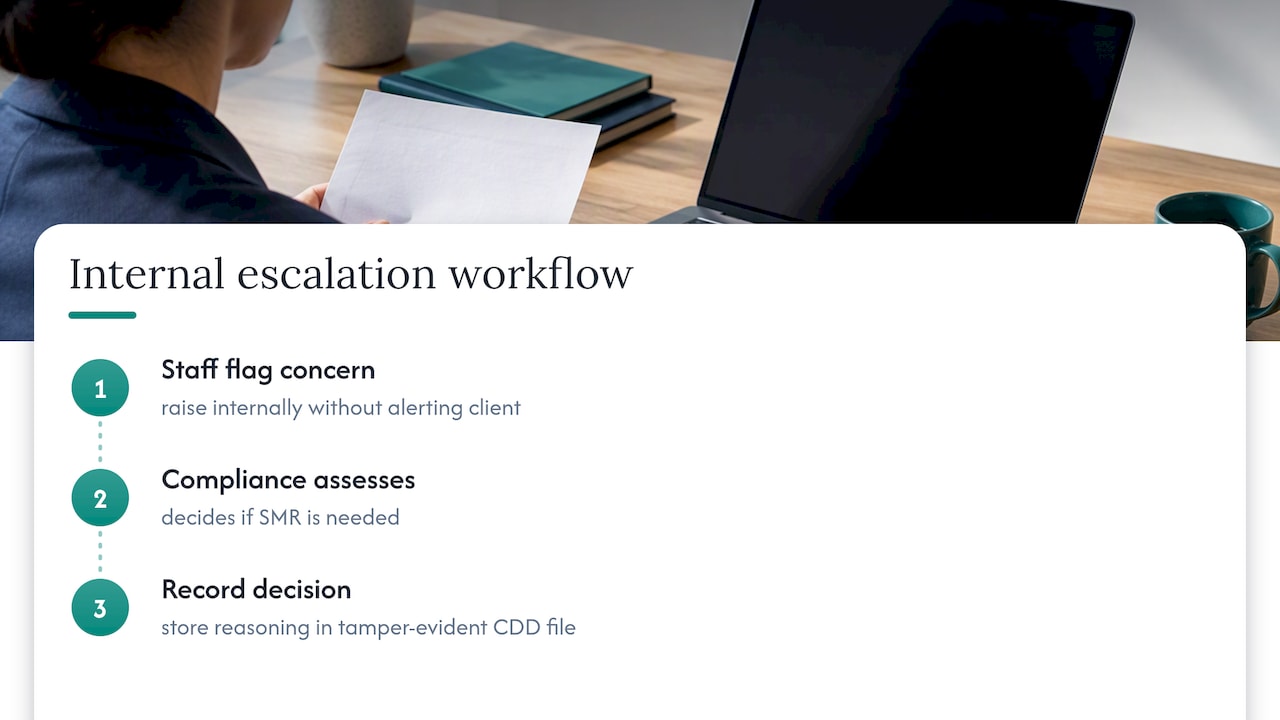
Tipping off is a separate offence under section 123 of the Act: disclosing that a report has been or will be made, where that would or could reasonably be expected to prejudice an investigation. In practice, do not tell the client, the other party or their representatives, and make your internal escalation path clear enough that frontline staff can raise a concern with the compliance officer without the client noticing anything unusual.
Build an internal escalation workflow that lets any staff member flag a concern quickly, with the compliance officer making the final call on whether a report is lodged. Keep the reporting decision and its reasoning in the same tamper-evident record as your other CDD evidence, separate from anything the client can access.
Interaction between buyer’s agents and real estate lawyers regarding AML compliance
A buyer’s agent and the conveyancer or solicitor acting on the same transaction are each independently regulated reporting entities under Tranche 2. Neither can rely on the other’s compliance work without following the reliance provisions properly, and neither is relieved of their own obligations simply because the other party is also checking the client.
Reliance covers the collection and verification of KYC information, not the rest of CDD: you still identify the customer’s ML/TF risk and make your own decisions. A standing arrangement under section 37A has to be assessed at least every 2 years and after any significant change (section 37B, Rules 6-30), and one-off reliance under section 38 needs reasonable grounds that it is appropriate for the risk. The Rules also provide a specific arrangement for parties to the same property sale (section 6-33). Our guide to CDD reliance sets out the conditions.
In practice, the division of labour tends to follow timing. A buyer’s agent’s CDD obligations start at engagement. A conveyancer starts providing its service when it acts on instructions that directly advance the transaction, and for a buyer client it may complete CDD as late as the earlier of 28 days after exchange or 3 days before settlement. Coordinating on who collects what, and when, avoids both duplicated requests to the client and gaps where neither party has verified something each assumed the other had covered. A short handover note at exchange, confirming what CDD has been completed and what remains outstanding, closes most of that gap.
Potential penalties and consequences for non-compliance
Non-compliance with Tranche 2 obligations carries both civil and criminal exposure under the Act, and AUSTRAC has a full range of regulatory tools short of prosecution, including infringement notices, enforceable undertakings and remedial directions. A firm that has not enrolled, has no program, or has a program that exists on paper but is not followed in practice is exposed on more than one front at once.
Beyond the formal penalty regime, the practical consequences tend to land first: an investigation disrupts transactions in progress, AUSTRAC can require an external audit, and a firm’s standing with lenders, insurers and referral partners can suffer once a regulatory issue becomes known in the industry. For a buyer’s agent, whose business depends on repeat referrals and trust built over years, that reputational cost often outweighs any formal fine.
The safest position is a program that is actually used, not just written. Failing to follow your own AML/CTF policies is itself a civil penalty provision (section 26G), so a risk assessment, policy set and training manual that do not match what staff do day to day are a liability, not a shield.
Best practices for ongoing customer transaction monitoring
Initial CDD answers the question of who your client is at the point of engagement. Ongoing monitoring answers whether anything about that client or the transaction has changed since, and it is the part of the obligation most firms under-invest in.
Re-screen sanctions and PEP status at key transaction milestones, not only at intake: an offer being accepted, a contract exchanging, and settlement approaching are each a reasonable trigger point. A client’s circumstances, and the public lists they are screened against, can both change over a transaction that runs for months.
Watch for changes in instructions that do not match the profile you built at engagement: a buyer who suddenly wants to add an undisclosed third party to the purchase, a sudden shift in the source of settlement funds, or pressure to compress timelines in a way that limits your ability to complete checks properly. Any of these should prompt a fresh look at the risk rating, not just a note in the file.
Keep the monitoring cadence proportionate to risk. A straightforward domestic buyer purchasing in their own name needs a light touch; a trust-structured purchase involving an overseas settlor warrants closer, more frequent review through to settlement.
Publisher perspective: compliance without losing deal momentum
The hardest part of this regime is not the paperwork, it is judgement: deciding what level of friction a given transaction actually warrants. A documented decision, signed off by a senior manager where the Rules require it, protects both the client relationship and the firm if that decision is ever questioned later. Use the starter kit documents as your starting structure, but keep a clear record of every judgement call and the reasoning behind it, because that evidence is what actually demonstrates compliance.
How AML Guard helps buyer’s agents meet Tranche 2 obligations
Building a risk assessment, policy set, compliance action plan and training manual that genuinely match each other is the part most firms underestimate, because each document has to be rewritten the moment one of the others changes. AML Guard generates all four from the same guided answers, so the policies and training manual follow the risk assessment.
End-to-end CDD runs through the same system: identity verification with biometric liveness, ACN-based beneficial ownership checks for companies, and sanctions and PEP screening with ongoing re-screening, with an officer reviewing each outcome and every step held in an 8-year tamper-evident audit trail, above the Act’s seven-year minimum. A client intake portal lets buyers and sellers complete verification remotely, and compliance status can go to REX without any CDD detail. A transaction party can pay for their own check, and each eligible CDD check fee earns a credit against that calendar month’s subscription, capped at the subscription fee.
If you are building or rebuilding a program ahead of brokering your next transaction, book a demo and we will set AML Guard up around your designated services and risk profile.
FAQ
Is AML a legal requirement for real estate agents in Australia?
Yes. Real estate agents, including buyer’s agents, are reporting entities under Tranche 2 of the AML/CTF Act 2006 (Cth) once they provide a designated service such as brokering a property purchase.
What are the new AML rules for buyer’s agents in Australia?
Buyer’s agents now need an AML/CTF program covering customer due diligence, risk assessment, policies and staff training, with delayed CDD on a seller permitted only within the timeframes set by the Rules.
When can a buyer’s agent delay customer due diligence on the seller?
CDD on the seller can be completed after the service starts, but by the earlier of 28 days after exchange of contracts and 3 days before the initially agreed settlement day (Rules 6-32(2) and (4)), and only where the section 29 conditions for delay are met.
How much does AML Guard cost for a buyer’s agent?
AML Guard runs on a subscription, month to month or on a 12-month term, with a fee for each CDD check; our pricing page has the details, and firms start with a demo.
Sources
- Anti-Money Laundering and Counter-Terrorism Financing Act 2006 (Cth)
- Anti-Money Laundering and Counter-Terrorism Financing Rules 2025
- Real estate designated services | AUSTRAC
- Delayed initial customer due diligence | AUSTRAC
- Politically exposed persons | AUSTRAC
- Real estate program starter kit | AUSTRAC
- Consolidated List | DFAT
- Sanctions compliance guidance for real‑estate professionals | DFAT
Recommended
- AML/CTF Compliance Checklist for Real Estate Agents: What You Need Before 1 July 2026
- AML/CTF Program Documents for Tranche 2
- AML training real estate: what agencies must do
See How AML Guard Works
Tranche 2 obligations are now in force.
Book a 20-minute demo to see how AML Guard supports your compliance from the moment your designated service begins.