AML Guard vs easyAML, Comparison for Australian Real Estate Agents
Feature-by-feature comparison for Australian real estate agents preparing for Tranche 2 compliance. Published pricing, CRM integrations, identity verification, risk scoring, and beneficial ownership tracing compared.
Methodology & Fairness
This comparison is based on publicly available information from both platforms' websites, marketing materials, and third-party reviews as of March 2026. Where a feature could not be verified from public sources, we state "public detail not confirmed from current materials". If any information is incorrect, we will correct it promptly. Contact: [email protected]
Last reviewed: 13 September 2026
Update, September 2026: AML Guard has been in production with Australian reporting entities since Tranche 2 obligations commenced on 1 July 2026. It is offered month-to-month or on a 12-month term, whichever suits the firm. The agent portal now shows each agent the tipping-off-safe status of their own cases, with opt-in SMS updates, without exposing the underlying CDD record.
Who This Comparison Is For
Australian real estate agencies evaluating AML/CTF compliance platforms now that Tranche 2 obligations are in force. Both AML Guard and easyAML are Australian-built compliance platforms targeting real estate agents, conveyancers, and other Tranche 2 professions. This comparison focuses on the real estate use case.
The Core Difference
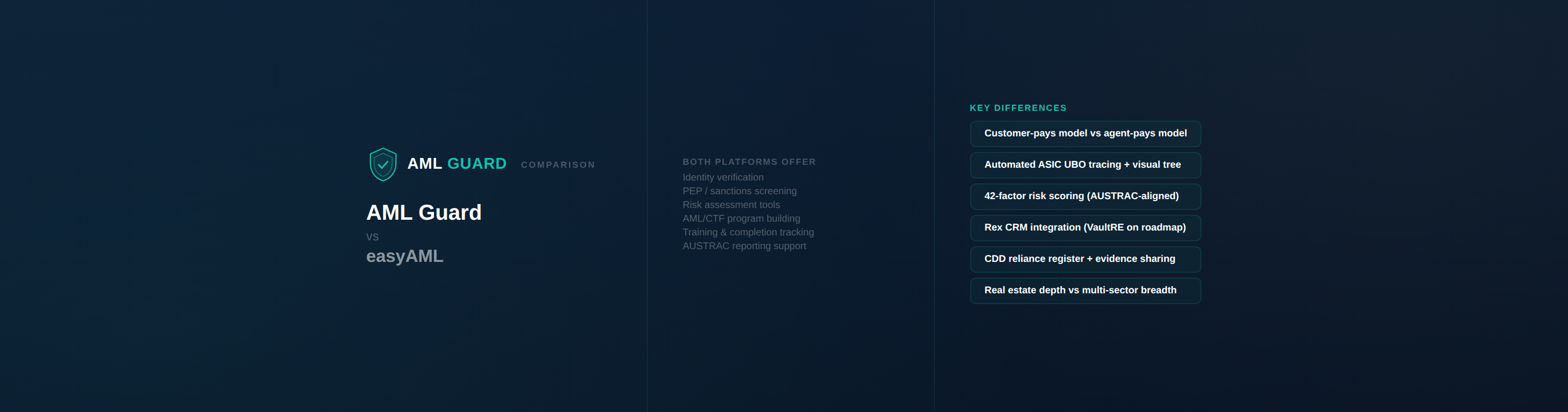
easyAML is built on Scantek's verification infrastructure and positions itself as a broader AML/CTF platform for SMEs. AML Guard is built specifically for Australian property transactions and puts more emphasis on real-estate-specific workflows such as automated ASIC ownership tracing, CDD reliance, CRM-linked compliance status, and a customer-pays pricing model.
AML Guard is purpose-built for Australian property transactions. It is designed to go deeper in areas specific to real estate compliance: automated ASIC beneficial ownership tracing with interactive visual ownership trees, 48-factor risk scoring across six categories, CDD reliance registers for statutory evidence sharing between reporting entities, and Rex CRM integration with tip-off safe compliance status push-back. AML Guard also uses a customer-pays pricing model where verification costs are passed to buyers and sellers, structurally different from most competitors.
Both platforms are positioned for Australian AML/CTF compliance, but they take different approaches to workflow design, integrations, and pricing.
Feature Comparison
| Feature | AML Guard | easyAML |
|---|---|---|
| IDENTITY & SCREENING | ||
| Identity verification | Biometric face match via secure link or SMS. Client self-serves on their own device. Results flow back into the compliance case automatically. | Biometric identity verification powered by Scantek's ISO 27001 platform. Public materials describe liveness validation, biometric matching, and back-to-source document checks. |
| Sanctions & PEP screening | 200+ country watchlists including DFAT, UN, EU, and OFAC. Includes adverse media (11 categories) and court records. | PEP and sanctions screening described in public materials. Specific Australian watchlist coverage and screening source configuration should be confirmed directly with easyAML. |
| Deceased checks | DVS integration for death register checks (Australian Death Check). | Public detail not confirmed from current materials. |
| Court records | Included. Australian court records search. | Public detail not confirmed from current materials. |
| CLIENT ONBOARDING | ||
| Client intake portal | Client Intake Portal: agency-branded secure link or supervised tablet mode. Client self-enters personal details, declarations, and source of funds. Payment and biometric identity verification are linked in the same client flow. For entity matters, beneficial owner portal links are generated automatically from the initial submission. The officer receives a substantially complete, audit-ready case without manual re-entry. | easyAML positions itself as an all-in-one AML/CTF compliance platform. Public materials describe client-link identity verification, beneficial owner checks, ongoing monitoring, audit-ready reporting, and onboarding integration. Whether easyAML’s public onboarding flow combines self-entered personal details, declarations, source-of-funds capture, payment, and biometric identity verification in one linked client flow is not clearly described in current public materials. |
| BENEFICIAL OWNERSHIP | ||
| UBO identification | Automated ASIC chain tracing, recursive company + relational extracts up to 5 levels deep. Interactive visual ownership tree with effective ownership percentages. | ABN/ACN lookup and beneficial owner checks described. The specific methodology and level of ASIC automation should be confirmed directly with easyAML. |
| RISK ASSESSMENT & MONITORING | ||
| Risk scoring | 48-factor engine across six risk categories. Automated scoring with officer review. | Risk assessment tools included. Described as "smart risk scoring". Specific scoring methodology not disclosed publicly. |
| Ongoing monitoring | Automated re-screening at risk-based intervals with change detection alerts. | Public materials describe ongoing monitoring, re-evaluation when risk changes are detected, and alerting functionality. The specific monitoring model and level of automation should be confirmed directly. |
| CDD & COMPLIANCE WORKFLOW | ||
| CDD workflow | Guided wizard: identity verification, screening, risk assessment, ECDD triggers, officer sign-off. Structured case lifecycle. | Step-by-step guidance through compliance requirements. Dashboard-based workflow with compliance status tracking. |
| AML/CTF program | Program document management with version control, approval workflows, and compliance calendar. | Public materials describe a guided AML/CTF program-building capability tailored by industry and risk profile. Buyers should confirm the extent of automation, update handling, and customisation directly with easyAML. |
| Training | Training register with tracking, evidence, and completion records. | Public materials describe role-specific and industry-specific training content with completion tracking. Buyers should confirm the detail of training workflows, assessments, and any access restrictions tied to training status. |
| CDD reliance register | Statutory reliance register (s37A/s38 AML/CTF Act) with cross-tenant secure evidence sharing. | Public detail not confirmed from current materials. |
| SMR/TTR reporting | Built-in tipping-off controls, officer approval workflow, and AUSTRAC submission support. | Reports described as generated in one click with prepopulated data. Timely reporting reminders and notifications. |
| Record keeping | 8-year tamper-evident encrypted vault with presigned URL access and full audit trail. | Securely stored records described as audit-ready for 7+ years. |
| CRM INTEGRATION | ||
| Rex CRM | Rex CRM integrated (API-based, not native). Tip-off safe compliance status push-back, contact/listing data sync, and trust data queries. | Rex was not listed among easyAML's current integrations in the public materials reviewed for this comparison. CRM integrations described generically as "coming" for third-party CRM systems. |
| VaultRE | Not offered. | VaultRE is listed among easyAML's integration partners. Buyers should confirm the current depth and scope of the integration directly. |
| Other integrations | Xero, Gmail, Google Workspace, Microsoft 365, Pipedrive, Asana. | Dye & Durham, Actionstep, Forms Live, Xero, Affinity, MRI Eagle, Box+Dice, Realtime Agent, Clio, RTC, Unity, XPM. Broad integration footprint across legal, conveyancing, and accounting tools. |
| PRICING | ||
| Pricing model | Published pricing. $170/month for 3-user bundle. Per-check fees: $45 (individual), $90+ (company/trust). Customer-pays model. | Published pricing (easyaml.com/pricing, March 2026). Starter: $179/month (5 users). Pro: $449/month (25 users). Enterprise: $999/month (unlimited users). Per-check fees: KYC $20–$15, KYB $40–$35 +GST. Agent-pays model. Buyers should confirm current rates directly. |
| Who pays for checks? | Customer-pays via secure payment link. 100% credit-back offsets agency subscription in active months. | Agent pays. Check costs are absorbed by the agency on top of the monthly subscription. |
| Included checks | Pay-per-check. No bundled credit. | Starter: no included checks. Pro: $220/month credit. Enterprise: $440/month credit. Unused credits roll over. |
| MARKET PRESENCE | ||
| Track record | New platform. Australian-built for Tranche 2. Purpose-designed for property transactions. | Public materials reference 1,000+ Australian businesses. Backed by Scantek, an established Australian VOI provider with ISO 27001 certification. Targets multiple Tranche 2 sectors. ALPMA partner. |
| Target sectors | Real estate, conveyancing, legal, accounting, and trust and company services. | Real estate, conveyancers, lawyers, accountants, tax agents. Multi-sector from launch. |
1. Identity Verification Heritage
easyAML's strongest foundation is Scantek. As an established Australian VOI provider with ISO 27001 certification, Scantek has years of experience processing identity verification for conveyancers and legal professionals. easyAML builds on this infrastructure, meaning the identity verification component is mature and battle-tested. For agencies where identity verification reliability is the primary concern, this heritage is meaningful.
AML Guard uses a biometric face match approach. The verification flow is link-based: the agent sends a secure link or SMS to the customer, the customer completes biometric face match on their own device, and results flow back into the compliance case. This approach provides separation between the agent's commercial relationship and the identity verification process.
2. Multi-Sector Breadth vs Real Estate Depth
easyAML is designed for multiple Tranche 2 sectors from day one: real estate, conveyancing, law, accounting, and tax. Its integration footprint reflects this: partners include legal practice management systems (Actionstep, Clio, Affinity), conveyancing tools (Dye & Durham, Unity, RTC), and accounting platforms (Xero, XPM). For firms that operate across multiple regulated sectors, one platform covering all of them has operational appeal.
AML Guard is built specifically for Australian property transactions. Its features reflect this focus: automated ASIC beneficial ownership tracing with visual ownership trees, Rex CRM integration with tip-off safe compliance status push-back, trust accounting data queries for CAAT investigations, and engagement context models designed around property transaction lifecycles. Agencies that want compliance deeply embedded in their real estate workflow may find this specialisation valuable.
3. Program Governance and Training
easyAML's public materials describe a guided program-building capability that generates an AML/CTF program tailored to the agency's specific business and risk profile. Training content is described as role-specific and industry-specific with completion tracking. For agencies starting from zero compliance experience, a guided approach may reduce the initial learning curve. Buyers should confirm the depth of program customisation and training workflows directly.
AML Guard's approach to compliance quality is structural: the 48-factor risk scoring engine, guided CDD wizard, ECDD trigger management, and mandatory officer sign-off workflow enforce consistency across every case. Program document management includes version control, approval workflows, and a compliance calendar. The compliance trail is built into the process rather than relying on after-the-fact quality checks alone.
4. Pricing Structure
This is the most significant structural difference between the two platforms.
Based on publicly available pricing at easyaml.com/pricing as of March 2026, easyAML uses a traditional agent-pays model. The agency pays a monthly subscription ($179–$999 depending on team size) plus per-check fees ($20–$15 per KYC, $40–$35 per KYB +GST). The Pro and Enterprise tiers include monthly credits ($220 and $440 respectively) that can be used toward checks, with unused credits rolling over. All costs are borne by the agency. Buyers should confirm current rates directly.
AML Guard uses a customer-pays model. The agency pays $170/month, but CDD check costs ($45 per individual, $90+ per company/trust) are charged to the buyer or seller via a secure payment link. In active months, 100% credit-back from customer payments offsets the agency's subscription, meaning the agency's effective compliance cost approaches zero.
For a small agency completing 3 sales per month (6 individual verifications), based on published pricing as of March 2026: easyAML Starter would be $179 subscription + $120 in KYC checks = $299/month borne by the agency. AML Guard would be $170 subscription offset by customer payments, with the agency's effective cost approaching $0 after credit-back. Buyers should confirm current pricing with both vendors.
Worked examples assume individual verification only and exclude additional entity/KYB costs unless stated.
5. CRM Integration
easyAML has a broad integration footprint spanning legal, conveyancing, and accounting tools. For real estate specifically, VaultRE is listed as an integration partner and Box+Dice and MRI Eagle are also covered. However, Rex CRM was not listed among easyAML's integrations in the public materials reviewed for this comparison. easyAML describes CRM integrations for third-party systems as "coming", so Rex support may be on their roadmap.
AML Guard has Rex CRM integrated (API-based, not native) with tip-off safe compliance status push-back, contact and listing data synchronisation, and trust accounting data queries. For agencies running Rex, this integration means compliance sits inside the CRM workflow rather than requiring a separate system.
6. Beneficial Ownership
AML Guard automates beneficial ownership identification with recursive ASIC company and relational extracts up to 5 levels deep. Results are presented in an interactive visual ownership tree showing effective ownership percentages at each level. Confirmed UBOs convert to individual compliance cases with one click.
easyAML describes ABN/ACN lookup and beneficial owner checks as platform capabilities. The specific methodology (whether this involves automated ASIC extract tracing or manual entity verification) is not detailed in their public materials. For agencies regularly handling company and trust buyers, the depth of UBO automation is worth exploring directly with easyAML.
7. Client Onboarding Workflow
What is a client intake portal? For the purposes of this comparison, a client intake portal means a client-facing onboarding flow that captures the intake work before the compliance officer starts building the case. In AML Guard, that means the client enters their own details, completes declarations, provides source of funds information, completes payment, and finishes biometric identity verification through one linked flow. For entity matters, beneficial owner invitations are generated automatically from the initial submission so the officer receives a substantially complete, audit-ready case without manual re-entry.
Based on public materials reviewed on 3 April 2026, we did not identify another provider that clearly describes the same intake structure as AML Guard: self-entered intake data, declarations, source-of-funds capture, payment, biometric identity verification, and beneficial-owner link generation combined in one linked client flow. Several competitors publicly describe client-facing onboarding, identity verification, and document collection. The comparison below focuses on whether the full intake chain is clearly described, not whether individual parts of the workflow exist.
easyAML publicly positions itself as a broader AML/CTF platform, not just a standalone verification tool. Public materials describe client-link identity verification, beneficial owner checks, monitoring, audit-ready reporting, and integration into onboarding workflows.
AML Guard’s difference appears earlier in the workflow. The Client Intake Portal is designed to remove the manual case-setup step by having the client complete intake before the officer begins compliance review. The client receives one agency-branded link, enters their own details and declarations, provides source of funds information, completes payment, and then finishes biometric identity verification in one linked flow. For entity matters, beneficial owner links are generated automatically from the initial submission, so the officer opens a substantially complete, audit-ready case without re-keying data.
For agencies where officer time is the real bottleneck, that difference is operationally meaningful.
What to confirm with easyAML
- Does the client enter their own personal details and declarations, or does the officer create the case first?
- Is source of funds captured in the same client-facing flow as identity verification?
- Is payment part of that same flow?
- For entity structures, are beneficial owner invitations generated automatically from the initial submission?
Read how the Client Intake Portal works in detail →
Where easyAML May Be the Better Choice
Your agency operates across multiple regulated sectors (real estate, conveyancing, accounting) and wants one compliance platform covering all of them. You use legal or conveyancing practice management systems (Actionstep, Clio, Dye & Durham) and want tight integration. You value Scantek's established identity verification heritage and ISO 27001 certification. Your team needs guided program building and structured training modules to get started with no prior compliance experience. You want VaultRE integration that is already listed as available.
Where AML Guard May Be the Better Choice
You want compliance integrated into your property workflow, with Rex CRM integration built and in production. You need automated beneficial ownership tracing with ASIC data and visual ownership trees, not manual entity verification. Cost transparency matters, and you want a customer-pays model where verification costs are passed to buyers and sellers rather than absorbed by the agency. You want a CDD reliance register for statutory evidence sharing between reporting entities under s37A/s38 of the AML/CTF Act. You need 48-factor risk scoring with structured ECDD trigger management designed specifically around AUSTRAC's risk categories. You want a platform purpose-built for property transactions, not adapted from a multi-sector compliance tool.
A Note on Pricing Models
The difference between agent-pays and customer-pays models deserves careful consideration. Under easyAML's model, compliance is a cost centre for the agency, the agency absorbs both the subscription and per-check fees. Under AML Guard's model, compliance costs are passed to the customer, with credit-back offsetting the agency's subscription.
Neither model is inherently right or wrong. Some agencies may prefer to absorb compliance costs as part of their service model, particularly if they are concerned about customer friction during onboarding. Others may prefer a model where the customer bears the cost of their own verification, especially where the business wants to reduce direct compliance spend.
AUSTRAC does not prescribe who pays for compliance checks. The choice is a business decision.
Our View
easyAML is a credible competitor backed by Scantek's established identity verification infrastructure. Its multi-sector approach, broad integration footprint, and guided program-building capability make it a practical option for agencies that want an accessible, guided entry into AML compliance, particularly those operating across multiple Tranche 2 sectors.
AML Guard's advantages are in real estate workflow depth, beneficial ownership automation, structured risk and ECDD workflows, compliance governance features (CDD reliance register, program document versioning), and a customer-pays pricing model designed to reduce the agency's direct compliance cost burden.
Both platforms can support your Tranche 2 obligations. The question is whether you want a broad, guided compliance tool with strong identity verification heritage, or a platform built specifically for how Australian real estate agencies work: with deeper automation, CRM integration, and a pricing model that can shift the compliance cost burden away from the agency.
Last reviewed: 13 September 2026. easyAML public materials reviewed on 3 April 2026, pricing re-verified 13 September 2026. If any information in this comparison is incorrect, please contact us at [email protected] and we will correct it promptly.
Capabilities, integrations, and pricing should be confirmed directly with each vendor before purchase decisions are made.
Frequently Asked Questions
How does easyAML pricing compare to AML Guard?
easyAML uses an agent-pays subscription model starting at $179/month with per-check fees of $20-$15 per KYC and $40-$35 per KYB. AML Guard uses a customer-pays model at $170/month where buyers and sellers pay for their own checks, with credit-back offsetting the agency subscription in active months.
Does easyAML integrate with Rex CRM?
Rex was not listed among easyAML's current integrations in the public materials reviewed for this comparison as of March 2026. easyAML does list VaultRE as an integration partner and has broad integrations across legal, conveyancing, and accounting tools.
What is the main difference between AML Guard and easyAML?
easyAML is a multi-sector compliance platform backed by Scantek's identity verification heritage (ISO 27001). AML Guard is purpose-built for Australian property transactions with deeper features like automated ASIC beneficial ownership tracing, 48-factor risk scoring, CDD reliance registers, and Rex CRM integration.
Which platform is better for real estate agencies?
Both platforms support Tranche 2 compliance. AML Guard may suit agencies wanting Rex CRM integration, automated ASIC UBO tracing, and customer-pays pricing. easyAML may suit agencies operating across multiple sectors (legal, accounting, conveyancing) wanting broader integration coverage and guided program building.
Ready to see AML Guard in action?
Book a demo and see how customer-pays compliance works for your agency.
Book a Demo