From 1 July 2026, real estate professionals, and lawyers or conveyancers when they provide designated services, come within Australia’s expanded AML/CTF regime under Tranche 2. The industry is gearing up, and a growing number of compliance tools are entering the market.
But here’s the critical question that too few property professionals are asking: when in a transaction do the AML obligations actually trigger, and is the answer the same for every role?
It isn’t. And that has profound implications for which tools will actually keep you compliant.
The Compliance Clock Doesn’t Start at the Same Time for Everyone
Under Australia’s AML/CTF reforms, obligations generally arise when you begin providing a designated service to a customer. The key compliance question is not when settlement occurs, but when your designated service to that customer begins. And the answer depends on your role.
For Real Estate Agents
For a seller’s agent: the designated service commonly begins when the agency or listing agreement is signed. Initial CDD generally needs to be completed before or at the start of that service. This can be months before settlement.
For buyer-side involvement: the trigger commonly arises once it is reasonably expected the transaction will proceed, typically when the offer is accepted and the contract is signed.
For Conveyancers and Lawyers
Conveyancers and lawyers providing designated services related to the sale, purchase, or transfer of real estate have their own independent AML/CTF obligations. Their designated service commonly begins when they are engaged and start assisting in the planning or execution of the transaction: which may be at or after exchange of contracts, and often closer to settlement than the agent’s obligations.
This difference in timing is important. A compliance tool that activates at the settlement preparation stage may align well with a conveyancer’s obligations, while leaving an agent’s earlier obligations uncovered. The best approach is a platform that supports both, triggering compliance at the right time for each role.
Different roles. Different trigger points. Same compliance standard. A single platform that adapts to each role’s timing can reduce gaps, minimise duplication, and create a clearer source of truth across the transaction.
For the party you are acting for, initial CDD generally needs to be completed before the designated service starts. Limited delayed CDD rules may apply to the counterparty in certain real estate transactions, but those rules are conditional and time-bounded. Based on current AUSTRAC reform guidance, this is generally no more than 15 days after exchange of contracts, or before settlement, whichever is earlier.
Key point: for the party you are acting for, initial CDD will often need to occur before, or at the very start of, the designated service. The compliance-critical window often sits well before settlement.
Even where some initial CDD steps can be delayed in a real estate transaction, targeted financial sanctions checks cannot be deferred. You must establish on reasonable grounds whether a customer is designated for targeted financial sanctions before you start providing the designated service.
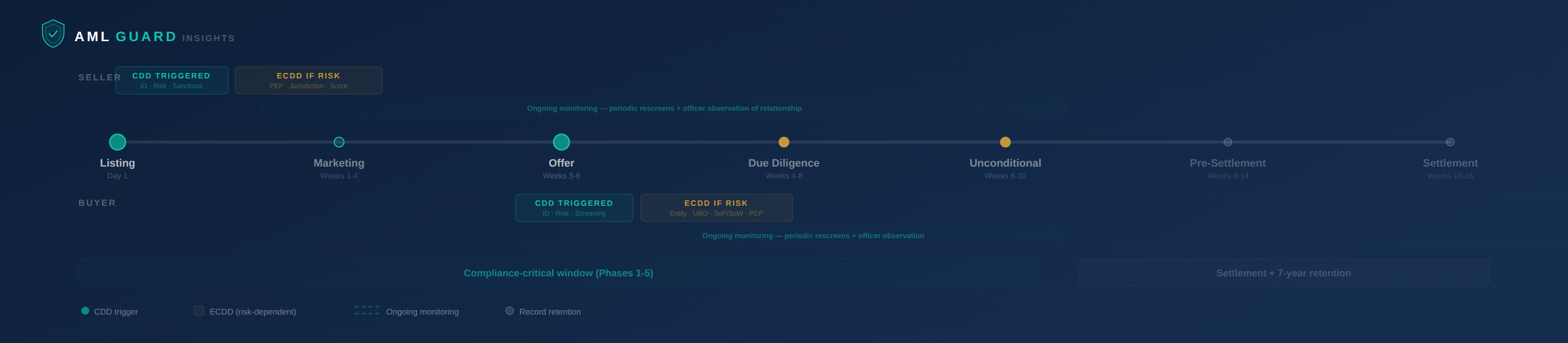
A Real Property Timeline: Where Do AML Obligations Fall?
Let’s map a typical residential property transaction from listing to settlement, and overlay the AML/CTF obligations at each stage: for agents, conveyancers, and lawyers.
Note: This timeline reflects a typical metro residential sale. Auction sales, off-the-plan purchases, regional transactions, and commercial deals may follow different timelines. The underlying obligations remain the same, but the phases may compress, extend, or reorder.
| Phase | Timing | AML/CTF Obligation |
|---|---|---|
| 1. Listing | Day 1 | Seller-side CDD triggered. Identify vendor, verify identity, assess risk, initiate screening (including sanctions). Enhanced CDD may be required immediately if risk factors are identified (e.g. foreign PEP, high-risk jurisdiction, elevated risk score). |
| 2. Marketing | Weeks 1–4 | Ongoing monitoring of seller. This includes both periodic automated rescreening (PEP, sanctions, adverse media) and the compliance officer’s awareness of the business relationship: watching for changes in behaviour, unusual requests, or new information that may affect the customer’s risk profile. |
| 3. Offer & Contract | Weeks 3–6 | Buyer-side CDD triggered. Conveyancer/lawyer CDD may commence. Identity verification, risk assessment, screening. SoF/SoW enquiries where risk requires it. CDD reliance arrangements may apply. |
| 4. Due Diligence | Weeks 4–8 | Enhanced CDD where buyer risk factors justify it. UBO tracing for entity buyers. Delayed initial CDD for counterparty must be completed within permitted window. |
| 5. Unconditional | Weeks 6–10 | Review SoF/SoW responses. Ongoing monitoring continues. SMR filed if suspicious (within 3 business days; terrorism-financing within 24 hours). |
| 6. Pre-Settlement | Weeks 8–14 | Core CDD should be completed or well advanced. Final compliance review if risk-based triggers require it. |
| 7. Settlement | Weeks 10–16 | Transaction complete. Records must be retained for 7 years by all reporting entities. |
The pattern is clear: the vast majority of AML/CTF obligations cluster around the beginning and middle of the transaction, not the end. A compliance platform needs to be active across all these phases, not just the final one.
The Compliance Gap Most Property Teams Miss
There’s a second, equally important dimension that the timeline alone doesn’t capture. Running identity checks and screening is only one part of your AML/CTF obligations. Under AUSTRAC’s reforms, reporting entities must have a comprehensive compliance framework in place, including:
A documented AML/CTF program: in place before you start providing designated services, covering your policies, procedures, and controls for managing ML/TF risk.
An ML/TF risk assessment, a documented assessment of the money laundering and terrorism financing risks your business faces.
An AML/CTF compliance officer, appointed within 28 days of commencing designated services.
Staff training: documented, role-appropriate training with records retained.
AUSTRAC reporting: the ability to identify, draft, and submit Suspicious Matter Reports (SMRs) and, where applicable, Threshold Transaction Reports (TTRs) within required timeframes.
Record keeping, 7-year retention of all CDD records, transaction records, reports, and program documents.
Ongoing CDD and monitoring: not just at onboarding, but throughout the business relationship, with periodic reviews based on the customer’s risk profile.
Running CDD checks is necessary, but it’s not sufficient. AUSTRAC will assess your entire program, not just whether you ran a screening check.
Program documents. Training registers. Compliance calendar. Governance dashboard. AUSTRAC reporting. All in one place. A compliance check is one step. A compliance program is the whole journey. The platform you choose should support both.
The Natural Next Step: CDD Reliance Across Roles
Once you accept that AML/CTF value does not automatically increase just because the same customer is checked again in a different system, the next question is straightforward: when can one reporting entity rely on CDD already completed by another?
In many property transactions, more than one reporting entity will have CDD obligations over the same customer. The agent verifies the seller at listing. Weeks later, the conveyancer is engaged and may have their own obligation in relation to the same person. Without coordination, the customer may be verified twice, may submit the same identity documents twice, and may pay twice.
This is exactly the problem that compliant reliance arrangements are designed to address.
What Is CDD Reliance?
The AML/CTF framework allows for CDD reliance arrangements, where one reporting entity may rely on CDD conducted by another, subject to specific conditions and a written arrangement.
The strongest compliance model will often be one where primary CDD is completed thoroughly at the earliest relevant trigger point, and later participants can assess whether they can rely on that work under valid written arrangements rather than duplicating it.
Comprehensive watchlist screening, deep beneficial ownership tracing, identity verification, and documented risk scoring all matter when the customer or ownership structure is more complex. The depth of your compliance checks matters. Surface-level screening may tick a box, but it may not survive regulatory scrutiny on a complex entity structure.
What to Look For in an AML Compliance Platform
Whether you’re an agent, a conveyancer, or a law firm, the questions you should ask of any compliance tool are largely the same:
1. When does it activate? Does it integrate with the systems you already use (your CRM, your practice management software) so compliance begins when your designated service begins?
2. Does it cover the full program? Can it manage your documented AML/CTF program, ML/TF risk assessment, compliance calendar, training registers, and governance dashboards, or just the CDD checks?
3. Can it trace beneficial ownership? For entity customers: companies, trusts, partnerships, SMSFs: does it trace through to the ultimate beneficial owners using ASIC data, including complex multi-layered structures?
4. Does it support AUSTRAC reporting? Can you draft and manage SMRs and, where relevant, TTRs within the platform, with appropriate audit trails, timeframe tracking, and tipping-off controls?
5. Does it provide ongoing monitoring? Not just a one-time screen, but continuous or periodic re-screening based on risk level throughout the business relationship?
6. Is it built for property? Generic AML platforms designed for banks and fintechs may not understand property transaction workflows, agency structures, conveyancing timelines, or the specific risk factors AUSTRAC expects you to assess in real estate.
7. Does it support your role specifically? An agent’s compliance workflow is different from a conveyancer’s, which is different from a lawyer’s. Does the platform adapt to your role?
8. Does it support CDD reliance? When multiple reporting entities are involved in the same transaction, can you support written CDD reliance arrangements, share appropriate CDD evidence, and maintain a formal reliance record?
The strongest compliance workflow is one that starts when your designated service starts, not when settlement is already in view.
See How AML Guard Works
Tranche 2 obligations commence 1 July 2026.
Book a 20-minute demo to see how AML Guard supports your compliance from the moment your designated service begins.