
Most Tranche 2 firms should budget an upfront setup cost between roughly $4,460 and $85,550, plus annual ongoing costs from about $6,020 to $82,660, depending on turnover. Small firms usually do best starting with the AUSTRAC starter kit or dedicated software; mid-sized firms tend to suit a hybrid model; larger or structurally complex firms need a consultant-backed program with strong governance. Check the government’s impact analysis and AUSTRAC’s guidance for your tier, then move to enrolment and risk assessment.
TL;DR:
- Firms with higher transaction volumes, especially those processing over 10,000 checks annually, face dominant costs in verification and registry fees surpassing software subscriptions.
- Complex structures like layered trusts or SMSFs significantly increase the likelihood of costs exceeding the impact analysis estimates, requiring more manual judgment and review.
- Smaller firms should start with the AUSTRAC starter kit or basic software, while larger firms need governance, dedicated officers, and specialist reviews to meet compliance efficiently.
- Controlling costs involves consolidating checks on one platform, shifting verification fees to clients, and automating recordkeeping to reduce manual labor.
- Most budget miscalculations stem from underestimating variable per-check fees rather than setup costs, which are relatively predictable within the given range.
Table of Contents
- Government regulatory-burden estimates by turnover: what the numbers mean
- Four ways to meet Tranche 2 obligations, and when each one fits
- What actually drives your AML compliance costs in Australia
- How to control ongoing AML compliance spend
- Which approach suits your business size
- Where lifetime AML compliance costs really blow out
- Keeping AML compliance costs predictable with AML Guard
- Where to verify these figures yourself
- Sources
- FAQ
Government regulatory-burden estimates by turnover: what the numbers mean
The Office of Impact Analysis modelled AML/CTF compliance costs across turnover bands, and its figures are the basis for most “average cost” claims you’ll see repeated elsewhere. Its impact analysis puts upfront setup at roughly $4,460 for the smallest reporting entities, rising to $85,550 for the largest, with ongoing annual costs running from about $6,020 to $82,660.
Those bands cover:
- Enrolment with AUSTRAC and initial program setup
- The business-wide ML/TF risk assessment
- Drafting AML/CTF policies and a compliance action plan
- Staff training development and delivery
- Systems and technology to support customer due diligence
The modelling is a policy planning tool, not a quote for your firm. It assumes a reasonably standard risk profile. Firms with complex beneficial ownership structures, high transaction volumes, or multiple designated services should expect to sit above their tier’s midpoint, sometimes well above it.
Four ways to meet Tranche 2 obligations, and when each one fits
Every reporting entity effectively chooses among four operational models. The right one depends less on turnover alone and more on transaction complexity, in-house capability, and how many beneficial ownership structures you touch in a typical year.
- DIY using the AUSTRAC starter kit. The real estate program starter kit gives a structured template for a simple program. It suits low-complexity firms with straightforward client bases and modest transaction volumes. It struggles once you’re dealing with trusts, SMSFs, or overseas beneficial owners, because the template doesn’t stretch to that judgement.
- Dedicated AML software. A platform-based approach automates identity verification, screening, and recordkeeping, and keeps the risk assessment, policies, training and audit trail as one linked set. Setup cost is usually predictable; ongoing cost tracks subscription plus per-check fees.
- AML consultant. A consultant can build a defensible program quickly and handle genuinely complex beneficial ownership work. The trade-off is cost concentration (most of the spend sits in professional fees) and a risk that in-house knowledge never really develops, which shows up later as slower transaction turnaround when the consultant isn’t immediately available.
- Hybrid model. Software handles the repeatable CDD and reporting workload; a consultant or specialist reviews complex structures and signs off the risk assessment. This tends to control lifetime cost better than pure consulting because routine checks don’t carry professional-fee rates.
Defensibility before AUSTRAC matters as much as sticker price. A cheap DIY build that can’t demonstrate a documented risk assessment under section 26C of the Act costs more in remediation than it ever saved in setup.
What actually drives your AML compliance costs in Australia
Line items matter more than the headline figure, because most firms underestimate the variable ones. Budget for:
- Software subscription, the fixed monthly or annual platform cost
- Identity verification and registry search fees: charged per check, not as a flat rate
- Compliance officer time: internal hours spent on risk decisions, approvals and reporting
- Independent review: periodic evaluation of the program’s effectiveness, required under the AML/CTF Rules 2025
- Staff training: development and delivery, refreshed as obligations change
- Record retention: secure, tamper-evident storage for the required seven-year period
- Integration and administrative overhead, connecting CDD tools to practice management and enrolment through AUSTRAC’s online services
Pro Tip: Model your per-check volume before you compare vendors. A firm processing 100 checks a year and one processing 10,000 face very different total costs even on an identical subscription, because verification and registry fees are charged per transaction, not per seat.
Per-check fees are where most firms get their budgeting wrong. A firm running 100 checks annually might see verification fees as a rounding error against its subscription. At 1,000 checks, those same per-check fees can exceed the subscription cost outright. At 10,000 checks, a high-volume conveyancing or real estate practice, the per-check line becomes the dominant cost, not the software.
Hidden one-off costs catch firms out too: remediation work after an independent review finds gaps, responding to an AUSTRAC information request, and unwinding complex beneficial ownership chains through layered trusts or SMSFs where officer judgement, not automation, does the work.

How to control ongoing AML compliance spend
Reducing cost of AML compliance without weakening your program comes down to where you spend and who pays for what.
- Consolidate checks in one platform. Running identity verification, screening and reporting through a single system avoids paying multiple vendors for overlapping data and keeps one audit trail instead of three disconnected ones.
- Shift verification fees to the transaction party where appropriate. A client-pays option lets buyers, sellers or other transaction parties fund their own identity check, which removes that line item from the firm’s own budget.
- Apply tiered CDD. Standard due diligence for low-risk clients and enhanced due diligence only where the risk assessment actually calls for it, rather than running every check at the highest tier by default.
- Automate recordkeeping. Manual filing eats compliance officer hours that are better spent on risk judgement calls.
- Schedule independent reviews on a fixed cycle. Reactive reviews after a problem surfaces cost more than a planned annual or biennial check.
Build a simple budget template that separates fixed costs (subscription, base training) from variable costs (per-check fees, officer hours), then model three volume scenarios, low, expected, and peak. When comparing vendors or consultants, ask what’s included in the headline price, how per-check fees scale, and whether independent review is bundled or billed separately.
Which approach suits your business size
Match your approach to your actual transaction complexity, not just your revenue.
- Small firms (low transaction volume, simple client base): start with the AUSTRAC starter kit or an entry-level software plan; keep beneficial ownership work in-house where structures are simple.
- Medium firms (moderate volume, occasional trusts or overseas parties): a hybrid model, software for routine CDD, specialist review for complex cases, usually delivers the best balance of cost and defensibility.
- Large or structurally complex firms: invest in governance, a dedicated compliance officer, and specialist review for beneficial ownership across trusts and SMSFs.
Whatever your size, the first three moves are the same: appoint your AML/CTF compliance officer, start the risk assessment under the Act, and model your expected per-check volume before you commit to a vendor.
Where lifetime AML compliance costs really blow out
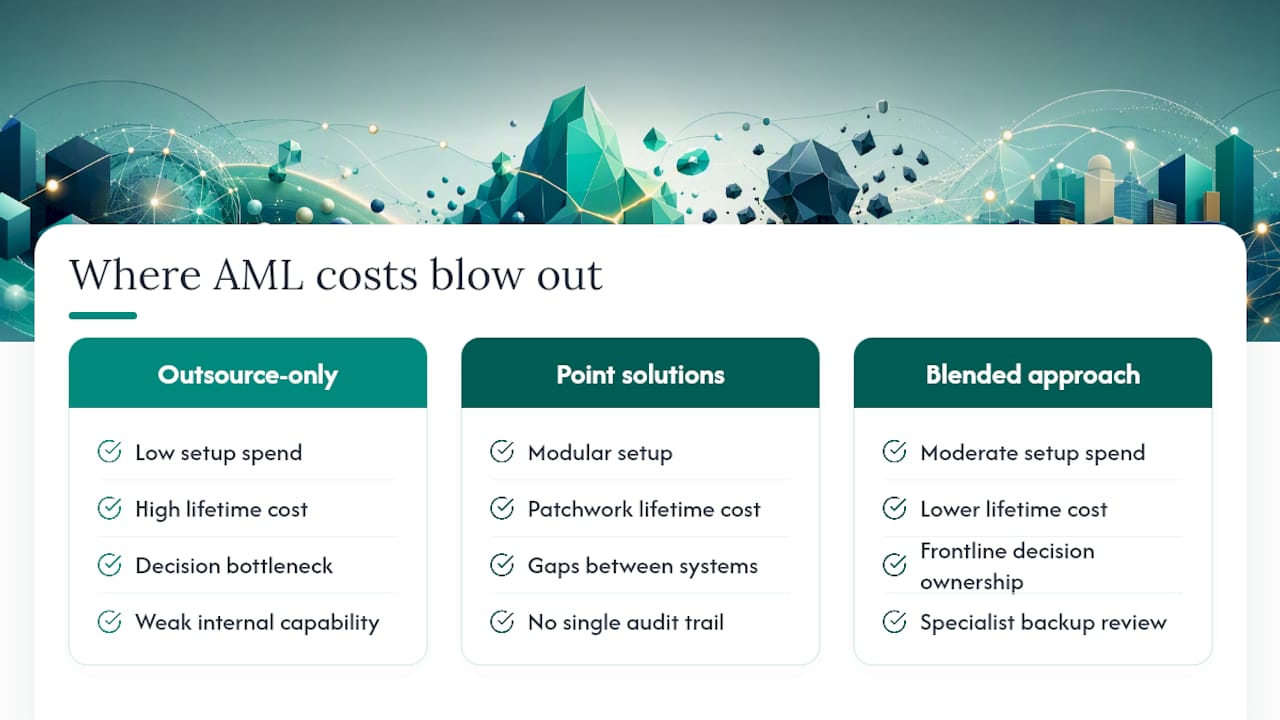
The mistake we see most often isn’t underspending on setup. It’s outsourcing all the judgement to a consultant and never building any internal capability. That works fine until the consultant is unavailable and a transaction is waiting on a decision only they can make.
The second mistake is stitching together separate point solutions, one tool for verification, another for screening, a spreadsheet for training records, with no single audit trail. Every gap between systems is a gap AUSTRAC can find first. A blended approach that keeps frontline staff trained and responsible for day-to-day decisions, backed by specialist review for the genuinely complex cases, tends to cost less over time than either extreme.
Keeping AML compliance costs predictable with AML Guard
AML Guard is built around the cost drivers this article just walked through. The business-wide risk assessment, AML/CTF policies, compliance action plan and staff training manual come out of the same guided wizard as one linked set, so you’re not paying separately to reconcile documents that should already match. Identity verification, sanctions and PEP screening, and beneficial ownership determination run through one platform with a single tamper-evident audit trail, which cuts the integration and remediation costs that stack up when firms bolt together separate tools.
Where it suits your transaction structure, AML Guard’s client-pays option lets the buyer, seller or other transaction party cover their own verification fee, crediting back against your subscription rather than sitting as a pure cost to your firm. If you’re mapping your own Tranche 2 compliance obligations against a realistic budget, visit the AML Guard pricing page or book a demo to see how the platform fits your volume and risk profile.
Where to verify these figures yourself
- Impact analysis: AML/CTF regime: the source table for regulatory-burden estimates by turnover
- AUSTRAC, AML/CTF reform: enrolment steps and program guidance
- AML/CTF Act 2006 (Cth): statutory program and officer requirements
- AML/CTF Rules 2025: CDD, training and independent evaluation detail
Sources
- Impact analysis: Anti‑Money Laundering and Counter‑Terrorism Financing regime
- AUSTRAC, AML/CTF reform
- Anti‑Money Laundering and Counter‑Terrorism Financing Act 2006 (Cth)
- Anti‑Money Laundering and Counter‑Terrorism Financing Rules 2025
- Real estate program starter kit, AUSTRAC
FAQ
How much does AML compliance cost in Australia?
The government’s impact analysis puts upfront setup between roughly $4,460 and $85,550, depending on turnover, with ongoing annual costs from about $6,020 to $82,660.
How much does an AML Hub or platform cost in Australia?
Software costs vary by vendor and firm size, and per-check verification and registry fees scale with your transaction volume on top of any subscription. Check AML Guard’s pricing page for current details rather than relying on a quoted figure elsewhere.
What does the AUSTRAC starter kit cost?
AUSTRAC’s real estate program starter kit itself is a free structured template, but firms still incur staff time, training and any identity verification fees needed to run the program it describes.
Why do AML compliance costs vary so much between firms?
Cost mainly depends on transaction volume and beneficial ownership complexity, since identity verification and registry fees are charged per check rather than as a flat rate.
What’s the biggest cost mistake newly regulated firms make?
Comparing only the subscription price between vendors and ignoring per-check verification fees, which scale directly with transaction volume and can exceed the subscription cost at higher volumes.
Recommended
- AML Compliance Pricing in Australia: 2026 Comparison
- Tranche 2 AML Australia: your compliance obligations explained
- Tranche 2 customer due diligence in Australia
- AML risk assessment template for Tranche 2 firms
See How AML Guard Works
Tranche 2 obligations are now in force.
Book a 20-minute demo to see how AML Guard supports your compliance from the moment your designated service begins.