
Adverse media is negative reporting that links a customer to crime or serious misconduct. The AML/CTF Act and the AML/CTF Rules 2025 do not name it as a check, so an agency needs its own category list, and the most defensible one follows the offence kinds the Rules already set for monitoring unusual transactions and behaviours. Those offences include money laundering, terrorism financing, proliferation financing and sanctions breaches, organised crime, trafficking, corruption, bribery, fraud, tax crime and cybercrime. Since Tranche 2 obligations commenced on 1 July 2026, real estate agencies have had to be able to show how a hit against any of them was weighed and what was decided.
TL;DR
- Adverse media screening is not named in the Act or Rules, but AUSTRAC’s real estate indicators include negative media from a reliable source linking a customer to profit-generating crime.
- Build your categories on the offence kinds in Rules 6-35(b), so every category traces to the Rules rather than to a generic checklist.
- Weigh each hit on three points: is the source reliable, is it the right person, and how far has the matter progressed.
- A confirmed, relevant hit may lead to enhanced customer due diligence (section 32) or a suspicious matter report (section 41). Sanctions screening is a separate check.
- Keep the screening result and the officer’s decision together in one case record.
Table of Contents
- Where adverse media sits in the Australian regime
- The categories to screen for
- How to weigh a hit
- What happens after a confirmed hit
- What an adverse media policy should say
- Choosing a way to run adverse media screening
- Our perspective
- Run it in one place
- FAQ
- Sources
Where adverse media sits in the Australian regime
Customer due diligence (CDD) is the process of identifying a customer, verifying who they are and understanding the risk they present. Adverse media is one input into that risk picture, not a stand-alone obligation. AUSTRAC’s risk indicators for the real estate sector list, as a customer-profile red flag, a customer who has been the subject of negative media reports or other adverse information from a reliable source connecting them to profit-generating criminal activity.
AUSTRAC’s real estate program starter kit goes a step further: information suggesting a customer has engaged in criminal activity is treated as a higher-risk factor, and an adverse media check is a control for high-risk customers. Its worked examples show a compliance officer running open-source background checks and finding that a customer had been investigated internationally for fraud and corruption.
The practical consequence is that the law gives you the outcome you must be able to demonstrate, a risk-based understanding of your customer, and leaves the method to your AML/CTF program. A written category list is the part of that method a supervisor can read in a minute.
The categories to screen for
Rules 6-35 of the AML/CTF Rules 2025 sets out monitoring that meets the Act’s requirement to monitor for unusual transactions and behaviours that may give rise to a suspicious matter reporting obligation. Paragraph (b) lists the kinds of offence involved. It opens with money laundering, financing of terrorism, proliferation financing, offences relating to the breach of sanctions, participation in organised crime or racketeering, terrorism, offences involving prohibited hate groups, and human trafficking or people smuggling. It goes on to cover sexual exploitation, drug, arms and other goods trafficking, corruption, bribery, counterfeiting, fraud (including identity theft and scams), tax crime, extortion, forgery, insider trading, environmental crime, robbery, kidnapping, smuggling, murder and cybercrime, and ends with any other offence your program identifies as a high money laundering risk. Read the live Rule when you finalise your policy, because the wording there is the authority.
The table below groups the kinds that most often matter in a property transaction. Your policy should still cover the whole list.
For day-to-day screening, those offence kinds group into the categories below.
| Category | What a relevant report looks like | Why it matters in a property transaction |
|---|---|---|
| Money laundering and proceeds of crime | Charges, convictions or asset restraint linked to laundering or unexplained wealth | The purchase may be a way of placing or layering funds |
| Terrorism and terrorism financing | Reports of links to a proscribed group or funding of one | Funds or beneficial ownership may sit behind a front |
| Proliferation financing and sanctions breaches | Reports of evading trade or financial sanctions | Overlaps with, but does not replace, the separate sanctions check |
| Organised crime and racketeering | Reporting on gang, syndicate or criminal enterprise involvement | High-value assets are a common way to hold illicit profit |
| Human trafficking and people smuggling | Prosecutions or investigations naming the customer or their business | Proceeds are profit-generating crime in the sense AUSTRAC’s indicators use |
| Corruption and bribery | Investigations into improper payments to officials or business partners | Source of wealth may be tainted, and domestic or foreign officials may be involved |
| Fraud, including identity theft and scams | Court reports, regulator actions or victim reporting about investment fraud, romance scams or identity misuse | The customer may be a victim, a mule or a perpetrator, and each reads differently |
| Tax crime | Reports of evasion or false returns | Concealed income often surfaces as an unusually large, unfinanced purchase |
| Cybercrime | Reports of hacking, ransomware or online fraud linked to the person or entity | Digital proceeds are frequently converted into property |
Two practical points follow from the table. First, the categories are anchored on offences, so a report about a business dispute, a planning objection or a civil debt does not belong in any of them unless it also describes one of these offence kinds. Second, the categories work for entities as well as individuals: the company, its directors and its beneficial owners are all subjects of the search.
Examples of what each looks like in practice
Categories are easier to apply with a picture of the report behind them.
- A buyer named in a regulator’s court action over an investment scheme. That sits under fraud. The question for you is whether the person named is your customer, and whether the matter is an allegation, a proceeding or a finding.
- A director of a buying company reported as under investigation for foreign bribery. That sits under corruption and bribery, and the company’s beneficial owners become the focus of your enhanced checks.
- A seller whose property was reportedly restrained in a proceeds-of-crime matter. That sits under money laundering and proceeds of crime, and it affects the seller side of the transaction as much as the buyer side.
- A customer who appears as a named defendant in a reported tax evasion prosecution. That is tax crime, and it bears directly on source of funds.
These are illustrations of how a report maps to a category, not findings about any real person.
How to weigh a hit
A match is a prompt to look, not a conclusion. Three tests do most of the work, and recording each of them is what turns a search result into a defensible decision.
Is the source reliable?
AUSTRAC’s indicator specifically refers to a reliable source. A major news outlet, a court judgment, a regulator’s media release or an official enforcement register carries weight. An anonymous forum post, a rumour on social media or a site that republishes other outlets without checking does not. Where a story originates from a single unreliable page, record that, and look for corroboration before it influences the risk rating.
Is it the right person?
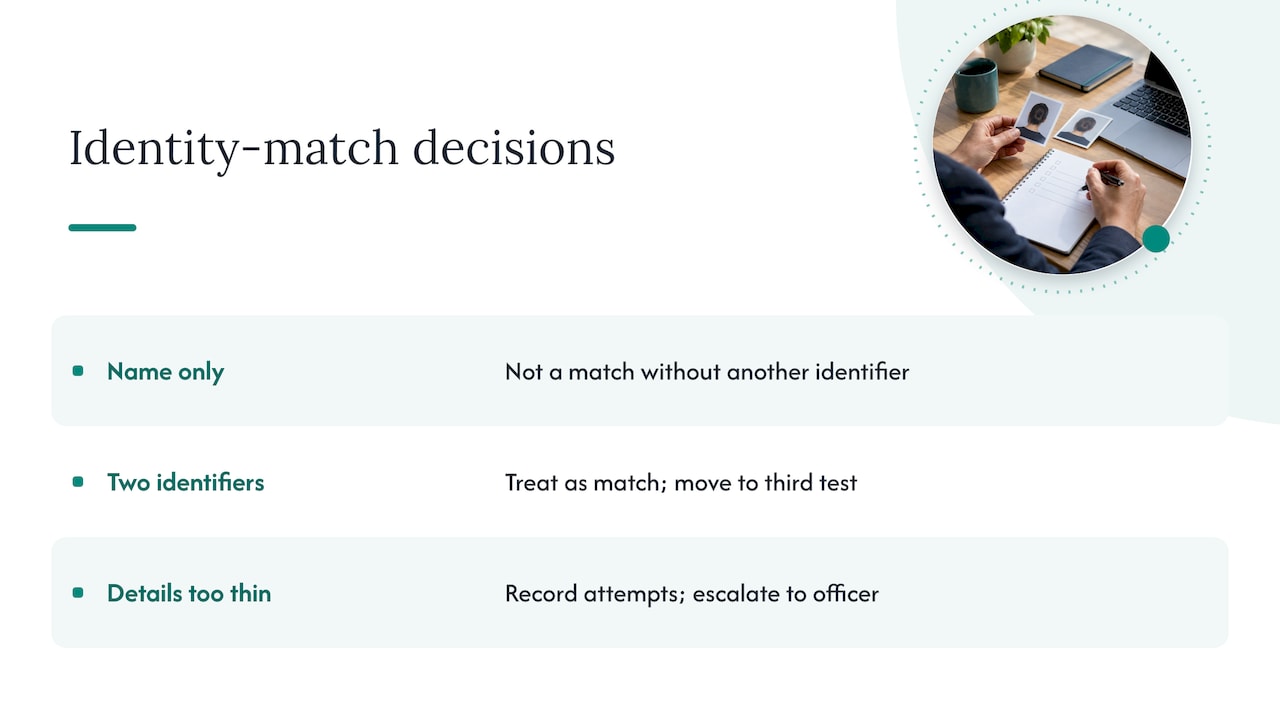
False positives in this field come overwhelmingly from name collisions. Compare the report against what you hold from identity verification: full name, date of birth, address, nationality, occupation, and for entities the ACN and officeholders. A common name with no second matching identifier is not a match. If two identifiers align, treat it as a match and move to the third test. If the details are too thin to decide either way, record what you tried and escalate to the officer rather than discarding it.
How far has the matter gone?
The stage of the matter changes its weight. In rough order of seriousness:
- A conviction or finding by a court or regulator.
- Charges laid, or a formal proceeding commenced.
- A reported investigation by an authority.
- Allegations in the media with no official step reported.
Also note how recent the matter is and whether it was resolved, for example an acquittal or a withdrawn charge. An old, resolved matter in an unrelated category may rate lower than a recent investigation into conduct that produces proceeds of crime. Do not rate a customer higher because of an acquittal or because they were the victim of a scam rather than its perpetrator, but record the reasoning either way.
What happens after a confirmed hit
The outcome depends on what the hit tells you about this customer and this transaction. There are three usual paths.
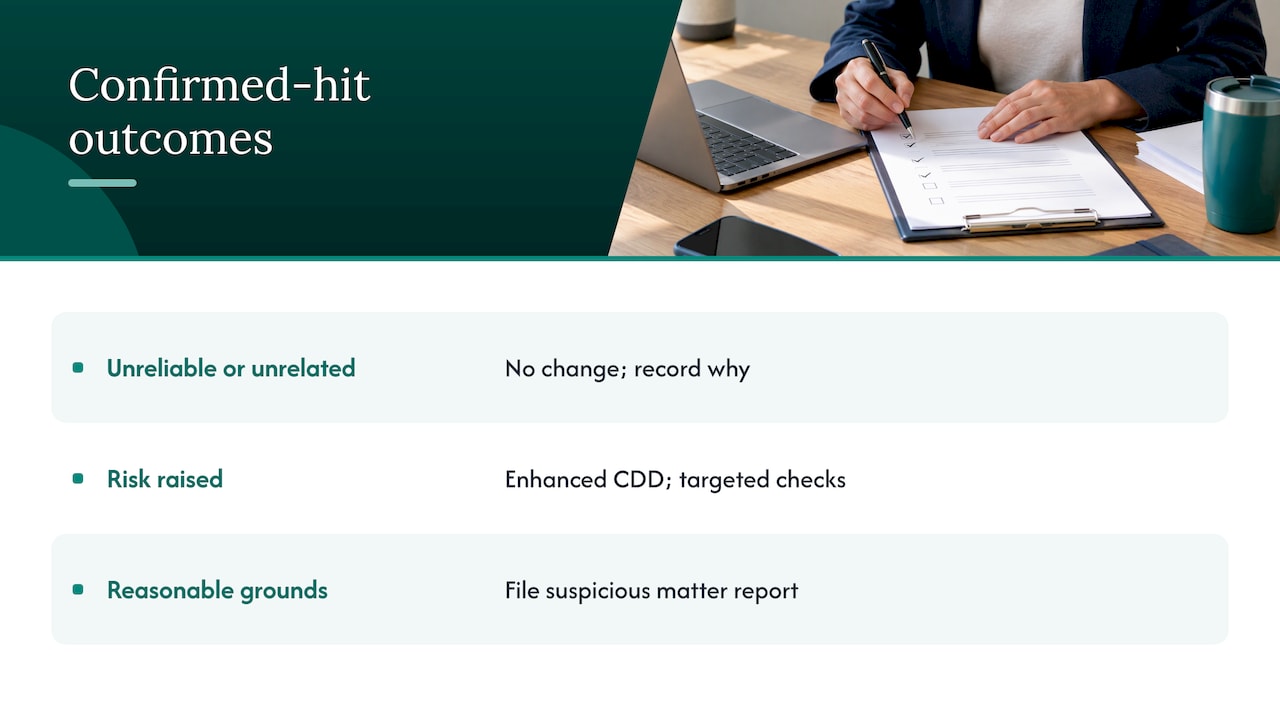
No change. The report is unreliable, concerns a different person, or is unrelated to the offence kinds above. Record why, and carry on.
Enhanced CDD. Where the hit raises the customer’s risk, section 32 of the Act calls for enhanced customer due diligence. AUSTRAC’s enhanced CDD guidance says the measures must be targeted, proportionate, effective and appropriate to the risk, and lists verifying source of funds or source of wealth, obtaining the reason for transactions, more in-depth monitoring and more frequent relationship reviews. Our guides on enhanced due diligence triggers and enhanced due diligence examples for real estate go through these measures in a property setting.
A suspicious matter report. Where you form a suspicion on reasonable grounds, section 41 requires a suspicious matter report to AUSTRAC. Adverse media alone is not automatically that suspicion, but a reliable report about profit-generating crime, combined with a transaction that does not fit the customer’s known means, may well be. The decision belongs to your AML/CTF compliance officer, and the reasoning should be written down at the time.
Sanctions screening is a separate check. A name on the DFAT Consolidated List is a matter for the sanctions process, while a media report about someone evading sanctions is adverse media. Run both, and do not treat a clear result on one as a clear result on the other.
What an adverse media policy should say
Your AML/CTF policies should let a new staff member apply the process the same way every time. At a minimum, cover these points:
- Who is screened: customers, beneficial owners, and for entities the officeholders, at onboarding and when risk changes.
- Which categories apply: the list above, tied to Rules 6-35(b).
- Source standards: what counts as reliable, and what needs corroboration.
- Matching standard: which identifiers must align before a hit is treated as the customer.
- Stage and recency weighting: how a conviction, charge, investigation or allegation is treated.
- Escalation: who reviews a hit, who approves a rating change, and when a matter goes to an SMR decision.
- Records: what is kept of each search, each hit and each decision.
The records point deserves care. Your program documents need to show the screening and the officer’s decision as they happened, and the risk assessment, policies and training should all describe the same process. A program in which the policy says one thing and the staff manual says another is the kind of inconsistency a supervisor notices. Our risk assessment guide for real estate agencies shows how the business-wide assessment feeds into those policies.
Choosing a way to run adverse media screening
Agencies broadly choose between manual searching by staff, a general-purpose screening tool built for banks, and a platform built for Australian Tranche 2 entities. Whatever you choose, test it against the questions an AUSTRAC supervisor would ask of your process:
- Do the categories follow the Australian Rules, or an overseas taxonomy?
- Does each hit show its source, so reliability can be judged and recorded?
- Can an officer make and record a decision against each hit?
- Is the result held with the rest of the customer’s CDD file, rather than in a separate system or a search-engine screenshot?
- Does it fit the way your team already works, including your CRM?
- Are records kept long enough and in a form that cannot be quietly altered?
Manual searches tend to fail on the second, fourth and sixth questions, because screenshots in a shared folder rarely show who decided what, or when. Tools designed for banking tend to fail on the first, because their categories and workflows are not framed around Australian real estate. Our overview of Tranche 2 customer due diligence sets out the wider process these checks belong to.
Our perspective
We built AML Guard for Australian Tranche 2 reporting entities, and we think adverse media is best handled as part of the customer record, not as a separate search.
The reason is evidence. An agency that screens but cannot show what it found, who looked at it and what was decided has a weak answer when AUSTRAC asks. So in AML Guard the screening results and the officer’s decisions sit in one case record, alongside the identity verification and the reasoning behind each decision.
We are also clear about where judgement sits. The platform automates the lookups and the record keeping, and a person makes each decision. Whether a hit is the right person, from a reliable source and serious enough to justify enhanced CDD or an SMR is a call for your compliance officer, and the record shows that it was made.
AML Guard’s guided wizards produce the risk assessment, the AML/CTF program, a customer acceptance policy and the training manual, and can pre-fill from your risk assessment, so the adverse media approach in your policy starts from the risks you assessed.
AML Guard
Run it in one place
AML Guard’s guided wizards produce the risk assessment, the AML/CTF program, a customer acceptance policy and the training manual, and can pre-fill from your risk assessment. On each matter, one case record holds each identity check, screening result and officer decision, and beneficial ownership determination runs from a company’s ACN, with an officer approving each one. The platform automates the lookups and the record keeping, not the judgement. AML Guard is not self-service; every firm starts with a demo. Book a demo, or see the pricing page for the subscription and per-check fees.
FAQ
Is adverse media screening mandatory for real estate agencies?
The Act and Rules do not name it as a required check. They do require a risk-based understanding of customers and monitoring for unusual behaviour, and AUSTRAC’s real estate guidance lists negative media as a risk indicator and an adverse media check as a control for high-risk customers. Most agencies therefore build it into their program.
How do I handle a false positive?
Compare the report with the identifiers you hold: full name, date of birth, address and, for entities, the ACN. If they do not align, record that the hit was dismissed and why, and keep that note with the case record. If the details are too thin to decide, escalate to your compliance officer instead of discarding the hit.
Does a news report automatically trigger enhanced due diligence or an SMR?
No. A reliable report about the right person, concerning profit-generating crime, may justify enhanced CDD under section 32. A suspicious matter report under section 41 depends on your compliance officer forming a suspicion on reasonable grounds, which the report may support alongside other facts.
Is adverse media the same as sanctions or PEP screening?
No. Sanctions screening checks names against official lists, and PEP screening identifies politically exposed persons. Adverse media looks at reporting about conduct. They answer different questions, so each is run and recorded separately.
Sources
- Risk insights and indicators of suspicious activity for the real estate sector, AUSTRAC
- Step 2: Use your real estate program, AUSTRAC
- Real estate program starter kit: examples of dealing with customers, AUSTRAC
- AML/CTF Rules 2025, Rules 6-35 Monitoring for unusual transactions and behaviours
- Enhanced customer due diligence, AUSTRAC
Recommended
- AML/CTF Compliance Checklist for Real Estate Agents
- AML risk assessment for real estate agencies
- AML Training Requirements for Real Estate
- AML training real estate: what agencies must do
See How AML Guard Works
Tranche 2 obligations are now in force.
Book a 20-minute demo to see how AML Guard supports your compliance from the moment your designated service begins.