To verify a trust deed for AML/CTF purposes, you obtain the whole, current deed with every amendment, read it for who the trustee is and who controls the trust, corroborate it against independent data such as ABN Lookup, and record what you checked and who approved it. The deed is evidence, not a formality. Since Tranche 2 obligations commenced on 1 July 2026, real estate agencies that act for a trust buyer or seller must be able to show a supervisor that this work was done on reasonable grounds. We built AML Guard so that each check and each officer decision sits in one case record, which is the form that evidence needs to take.
TL;DR
- AUSTRAC expects you to establish a trust’s existence, its governing powers, its trustees and its control structure, and the deed plus any deeds of variation is the primary evidence.
- Holding the first page and the signature page is not enough: you need the whole deed, every variation, every change of trustee and every schedule.
- A letter from the trust’s independent lawyer or accountant (not the trustee) can corroborate the deed or stand in where it is not available.
- AUSTRAC does not require you to keep copies of the documents, but you must keep accurate records of what you collected and the decisions you made.
- In AML Guard, each check and officer decision is recorded in one case record, so the file explains itself at review.
Table of Contents
- What the Rules ask of you when the customer is a trust
- Why the deed is the central document
- Check that you hold the whole, current deed
- Read the deed for control, not just for names
- When the deed alone is not enough
- Timing, and what changed in 2026
- What to record so the file is audit-ready
- Where AML Guard fits
- Our perspective
- FAQ
- Sources
What the Rules ask of you when the customer is a trust
A trust is not a legal person. It is a relationship in which a trustee holds assets for others, so you cannot verify “the trust” the way you verify a company on an ASIC register. You verify the people and the instrument that give it shape.
The AML/CTF Rules 2025 deal with this in a dedicated provision, Rules 6-3, which sits in Part 6 alongside the rules for persons associated with the customer (Rules 6-5) and for beneficial owners (Rules 6-7). AUSTRAC’s initial CDD guide for trusts sets out what you must establish on reasonable grounds:
- the identity of the trust;
- the beneficiaries, or each class of beneficiaries where individuals cannot be identified;
- the identity and authority of the trustee or any other representative acting for the trust;
- all beneficial owners, including individual trustees, the beneficial owners of a corporate trustee, settlors, appointors, guardians, protectors and anyone else with control;
- whether any of those people is a politically exposed person (PEP) or subject to targeted financial sanctions; and
- the nature and purpose of the relationship or transaction.
The guide also tells you to collect the trust’s full name, evidence that it exists, the powers that bind and govern it, and its control structure. A control structure is simply who can make decisions, who can appoint or remove the trustee, and who benefits. The deed is where nearly all of that is written down.
Why the deed is the central document
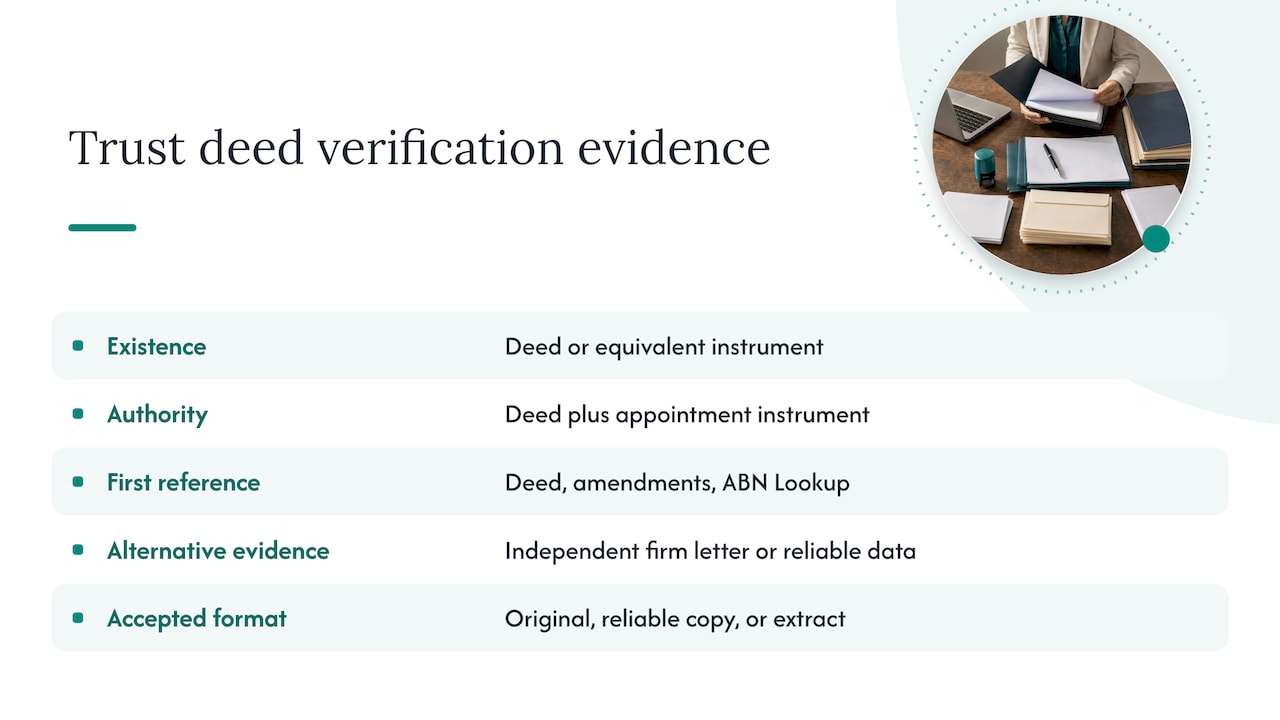
The deed is the founding instrument. It names the original trustee and settlor, sets the trust’s terms, defines the beneficiaries or classes, and gives particular people powers such as appointing and removing trustees. AUSTRAC says evidence of existence is generally the trust deed or an equivalent instrument, such as a will or letters of administration for an estate. A trustee’s authority is typically shown by the deed and the instrument that appointed them.
For verification, AUSTRAC’s guide points first to the trust deed and amendments such as deeds of variation, together with unique-identifier information such as ABN Lookup data. The alternative is a letter or document from the trust’s professional services firm, “from a person who doesn’t play a role in the trust”, which in practice means an independent lawyer or accountant rather than the trustee.
Two practical points follow. First, the same guide allows an original, a reliable copy or an extract of a document, so you do not need to chase the signed original in every case. Second, you may use other independent and reliable data if it establishes the same matters, which matters when the deed is old, held by a lawyer, or partly missing.
Check that you hold the whole, current deed
This is where most files fail. A deed that is complete on the day it was signed may be out of date today, and a partial deed can hide the one clause that shifts control.
Is it complete?
Confirm the document runs from the title page to the execution page with no gaps. The title page typically gives the trust name and establishment date. The schedules usually name the initial trustee, settlor and beneficiaries or classes. The execution page shows that the deed was signed. If pages are missing, you cannot be satisfied about the trust’s terms, however reassuring the first page looks.
Is it current?
A deed is the original as amended. Ask for every deed of variation, every deed of appointment or retirement of trustee, and any restated or replacement deed, and put them in date order. For each change, note:
- the date and the parties;
- the power the change relied on (the deed’s amendment power, a trustee’s power to appoint, or a court order);
- which clause or schedule changed; and
- who the trustee and appointor are after the change.
The principle is simple: the correct deed is the original executed deed as amended under its amendment power, and an unexecuted consolidation can miss amendments. Where only a consolidation is available, a sensible model is to ask for a certification on its first page, by a trustee director, company secretary or practising solicitor, that it is a true and correct copy of the provisions in force.
Does the trustee chain reach today?
Trace from the first trustee to the current one. A trustee named in the deed may have been replaced years ago, and the person signing your agency agreement must be the current trustee. If the trustee is a company, the beneficial owners include the individuals behind it, so you follow the chain through the company to the people.
Worked example
A couple want to sell an investment property held by “Harbourview Family Trust”. The deed supplied is a 2014 deed with a signature page, and the vendor says the trustee is a company, Harbourview Pty Ltd. You check the deed and find the original trustee was one of the couple, individually. There is no document explaining the change to the company. You ask for the deed of appointment and any deed of variation. They arrive: the company was appointed in 2019, and a variation moved the appointor power from the settlor to the couple’s adult son. You now know the trustee, who to verify as its directors and shareholders, and that the son, as appointor, holds control and needs to be identified and screened. Had you worked only from the 2014 deed, you would have identified the wrong people.
Read the deed for control, not just for names
Beneficial ownership in a trust is about control as much as entitlement. Under AUSTRAC’s ownership and control guidance, a beneficial owner is an individual who owns 25% or more of the customer, directly or indirectly, or who controls it, and you follow the chain through any companies or intermediaries until the individuals are determined. Trust deeds are named among the documents that help with this.
In a discretionary trust, no beneficiary may hold a fixed share, so the person with the power to appoint or remove the trustee often holds the real influence. That is why the deed has to be read for the appointor, guardian or protector clauses, and for any requirement that a trustee obtain someone’s consent before acting. The testamentary trust, created by a will rather than a settlement, is a common variant, and how testamentary trusts differ from simple wills is worth understanding when the evidence of existence is a will and the appointor’s role is not obvious. For the full control analysis, see our guide to trust KYC in Australia.
When the deed alone is not enough
Some deeds are silent, inconsistent or incomplete. A schedule may name beneficiaries who do not match what the customer tells you, or the trustee on the deed may differ from the trustee on the ABN record. In those cases you corroborate from independent sources AUSTRAC lists:
| Source | What it helps establish |
|---|---|
| ABN Lookup data | That the trust has an ABN, the trust name and the trustee entity on record |
| Letter from the trust’s independent lawyer or accountant | The trust’s existence, terms and parties, from someone who plays no role in it |
| Will or letters of administration | The existence of a testamentary trust or estate |
| Evidence of trust activity, such as disbursements to beneficiaries | The purpose of the trust, where purpose must be verified |
| Foreign registration body information | The existence of a foreign trust |
Document what does not match, what you asked for and how the discrepancy was resolved. A discrepancy that is noticed, explained and recorded is a sign of a working program. One that is ignored is what a reviewer finds.
Timing, and what changed in 2026
Timing is the practical pressure point in real estate, because trust buyers often appear close to exchange or settlement. AUSTRAC’s update to the real estate program starter kit, released on 10 June 2026, changed the delayed initial CDD timeframe for counterparties from 15 days to the period the Rules now set: ending at the earlier of 28 days after exchange of contracts and 3 days before the initially agreed settlement day (Rules 6-32). It also added a step for uncooperative counterparties and clarified, in the trust CDD form and beneficial ownership process, when checks can stop.
Delay is not a way to skip the deed. Your program must have identified the customer’s ML/TF risk and collected appropriate information before you begin, and the delayed matters must be completed within the window. Asking for the deed at the start of the engagement, rather than the week before settlement, removes the problem.
What to record so the file is audit-ready
AUSTRAC requires sufficient and accurate records of the type and content of the data you collected during initial CDD, and of the ML/TF risk identifications and other decisions you made. Under AUSTRAC’s overview of initial CDD, these are kept for 7 years after the end of the business relationship, or 7 years after the last occasional transaction.
Because AUSTRAC’s trust guide says you need not keep copies and can instead record details of the documents, a good trust record states:
- the documents seen (deed, each variation, each appointment), with dates and whether original, reliable copy or extract;
- who certified or supplied them, and when;
- the trustee, appointor, settlor and any other controllers identified;
- the corroborating sources used, such as the ABN Lookup result;
- the risk rating and the reasoning for it; and
- the name of the person who approved the determination, and when.
The last two are the ones most often missing. A file that shows the documents but not the judgement leaves a reviewer unable to see why you were satisfied.
Where AML Guard fits
AML Guard is an AML/CTF compliance platform built for Australian Tranche 2 reporting entities, including real estate agencies, buyers agents and property developers. For a trust customer, each identity check, screening result and officer decision sits in one case record.
A company’s beneficial ownership determination starts from its ACN, and an officer approves each one, so the platform automates the lookups and the record keeping while the judgement stays with your people. AML Guard is not self-service; every firm starts with a demo. The subscription and per-check fees are on the pricing page, and you can see the whole workflow on the AML Guard home page.
Our related guide to buyer due diligence for real estate agencies shows how trust checks sit within the wider buyer process.
Our perspective
Most trust files we would want to prevent fail on the same point: the deed was treated as a document to collect rather than a document to read. A trustee name on page one tells you nothing about who holds the power to remove that trustee, and a missing variation can change the answer completely.
Our view is that the deed check belongs in the same record as every other decision on the customer. When the identity checks, the screening, the officer’s reading of the deed and the final approval are one case record, the reasoning is visible, and a supervisor can follow it without reconstructing it from email threads and folders.
That is why AML Guard automates the lookups and the record keeping but leaves the determination to an officer. The judgement about who controls a trust is yours to make, and the record should show that you made it.
AML Guard
FAQ
Do I need to keep a copy of the trust deed?
AUSTRAC’s trust guide says you are not required to keep copies of the documents under your record keeping obligations, and you can record details of them instead. You must still keep accurate records of what you collected and the decisions you made. Many agencies choose to hold a copy anyway so the file is complete.
Can a letter from the trust’s accountant replace the deed?
AUSTRAC lists letters or documents from the trust’s professional services firms as an alternative verification source, provided they come from someone who plays no role in the trust, such as an independent lawyer or accountant, and not the trustee. Your program should say when you accept this and what the letter must confirm.
What if the deed has been varied several times?
Obtain every deed of variation and every change of trustee, put them in date order, and record the power each one relied on and what it changed. The current terms are the original deed as amended, so a variation you have not seen may change the trustee, appointor or beneficiaries.
Is a will enough to verify a testamentary trust?
AUSTRAC accepts a will or letters of administration as evidence that a trust or estate exists. You still need to establish the trustee, their authority, the beneficial owners and the nature and purpose of the relationship, so read the will for those details.
Sources
- Initial CDD for trust | AUSTRAC
- Overview of initial customer due diligence | AUSTRAC
- Determining ownership and control structures | AUSTRAC
- Updates to the real estate program starter kit | AUSTRAC
Recommended
- AML/CTF Compliance Checklist for Real Estate Agents
- Overseas buyer AML checks for Australian agents
- Verifying identity remotely under Tranche 2
- Trust KYC in Australia: what the Rules require
See How AML Guard Works
Tranche 2 obligations are now in force.
Book a 20-minute demo to see how AML Guard supports your compliance from the moment your designated service begins.