
A trust’s beneficial owner(s) are the natural person(s) who ultimately own or control the trust, and that group typically stretches across the trustee, individual owners of a corporate trustee, the settlor, the appointor, any protector, and, in some structures, named beneficiaries or beneficiary classes. Under section 5 of the Act a beneficial owner is an individual who directly or indirectly owns 25% or more of the customer, or controls it. Ownership of 25% or more is one limb, but it is not definitive evidence of beneficial ownership on its own. Control is a separate test entirely, and someone with no financial stake in a trust can still be a beneficial owner if they hold the power to direct it.
TL;DR:
- Beneficial owners include individuals who hold at least 25% ownership or have control over the trust, with control existing even without a financial stake.
- Verification requires examining deed pages, ASIC extracts, and screening all identified natural persons for PEP status and sanctions.
- Discretionary trusts, unit trusts, fixed trusts, and bare trusts each need different approaches to identifying beneficial owners based on their structure.
- Reduced or exempt CDD may apply only to low-risk trusts with documented reasonable grounds, but enhanced due diligence is required for opaque or foreign trusts.
- Digital identity tools support verification but cannot replace manual deed interpretation and officer judgment in determining beneficial ownership.
Table of Contents
- Who counts as a beneficial owner of a trust?
- How do you determine and verify a trust’s beneficial owners?
- What evidence should you collect and how should you record it?
- Worked examples: discretionary, unit, fixed and bare trusts
- When does reduced or exempt CDD apply?
- What are the reporting and recordkeeping obligations?
- Practical checklist for onboarding and transaction reviews
- How have recent regulatory changes affected trust beneficial ownership?
- Domestic versus foreign trusts: what changes?
- What role does digital identity technology play in verifying trust owners?
- How does AML Guard operationalise trust UBO checks?
- Get trust beneficial ownership right, from first onboarding to reporting
- Sources
Who counts as a beneficial owner of a trust?
AUSTRAC applies two distinct tests when assessing ownership and control structures: the ownership limb, which asks whether a person directly or indirectly holds 25% or more of the entity, and the control limb, which asks who can actually direct decisions. For a body corporate, control means more than 50% of voting power, more than 50% of issued share capital, or the ability to control the composition of the board. For anything other than a body corporate, including a trust, it means control of the governing body or practical influence over decisions. These tests apply independently. A person can fail the ownership test entirely and still be a beneficial owner through control.
Several roles need checking on every trust file:
- Trustee, individual or corporate. A corporate trustee is resolved via its ACN, then its own shareholders and directors are traced to natural persons.
- Settlor: the person who established the trust and contributed the initial property, relevant even where their ongoing role has ended.
- Appointor: often the person with the greatest practical power, holding rights to remove and replace the trustee.
- Protector: where the deed creates this role, it can carry veto or consent rights over trustee decisions.
- Beneficiaries and beneficiary classes, named individuals or defined classes who may receive trust property or income.
Conflating legal title with beneficial ownership is the single most common error officers make. A trustee holds legal title, but the deed clauses granting appointment or removal powers are usually what identify the real controller.
How do you determine and verify a trust’s beneficial owners?
Work through the following sequence for every trust customer, adjusting depth to the trust type and risk rating.
- Confirm the trust’s identity. Record the trust’s full name, ABN where held, and trustee details. Request the trust deed, not a summary of it.
- Resolve the trustee. If the trustee is a company, run an ASIC extract against its ACN and trace the shareholders and directors to natural persons. If the trustee is an individual, verify that person directly.
- Apply the correct test. Use the 25% ownership threshold for unit trusts and fixed trusts where unit holders or named beneficiaries hold quantifiable interests. For discretionary trusts, apply control analysis instead, since no beneficiary holds a fixed entitlement until a distribution is made.
- Review the deed pages. Identify the settlor, appointor, protector, and any clause granting removal, variation, or veto rights. This step cannot be automated; an officer has to read the actual clauses.
- Verify every identified natural person. Collect identity documents and screen each person for PEP status and targeted financial sanctions listings.
- Log the evidence and get sign-off. Record which deed pages were relied on, the reasoning applied, and an officer’s approval before customer due diligence proceeds.
- Document any reduced or exempt CDD decision. Where a lower-risk pathway is used, the reasonable grounds for that decision need their own written record.
Pro Tip: Never rely on a trustee’s covering letter or a lawyer’s summary of “who the beneficiaries are.” Ask for the specific deed pages, and keep copies of those exact pages, not a paraphrase, in the file.
What evidence should you collect and how should you record it?
A defensible file rests on primary documents, not secondhand descriptions. Collect the trust deed pages that establish the trustee, settlor, appointor, and protector roles; ASIC company extracts for any corporate trustee; ABR records confirming ABN and entity status; identity documents for every natural person identified; and, where relevant, distribution records or a unit register showing who has actually received trust property.
Some of this work is genuinely automatable. ACN-based ASIC extracts and ABR lookups run quickly and reliably because they query a structured registry. Deed interpretation does not work that way. AUSTRAC’s own guidance on ownership and control structures makes clear that tracing complex ownership chains requires officer judgement rather than blind reliance on database extracts.
- Retain deed pages, verification evidence, risk reasoning, and officer approval in a tamper-evident audit trail for seven years.
- Screen every identified beneficial owner for PEP status and sanctions exposure, and repeat that screening on an ongoing basis.
- Store the actual pages relied on, never a summary written by the trustee or their lawyer.
AUSTRAC’s initial CDD guidance for trusts requires reporting entities to identify and verify the trust itself, anyone acting on its behalf, and every identified beneficial owner as a matter of course.
Worked examples: discretionary, unit, fixed and bare trusts
Trust structures differ enough that a single checklist rarely fits every case. Four scenarios cover most of what you’ll see at onboarding.
- Discretionary trust. No beneficiary has a fixed entitlement, so ownership percentages are close to meaningless here. Review recent distribution records to see who has actually received income or capital, and identify the appointor’s removal powers and the trustee’s discretionary powers. Likely beneficial owners include the appointor and any beneficiary who has received substantial recent distributions.
- Unit trust. Unit holders owning 25% or more of units meet the ownership limb directly. Where units are held through a corporate entity, trace that holding down to natural persons the same way you would for any corporate shareholder.
- Fixed trust. Beneficiaries named in the deed with fixed entitlements generally must be recorded as beneficial owners, since their interest is defined rather than discretionary.
- Bare trust. Legal title sits with the trustee, but the beneficiary is typically the beneficial owner in substance, because the trustee holds no independent discretion over the asset.
Separately from the AML/CTF regime, Treasury’s policy work on a public beneficial ownership register proposes that trustees in an ownership chain record identity details and, for discretionary trusts, maintain a reasonable list of persons who have received distributions or who exert significant influence. That is a proposal, not a current obligation, but that direction lines up closely with how AUSTRAC already expects officers to approach discretionary structures today.
The same conclusion is reached independently outside Australia. The Wolfsberg Group, an association of global banks whose guidance has no legal force but is widely used to benchmark practice, addressed this in its FAQs on Beneficial Ownership (2012): for trusts, identification is expected to reach the trustees, the settlor and the beneficiaries or classes of beneficiary, not simply whoever holds the account. That document is now well over a decade old and is written for banks rather than property or professional services, so it is context rather than authority. It is worth noting only because two separate regimes, approaching the problem from different directions, land in the same place: a trust is not identified until the people behind it are.
When does reduced or exempt CDD apply?
AUSTRAC allows reduced identification of individual beneficial owners for certain low-risk trusts, but only where the reporting entity has reasonable grounds for that assessment, as set out in its guidance on initial CDD for trusts. This is not a blanket exemption for any trust that looks straightforward.
- Reduced CDD may be considered for certain regulated, publicly supervised trust structures where risk indicators are genuinely low.
- The decision must sit inside the business-wide ML/TF risk assessment required under section 26C, not as a standalone judgement call.
- Enhanced CDD is triggered by opaque ownership chains, foreign trustees in higher-risk jurisdictions, or any refusal to produce deed pages.
- Record the risk factors considered, the reasoning applied, and the officer’s approval every time a reduced pathway is used.
What are the reporting and recordkeeping obligations?
Customer due diligence duties for trusts sit within the broader framework set by the AML/CTF Act 2006 (Cth), with the AML/CTF Rules 2025 filling in the detail on program content, verification standards, and recordkeeping. Together they set the baseline every reporting entity works to, regardless of sector.
- The Act requires reporting entities to verify customer identity and retain supporting evidence as part of their AML/CTF program.
- Suspicious matter reporting obligations under section 41 can arise directly from trust onboarding, particularly where ownership chains resist reasonable explanation.
- Threshold transaction reporting duties sit alongside SMR obligations and may be triggered by trust-related transactions independently of the UBO determination itself.
- Treasury’s proposed direction on trustee disclosure signals that registers and trustee reporting expectations are likely to tighten further, not loosen.
- Officer sign-off and retention of the specific deed pages relied on remain the practical backbone of a defensible file, whatever else changes.
Practical checklist for onboarding and transaction reviews
A working checklist keeps a trust file consistent whether it’s an onboarding, a periodic review, or a transaction that has triggered enhanced scrutiny.
- Trust identity confirmed: name, ABN, trust type.
- Trustee identity resolved: individual verified, or corporate trustee traced via ACN.
- Deed pages collected covering trustee, settlor, appointor, and protector clauses.
- ASIC and ABR extracts obtained for any corporate trustee.
- Distribution records or unit register reviewed where relevant.
- Identity documents and PEP/sanctions screening completed for every natural person identified.
- Officer approval recorded before CDD proceeds.
Red flags that warrant a second look include opaque ownership chains that don’t resolve cleanly to natural persons, nominee arrangements layered over the real controller, trustees swapped shortly before a transaction, and any refusal to produce deed pages on request.
Pro Tip: Treat a refusal to produce deed pages the same way you’d treat a refusal to produce photo ID. It’s not a paperwork gap, it’s a reason to pause the transaction and consider whether an SMR is warranted.
How have recent regulatory changes affected trust beneficial ownership?
Tranche 2 obligations for real estate, legal, accounting, and trust and company service providers commenced on 1 July 2026, bringing a much larger group of professionals into direct contact with trust UBO determinations for the first time. Many of these entities previously had no statutory duty to trace beneficial ownership at all.
Treasury’s beneficial ownership reform work points toward a future where trustees in an ownership chain carry explicit disclosure obligations, particularly for discretionary trusts where a reasonable list of past and likely distribution recipients would need to be maintained. That’s a meaningful shift from the current position, where officers assemble this picture case by case from deed review and distribution history rather than from a central register.
For compliance officers, the practical effect is twofold. First, the pool of reporting entities now applying these tests has expanded sharply, which means consistency across sectors matters more than it used to; a law firm and a real estate agency assessing the same trust should reach the same conclusion. Second, the direction of travel is toward more documentation, not less. Officers who build strong deed review habits and retain the specific pages relied on now will be better placed if formal trustee disclosure requirements arrive. Waiting for a register to make this easier isn’t a sound strategy, given how long registry reform tends to take in practice.
Domestic versus foreign trusts: what changes?
A domestic trust with an Australian corporate trustee is usually the more straightforward case. The trustee resolves via ACN through ASIC, the deed is typically drafted under Australian law, and distribution records sit with an accountant or trustee who is directly contactable.
Foreign trusts complicate every step of that process. There may be no ACN to search at all if the trustee is a foreign entity with no Australian registration, which removes the fastest verification path available for domestic structures. Deed terms can be governed by another jurisdiction’s law, with roles like protector or appointor carrying different legal weight than they do under Australian trust law. Identity verification for foreign settlors, appointors, or beneficiaries often requires different document types and, in some cases, a higher standard of scrutiny given the reduced ability to cross-check against Australian registries.
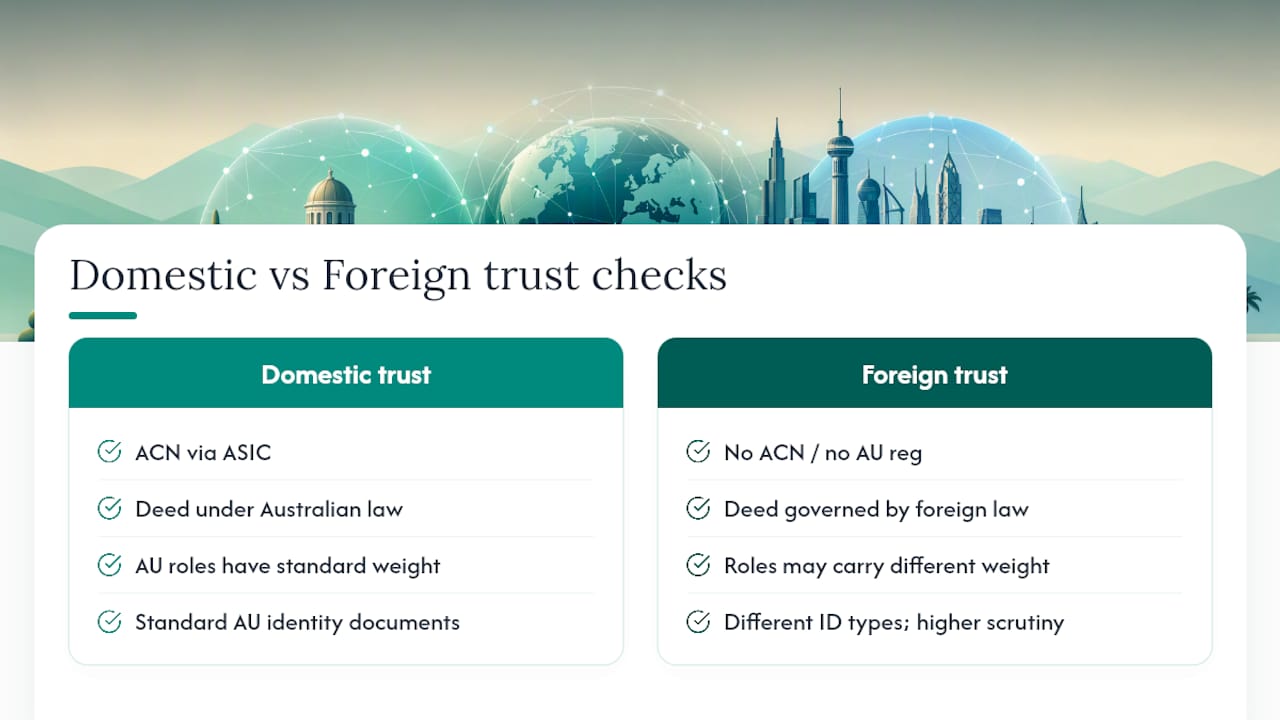
The practical consequence is that foreign trusts almost always sit at a higher inherent risk rating until proven otherwise, and reduced CDD pathways are far less likely to be appropriate. Officers should expect to request certified translations of deed pages where the original isn’t in English, and to apply enhanced due diligence as a starting assumption rather than a fallback triggered by a specific red flag. A trust with a foreign trustee and Australian-resident beneficiaries deserves particular attention, since it can create exactly the kind of opaque ownership chain that AUSTRAC’s guidance flags as a common challenge.
What role does digital identity technology play in verifying trust owners?
Digital identity verification has become the practical backbone of confirming that a natural person named in a deed or an ASIC extract is who they claim to be. Document capture paired with biometric liveness checks lets an officer verify a settlor, appointor, or beneficiary without an in-person meeting, which matters given how often trust beneficiaries are scattered across different states or countries.
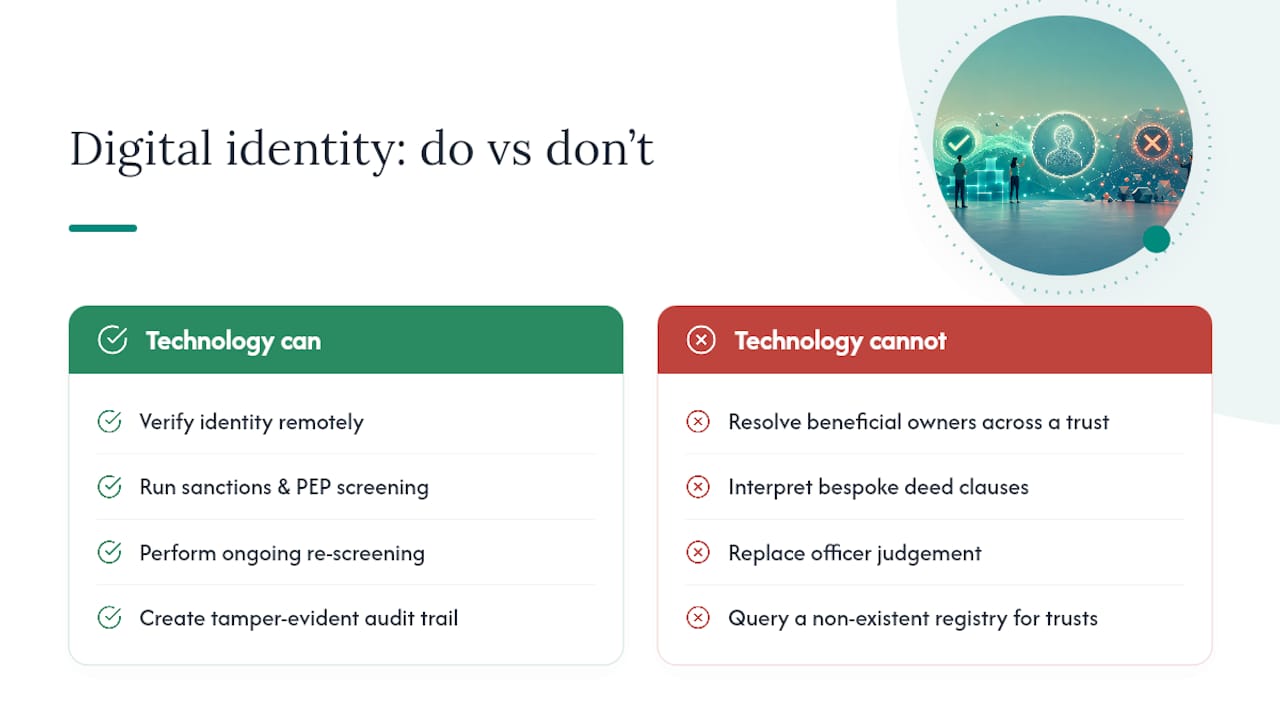
Technology’s role has clear limits, though, and those limits matter more here than in almost any other part of CDD. An ACN-based registry search can resolve a corporate trustee reliably because it queries a structured, government-maintained database with a single definitive answer. A trust deed is a different kind of document entirely: it’s a bespoke legal instrument, often amended multiple times, with clauses that require legal interpretation rather than field-matching. No automated lookup traces beneficial owners across a trust or an SMSF directly, because there’s no equivalent registry to query. The corporate trustee gets resolved via its own ACN, and the deed itself still needs a human officer to read it.
What technology does well is handle the repeatable, structured parts of the file: identity verification, sanctions and PEP screening, ongoing re-screening, and building a tamper-evident record of what was checked and when. It also captures and stores the deed pages an officer relies on, so the evidence sits alongside the determination rather than in a separate email chain. The judgement call, on the other hand, stays with the officer every time.
How does AML Guard operationalise trust UBO checks?
Some compliance platforms run ACN-based lookups to resolve corporate trustees and screen identified individuals for PEP and sanctions exposure, but deed interpretation requires officer judgement, as AUSTRAC’s guidance requires. Some compliance platforms produce linked risk assessments, policies, action plans and training so that trust file reasoning matches program documents. Officer sign-off and retention of specific deed pages in a tamper-evident audit trail is considered best practice.
Get trust beneficial ownership right, from first onboarding to reporting
Reading AUSTRAC guidance is one thing. Running consistent trust UBO checks across every file, every trustee swap, and every deed amendment is another challenge entirely, particularly once Tranche 2 obligations apply to your day-to-day onboarding volume.
AML Guard resolves corporate trustees via ACN lookup, runs identity verification and PEP and sanctions screening on every individual you identify, and captures the specific deed pages your officer relies on rather than a summary of them. Nothing proceeds to CDD without officer approval, and every determination sits in an 8-year tamper-evident audit trail alongside the risk assessment and policies it was made under. It’s built for the real estate agencies, conveyancers, law firms, and accounting practices now carrying trust and SMSF beneficial ownership CDD obligations for the first time, including trusts that surface inside property transactions.
AML Guard doesn’t run a free trial or open self-service sign-up. Book a demo through the AML Guard platform and your tenant gets configured to your designated services and risk profile before your team starts using it.
Sources
- Determining ownership and control structures (Reform) | AUSTRAC
- Policy specifications: beneficial ownership register (Treasury proposal, not a current AML/CTF obligation)
- Anti‑Money Laundering and Counter‑Terrorism Financing Act 2006 (Cth)
- ASIC registers
- FAQs on Beneficial Ownership (2012) | The Wolfsberg Group: international banking context, not an Australian obligation
Recommended
- Beneficial Ownership in Property Transactions: How to Trace UBOs Under Tranche 2
- Beneficial Ownership CDD for Trusts, SMSFs & Companies
- AML/CTF Compliance Checklist for Real Estate Agents: What You Need Before 1 July 2026
- Who is a company’s beneficial owner under Australian law?
See How AML Guard Works
Tranche 2 obligations are now in force.
Book a 20-minute demo to see how AML Guard supports your compliance from the moment your designated service begins.