
Outsourcing and reliance are two different legal arrangements under the AML/CTF Act, and the difference decides who is liable when a customer due diligence (CDD) check is wrong. When you outsource, a third party acts as your agent and you remain fully responsible for the result. When you rely, the Act treats the other party’s collection and verification of customer information as yours, but only if that party is a reporting entity or a qualifying foreign regulated business, and only if the conditions are met. In both cases the risk rating, the CDD decision, ongoing monitoring and reporting stay with your agency.
Since 1 July 2026, real estate agents, buyers agents and property developers have been reporting entities under the AML/CTF regime, supervised by AUSTRAC. This article sets out the legal basis for each arrangement, a decision table you can use for any third party you deal with, and the records a supervisor will expect to see.
TL;DR
- Outsourcing is agency (section 37). A third party collects and verifies KYC information for you, and your agency stays liable for any breach.
- Reliance is a different legal footing (sections 37A and 38). The Act treats the collection and verification as yours, but the third party must be a reporting entity or a foreign person regulated under laws applying the FATF Recommendations.
- Neither moves your core duties. Risk rating, CDD decisions, ongoing monitoring and reporting remain with you, and reliance does not carry the Part 10 records.
- A supplier is not automatically “reliance”. A vendor that runs identity checks is usually an outsourced service, and the paperwork has to match that reality.
- Keep one case record. Checks, evidence and the officer’s decision belong together so you can show them to AUSTRAC.
Table of Contents
- Why the distinction matters for an agency
- Outsourcing: the third party acts as your agent
- Reliance: the Act treats the work as yours
- The decision table
- What stays with your agency whichever you choose
- Is your supplier outsourcing or reliance?
- Records a supervisor will ask to see
- Why reliance matters commercially in real estate
- In-house or outsourced: how to decide
- Putting it into practice with AML Guard
- FAQ
- Sources
Why the distinction matters for an agency
An agency usually meets this question in one of three places. A conveyancer or bank has already identified the buyer, and you want to avoid asking again. A digital identity vendor offers to “handle KYC”. Or a head office or group business wants to run checks for several offices. Each looks like a shortcut, and each sits on a different legal basis.
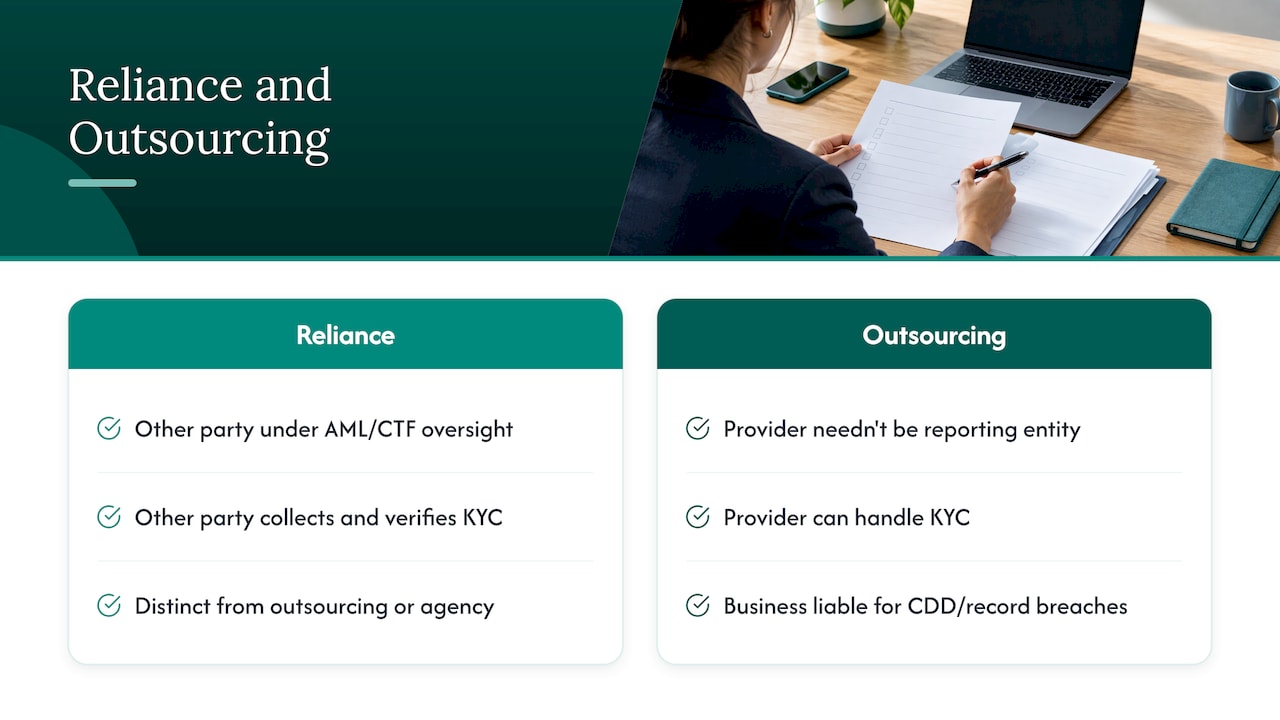
AUSTRAC describes reliance as relying on KYC information collected and verified by another reporting entity, or by a foreign business regulated under laws that give effect to the FATF recommendations. It states that this is not the same as outsourcing or agency arrangements. In reliance, the other party is itself subject to oversight under AML/CTF laws. In outsourcing, the provider need not be a reporting entity at all, and the business remains liable for any breach of its CDD and record-keeping obligations.
That is the whole practical point. If you choose the wrong label, your policies, your agreement and your records will describe an arrangement that does not exist, and the gap shows up at the first review.
Outsourcing: the third party acts as your agent
Section 37 of the Act allows a third party to collect and verify KYC information for you as your agent (the collection and verification steps in section 28(3)(c) and (d)). The words that matter are “for you”. The work is done in your name, and legally it is your work.
AUSTRAC accepts that an agency may outsource AML/CTF functions once or on an ongoing basis, including CDD, customer monitoring and reporting, but the agency remains responsible for complying with the Act and Rules and is legally liable for breaches. Practical consequences follow.
What AUSTRAC expects before you outsource
Before entering an arrangement, AUSTRAC’s guidance is to carry out due diligence on the provider: its experience, its qualifications or expertise relevant to AML/CTF and to your industry, and its willingness to agree to performance monitoring and breach mechanisms. You must also meet your personnel due diligence obligations for people engaged to perform AML/CTF functions.
What the agreement should contain
AUSTRAC expects a written outsourcing agreement to set out, at a minimum:
- the services and the performance targets the provider must meet;
- oversight mechanisms so you can confirm the agreed services are produced;
- mechanisms to manage compliance risk if the functions are not carried out properly.
Ongoing arrangements call for more oversight, monitoring and review than a one-off service. A short engagement to verify one vendor’s identity needs a lighter touch than a standing arrangement that touches every buyer.
Where outsourcing goes wrong
The usual failure is treating a delivered result as a finished obligation. A provider returns a green tick, the file is marked complete, and nobody at the agency can say what was collected, how it was verified or why the customer was rated low risk. Because the work is yours in law, that gap is yours too.
Reliance: the Act treats the work as yours
Reliance works differently. Under a written arrangement (section 37A, with the conditions in Rules 6-29) or case by case (section 38, with Rules 6-31), the Act treats the other party’s collection and verification of KYC information as yours. You do not repeat it, and you are not simply an agent’s principal.
Two limits come with that.
- Who can be relied on. Only a reporting entity, or a foreign person regulated under laws that apply the FATF Recommendations. A company that sells identity checks but is not itself a reporting entity cannot be the party you rely on. AUSTRAC’s page is explicit that a KYC or outsourced service provider is not reliance because those entities are not under AML/CTF oversight.
- What does not transfer. The reliance provisions cover collection and verification. They do not cover the Part 10 records. If you want to hold the evidence, you must obtain it, and the retention duty is yours.
AUSTRAC also says reliance must suit the risks your business reasonably faces, and your policies should set out how and when you use it, how you assess arrangements and the steps you take to ensure the third party has and applies appropriate measures.
Section 37A: a standing written arrangement
A section 37A arrangement is the formal route, suited to a relationship that repeats, such as a conveyancer who regularly acts on the other side of your sales.
- Senior manager approval is required (Rules 5-5(1)(f)).
- You must assess the arrangement at least every two years, and on any significant change (Rules 6-30).
- You must make a written record of each assessment within 10 business days of completing it (section 37B).
AUSTRAC’s examples of reliance in practice include a conveyancer and a bank in a real estate transfer, and a lawyer and an accountant setting up a company. It also notes that arrangements made before 1 July 2026 need to be reviewed to confirm they meet the Act and Rules. If your agency has an informal understanding with another professional from before that date, the review is worth doing now.
Section 38: reliance case by case
Section 38 covers reliance in other circumstances, one customer at a time, under Rules 6-31. It suits a one-off situation where a bank or conveyancer has already verified a particular party and you decide, for that matter, to rely on it. You still need to be satisfied the conditions are met and to record why you relied.
The decision table
Use this for each third party and each task. Identify who does the work first, then who they are, then what you hold.
| Question | Outsourcing (section 37) | Reliance, standing (section 37A) | Reliance, case by case (section 38) |
|---|---|---|---|
| Who does the collection and verification? | An agent acting for you | Another reporting entity or qualifying foreign regulated person | Another reporting entity or qualifying foreign regulated person |
| Who can it be? | Anyone you can properly appoint, including a non-reporting entity | A reporting entity, or a foreign person regulated under laws applying the FATF Recommendations | The same |
| How is it documented? | Written agreement with services, performance targets, oversight and breach mechanisms | Written arrangement meeting Rules 6-29, approved by a senior manager (Rules 5-5(1)(f)) | Conditions in Rules 6-31 met and recorded for that customer |
| Who is treated as having done the work in law? | You, as principal, and you stay liable | You: the Act treats it as your collection and verification | You, for that customer |
| What must you obtain? | The evidence and results, to meet your record-keeping | The KYC information and the access you need, as the Part 10 records are not covered | The same |
| Review | Oversight proportionate to the arrangement | At least every 2 years and on significant change (Rules 6-30), with a written record within 10 business days (section 37B) | On each use |
| What stays yours? | Risk rating, CDD decisions, ongoing monitoring, reporting | Risk rating, CDD decisions, ongoing monitoring, reporting | Risk rating, CDD decisions, ongoing monitoring, reporting |
The last row is identical across the columns on purpose. No arrangement hands off your judgement about the customer.
What stays with your agency whichever you choose
AUSTRAC’s tranche 2 factsheet sets out initial CDD before a designated service begins in most cases, ongoing CDD throughout the relationship, enhanced CDD where ML/TF risk is high, and accurate records of the program and compliance activity, retained for seven years for most obligations. It also says a senior manager approves the program, the governing body oversees it and an AML/CTF compliance officer is appointed (all three can be the same person).
In plain terms for an agency: a third-party vendor or platform mostly helps with onboarding, meaning identity verification, sanctions and PEP screening and an initial risk rating. Ongoing CDD runs until the relationship ends, and transaction monitoring stays with the agency. Unusual matters, such as an unexpected source of funds, a sudden change of buyer, a structure that does not fit or reluctance to provide information, should be escalated to the compliance officer.
In practice, that gives you four things to keep in-house:
- The risk rating. A vendor may propose one, but you decide and record it.
- The CDD decision. Whether to proceed, seek more information or apply enhanced measures is a decision of your agency.
- Monitoring. Watching how the customer behaves across the matter, and re-rating when something changes.
- Reporting. Suspicious matter and threshold transaction reports are your obligation, however the checks were gathered.
Is your supplier outsourcing or reliance?
The commercial word “partner” decides nothing. A short test:
- Is the supplier a reporting entity (or a foreign person regulated under FATF-aligned laws)? If not, it cannot be relied on, and the arrangement is outsourcing.
- Is there a written section 37A arrangement meeting Rules 6-29 and approved by a senior manager? If not, you are either outsourcing or using section 38 for a single matter.
- Do you hold what you need? Under reliance you must still be able to show what was collected and verified. Under outsourcing, the results are your records.
- Is the assessment diary in place? Two-year reviews, reviews on significant change and the 10-business-day written record apply to section 37A arrangements.
Where the answer to the first question is no, which is the usual position for an identity-verification software supplier, treat it as outsourcing and build the oversight and agreement to match.
Records a supervisor will ask to see
A statement that “AML has been done” is not a record. Whichever arrangement you use, you should be able to show the following for any customer file:
- what information was collected, from which source, and how it was verified;
- which arrangement applied (agent, standing reliance or case-by-case reliance) and where it is documented;
- the risk rating, the reasoning behind it and who approved the CDD decision;
- the screening results, and any escalation to the compliance officer;
- evidence of the periodic review of any reliance arrangement.
Protect AML/CTF records from unauthorised access, loss and tampering, limit access to authorised staff, and keep them accessible for compliance reviews or audit. The Australian Privacy Principles also require reasonable steps to protect personal information from misuse, loss and unauthorised access. For trust and company customers, the records also need to show how you reached the people behind the structure. Our guide to trust KYC in Australia covers that, and the Tranche 2 CDD guide covers the wider process.
Why reliance matters commercially in real estate
A residential sale involves several regulated parties: the agent, the seller’s and buyer’s conveyancers or solicitors, and sometimes a developer with its own sales team. Done well, reliance means vendors and buyers are not put through the same KYC process several times at different stages of a transaction. That is the commercial promise of reliance, and the reason to set up section 37A arrangements properly with the professionals you deal with most.
Two cautions keep that promise honest. A solicitor’s CDD obligation applies only to its own client, so you cannot assume another party’s check covers your customer. And reliance covers collection and verification only, so your own risk rating, decision and monitoring still have to be done and recorded.
In-house or outsourced: how to decide
The choice is the agency’s own, weighed against cost, the agency’s size and risk profile, and how a tool fits the workflow. Add the AUSTRAC provider checks above and the choice becomes a short list of questions:
- How many customers and matters do you handle, and how many are companies, trusts or foreign parties?
- Who in the agency approves a CDD determination, and can they see the evidence behind it?
- Can you produce the file, the rating and the reasoning for any matter on request?
- Do your policies describe the arrangement you actually use?
A single platform that holds the checks and the decision together answers the third question directly. A set of separate suppliers, each holding a fragment, makes it harder.
Our view: one record beats several arrangements
We built AML Guard for Australian Tranche 2 reporting entities, and the question we hear most about third parties is who answers for a check. Whatever the contract says, the agency answers. That is why we design around a single case record rather than around handing work away.
In AML Guard, each identity check, screening result and officer decision sits in one case record. A company’s beneficial ownership determination starts from its ACN, and an officer approves each one. The platform automates the lookups and the record keeping, not the judgement, which is where the Act keeps responsibility.
The same discipline applies to reliance: record the decision to rely, and why, with the customer’s checks. Our guided wizards produce the risk assessment, the AML/CTF program, a customer acceptance policy and the training manual, and can pre-fill from your risk assessment, so the policies start from the arrangements you assessed.
The result is a file you can show AUSTRAC: what was done, by whom and on what basis.
AML Guard
Putting it into practice with AML Guard
AML Guard is an AML/CTF compliance platform for real estate agencies, buyers agents, developers, conveyancers, law firms, accounting practices and trust and company service providers. Its guided wizards produce the risk assessment, the AML/CTF program, a customer acceptance policy and the training manual, and each customer’s identity checks, screening results and officer decisions sit in one case record. AML Guard is not self-service; every firm starts with a demo.
To see how a case record holds the checks and the officer’s decision together, book a demo or review the pricing page for the subscription and per-check fees.
FAQ
Can I rely on a vendor that runs identity checks for me?
Only if the vendor is a reporting entity or a qualifying foreign regulated person. A software or verification supplier that is not itself under AML/CTF oversight is an outsourced service, not reliance. You stay liable and need an agreement and oversight to match.
Does reliance remove my record-keeping duty?
No. The Act treats the other party’s collection and verification as yours, but the Part 10 records are not covered. You need to obtain and keep what you require to evidence the CDD, and AUSTRAC’s tranche 2 guidance sets retention at seven years for most obligations.
How often must a reliance arrangement be reviewed?
A section 37A arrangement must be assessed at least every two years and on significant change (Rules 6-30). A written record of each assessment is required within 10 business days of completion (section 37B). A senior manager must approve the arrangement in the first place.
Can I outsource ongoing monitoring?
You can use a platform or provider to support it, but monitoring and the decisions that follow remain your responsibility. AUSTRAC accepts outsourcing of monitoring and reporting functions only on the basis that you remain legally liable.
Do arrangements from before 1 July 2026 still work?
AUSTRAC says agreements in place before the amendments took effect need to be reviewed to confirm they meet the Act and Rules. Check whether each one is really an agency arrangement or a reliance arrangement, then bring the documents, approvals and assessment records into line.
Sources
- AUSTRAC: Overview of reliance on customer identification by a third party
- AUSTRAC: Using outsourcing to help meet your obligations
- AUSTRAC: AML/CTF obligations factsheet for tranche 2 reporting entities
Recommended
- CDD reliance checklist for Tranche 2 firms
- What Is an AML/CTF Program? A Plain-English Guide for Property Professionals
- AML/CTF Compliance Checklist for Real Estate Agents
- When a Client Can’t Provide Standard ID: AML/CTF Options for Agents
See How AML Guard Works
Tranche 2 obligations are now in force.
Book a 20-minute demo to see how AML Guard supports your compliance from the moment your designated service begins.