
Yes, conveyancers are regulated and must have an AML/CTF program: a business-wide ML/TF risk assessment and AML/CTF policies. A conveyancer is regulated for assisting a person in the planning or execution of a transaction to buy, sell or transfer real estate, and for receiving, holding or controlling a person’s money or property to help in a transaction (AUSTRAC’s professional services guidance, items 1 and 3). The program has to be in place before the first designated service; enrolling with AUSTRAC and designating a compliance officer follow within 28 days of starting.
TL;DR:
- The assessment and policies must suit the practice’s size and complexity, be approved by a senior manager, keep any governing body informed, and be independently evaluated at least every three years.
- Verify individuals from reliable and independent sources, start company beneficial ownership from the ACN, reach a trust with a corporate trustee through that company, and apply enhanced CDD where section 32 requires it.
- CDD on a buyer client may wait until the earlier of 28 days after exchange or three days before the initially agreed settlement day, but only where delay is essential to avoid interrupting business and the added risk is low; record the determination when you make it.
- Keep records for the Act’s seven-year periods, report suspicious matters within 3 business days (24 hours for terrorism financing), and report receipts or payments of $10,000 or more in physical currency within 10 business days.
- AUSTRAC’s starter kit is a starting point: tailor its assessment, policies, and forms to actual services, clients, and practice size, then log updates and tests.
Table of Contents
- What an AML/CTF program must contain: structure and artefacts
- Customer due diligence for individuals, companies and trusts
- Enrolment, compliance officer and governance duties: timelines and responsibilities
- Record keeping, suspicious matter and threshold transaction reporting, and independent evaluation
- How to use AUSTRAC’s conveyancing program starter kit: practical steps and timeline
- Practical example: how a purpose-built platform maps to AUSTRAC expectations
- Publisher perspective: why connected documents and active oversight reduce audit risk
- How AML Guard helps conveyancers implement and maintain an audit-ready program
- FAQ
- Sources
What an AML/CTF program must contain: structure and artefacts
The Act sets out two parts. The first is a business-wide ML/TF risk assessment under section 26C, covering how money laundering, terrorism financing and proliferation financing could occur through the practice’s designated services. The second is a set of AML/CTF policies under section 26F, which translate that risk assessment into day-to-day processes proportionate to the size and complexity of the practice.

Together, these obligations require a documented AML/CTF program approved by a senior manager, with oversight from the governing body and periodic internal reviews to confirm the program still reflects how the practice actually operates.
In practice, a conveyancing practice needs:
- A written risk assessment covering client types, services, delivery channels and jurisdictions.
- An AML/CTF policy document setting out procedures for due diligence, monitoring and reporting.
- Process documents and client-facing forms used for onboarding and verification.
- A maintenance log recording reviews, updates and staff sign-off.
The Act sets the governance chain: a senior manager approves the risk assessment and policies (section 26P), the policies keep the governing body informed of the practice’s risks (for a practice that is not an individual), and the program is independently evaluated at least every three years (section 26F(4)).
Customer due diligence for individuals, companies and trusts
Every client relationship starts with identity verification, but the depth of that check depends on who, or what, the client is.
- For individual clients, verify identity against a reliable and independent source such as a current driver licence or passport, and record how that verification was performed.
- For companies, start the beneficial ownership determination from the company’s own Australian Company Number (ACN), and identify the individuals who ultimately own or control it.
- For trusts and self-managed super funds with a corporate trustee, the trustee company runs its own determination on its own ACN; individual trustees are verified as individuals, and the trust deed is read by an officer.
- Apply enhanced CDD where section 32 requires it: high ML/TF risk, a foreign PEP, a FATF call-for-action jurisdiction, or a suspicious matter reporting obligation where you continue to act. Third-party funds, unusual funding and adverse media are facts that should prompt a review of the risk rating.
- Keep due diligence current through periodic re-screening and by updating client records whenever circumstances change.
For a buyer client, CDD can be completed after the service starts, by the earlier of 28 days after exchange or three days before the initially agreed settlement day (section 6-32(3) and (4) of the AML/CTF Rules). Section 29 of the Act sets the conditions: the practice must determine on reasonable grounds that delay is essential to avoid interrupting the ordinary course of business and that any added risk is low. A higher-risk buyer is not a candidate.
Pro Tip: Document the reason for any CDD delay at the time you rely on it, not after settlement, so the file shows a risk-based decision rather than an oversight.
For a fuller walkthrough of enhanced due diligence triggers, our guide to tranche 2 customer due diligence covers the practical steps in more depth.
Enrolment, compliance officer and governance duties: timelines and responsibilities
Two clocks start the day the practice first provides a designated service, and both run to 28 days.
- Enrol with AUSTRAC within 28 days of commencing a designated service, under section 51B, providing details of the practice, its principals and the services it offers.
- Designate an AML/CTF compliance officer within 28 days of starting, under section 26K, with responsibility for day-to-day oversight, liaison with AUSTRAC and keeping the program current.
- Maintain evidence of governing body oversight, such as board or management reports that show the program was discussed and endorsed, not merely filed away.
- Where practices operate as part of a reporting group, confirm whether a shared program arrangement applies, since obligations can be managed jointly but accountability still sits with each reporting entity.
A sole compliance officer with no record of governing body engagement is a gap an independent evaluation is likely to find.
Record keeping, suspicious matter and threshold transaction reporting, and independent evaluation
The Act’s record-keeping periods are seven years, running from different starting points and covering program documents, CDD outcomes, transaction records and staff training completion logs.
Beyond storage, two reporting duties sit alongside the program itself:
- Lodge a suspicious matter report within 3 business days after forming a suspicion on reasonable grounds (24 hours for terrorism financing), supported by the records that informed that judgement.
- Lodge a threshold transaction report within 10 business days when the practice receives or pays $10,000 or more in physical currency (notes and coins) in providing a designated service.
- Have the program independently evaluated at least every three years (section 26F(4)(f)), with the evaluator reviewing risk assessment currency, policy adherence and staff training records.
Preparing for that evaluation is largely a matter of keeping the audit trail tidy as you go, rather than reconstructing it under time pressure.
How to use AUSTRAC’s conveyancing program starter kit: practical steps and timeline
AUSTRAC’s conveyancer program starter kit gives small practices that meet its suitability criteria a working starting point rather than a blank page.
- Customise the risk assessment, policy document and process forms to reflect the actual services, client base and size of the practice.
- Implement client onboarding and CDD forms into everyday workflows, so verification happens consistently rather than ad hoc.
- Maintain, test and document updates over time, recording effectiveness checks ahead of the next independent evaluation.
An AML/CTF program template can shorten the drafting stage, though the customisation and maintenance steps still need to reflect how the practice genuinely operates.
Practical example: how a purpose-built platform maps to AUSTRAC expectations
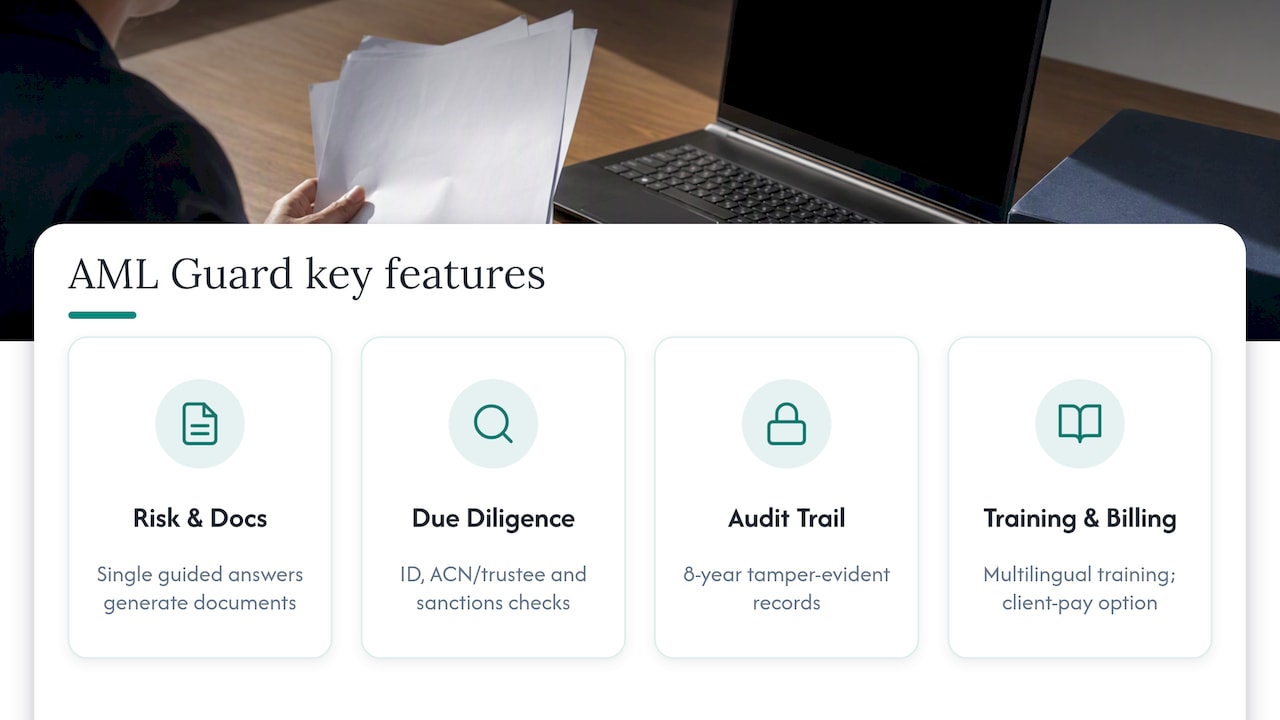
A guided platform can produce the risk assessment and policies from the same set of inputs, with the action plan and training manual generated alongside them. Because all four documents trace back to the same answers, the policies reflect the risk assessment and the training manual reflects the policies, which is the consistency an independent evaluation looks for.
- Identity verification runs with document capture and biometric liveness checks, alongside sanctions, PEP and adverse media screening.
- Beneficial ownership resolves on a company’s own ACN, with trusts and SMSFs reached through their corporate trustee’s own ACN and determination.
- An 8-year tamper-evident audit trail, above the Act’s seven-year minimum.
- Compliance status can go to REX, with no CDD data leaving the compliance platform.
Pro Tip: Keep an officer’s approval recorded against every CDD determination before the transaction proceeds. That approval step is what shows judgement sat with a person, not just a system.
Publisher perspective: why connected documents and active oversight reduce audit risk
What tends to trip practices up at evaluation isn’t a missing document, it’s a policy that doesn’t match the risk assessment it’s supposed to implement. Regular governance reporting, dashboard evidence of monitoring activity, and a visible testing cadence do more to satisfy a reviewer than a thicker folder. A documented, supervised process beats a borrowed template every time, because evaluators are checking whether the program reflects the practice, not whether the paperwork exists.
How AML Guard helps conveyancers implement and maintain an audit-ready program
We built AML Guard around the two-part structure the Act requires, so the risk assessment and AML/CTF policies, along with the action plan and training manual, generate from a single guided set of answers rather than separate documents that drift apart over time.
Our end-to-end due diligence covers identity verification, beneficial ownership checks resolved through ACNs and corporate trustees, and ongoing sanctions and adverse media screening, with an officer reviewing each outcome and an 8-year tamper-evident audit trail, above the Act’s seven-year minimum, behind every determination. Staff training comes with completion records in multiple languages, and a transaction party can pay for their own check, with each eligible CDD check fee earning a credit against that calendar month’s subscription, capped at the subscription fee.
We offer AML Guard month-to-month or on a 12-month term, whichever suits the practice, with onboarding that starts by booking a demo so the platform can be configured to the designated services and risk profile involved. See current plans and pricing or visit AML Guard to arrange a demo.
FAQ
What is the AML/CTF program structure for conveyancers?
A conveyancer’s AML/CTF program has two parts: a business-wide ML/TF risk assessment under section 26C and AML/CTF policies under section 26F. Both must be approved by a senior manager (section 26P), and, unless the practice is an individual, the policies must keep its governing body informed of its risks.
How much does an AML compliance platform cost in Australia?
Pricing depends on the plan and the volume of checks a practice runs. Current options, including Platform subscription, Standard Individual, High-Risk Individual and Company/Trust services, are listed on the AML Guard pricing page.
What are the new AML rules for Australian conveyancers?
From 1 July 2026, conveyancers are regulated under the Anti-Money Laundering and Counter-Terrorism Financing Act for assisting in property transactions and for holding client money, as confirmed in AUSTRAC’s guidance. This brings enrolment, a compliance officer appointment and an AML/CTF program into effect for the sector.
Where can conveyancers find AML training resources in Australia?
AUSTRAC’s conveyancer program starter kit gives small practices a program to customise, including how to use it day to day. Training itself is a policies duty: initial and ongoing, and suited to each person’s role (section 26F(4)(e) and Rules 5-9). AML Guard also generates a training manual, with completion records, as part of the same program documentation.
What risks are specific to conveyancing transactions?
Conveyancing carries particular exposure to third-party funds, late changes to the parties or settlement accounts involved in a transaction, and buyers operating through trusts and companies rather than as individuals. These risks are part of why the business-wide risk assessment needs to reflect how a specific practice actually transacts.
Sources
- Anti-Money Laundering and Counter-Terrorism Financing Act 2006 (Cth)
- Anti-Money Laundering and Counter-Terrorism Financing Rules 2025
- Professional designated services | AUSTRAC
- Conveyancer program starter kit | AUSTRAC
Recommended
- AML/CTF Compliance Checklist for Real Estate Agents: What You Need Before 1 July 2026
- AML Record Keeping: The Seven-Year Clocks
- Tranche 2 AML Australia: Your Compliance Obligations Explained
See How AML Guard Works
Tranche 2 obligations are now in force.
Book a 20-minute demo to see how AML Guard supports your compliance from the moment your designated service begins.