
Auction sales attract the same customer due diligence as any other sale, and bidder registration is the practical point to start collecting the information. Because the successful bidder is not known until the hammer falls, and the resulting contract is unconditional, there is little time to complete initial CDD on the buyer before the contract is signed. The Act and Rules let a seller’s agent delay it where that is essential to avoid interrupting the ordinary course of business, and AUSTRAC’s guidance says this will often be the case at an auction. The delay has a hard deadline, and the agency needs a documented basis for using it and policies that manage the risk while it runs.
TL;DR:
- A seller’s agent can delay initial CDD on the buyer where the conditions in section 29 of the Act are met, but must complete it as soon as reasonably practicable, and in any case within 28 days after exchange of contracts, or at least 3 days before the initially agreed day for settlement, whichever is earlier.
- Collecting registration data digitally lets verification start straight after the auction, and the file shows when each step happened.
- Your AML/CTF policies should set out when delaying initial CDD is appropriate, how uncooperative bidders are escalated, and that records are kept for at least the Act’s seven-year minimum.
- Mistakes to avoid: trying to verify every bidder before the auction, a thin record of why CDD was delayed, and leaving the sanctions check until verification, when it can run on registration details alone.
- A platform like AML Guard runs a sanctions-only check as bidders register, lets the buyer verify remotely, and keeps the whole file in one audit trail.
Table of Contents
- Quick operational checklist: what to do before, during and after auction day
- Bidder registration: what to collect and what verification can wait
- Delayed initial CDD: timeframes, conditions and required controls
- Program essentials: risk assessment, policies and escalation for auctions
- Handling uncooperative bidders and deciding when to file an SMR
- Sanctions, PEPs and source of funds: red flags at auction
- Records, retention and audit readiness
- How AML Guard supports auction CDD from registration to settlement
- What AUSTRAC expects of agencies in 2026-27
- Three mistakes to avoid in auction CDD files
- Automate your auction CDD workflow with AML Guard
- Sources
- FAQ
Quick operational checklist: what to do before, during and after auction day
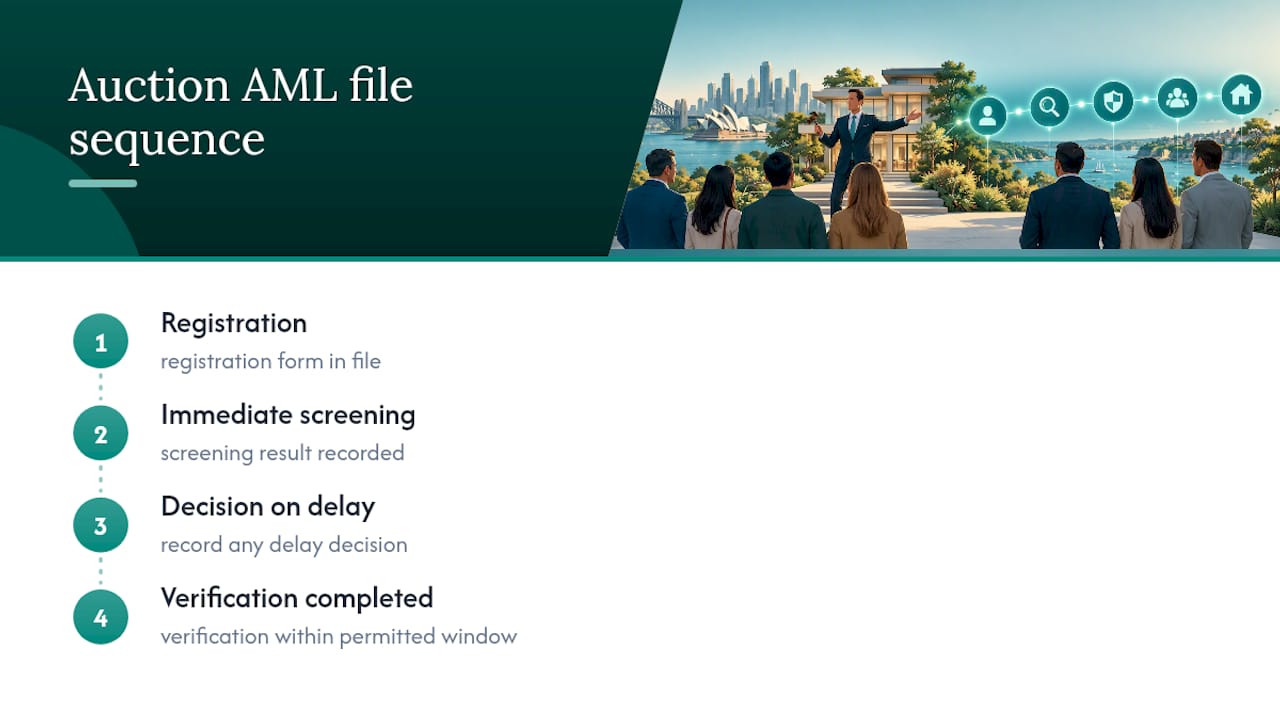
At an auction, the order of the steps matters as much as the steps themselves. The sequence below follows the delayed-CDD rules and leaves a file an auditor can follow.
Before auction day:
- Publish registration requirements to bidders in advance, including what identification they will need to bring.
- Prepare screening so a sanctions check can run the moment a bidder registers.
On auction day:
- Collect know-your-customer details at registration and request identity evidence where practical.
- Retain the successful bidder’s registration form and deposit evidence securely and immediately.
- Run a sanctions check on each registrant, and on anyone they are bidding for, as soon as registration data is captured, and record it as a registration check, not CDD approval.
- Before the contract is signed, decide whether delaying initial CDD on the buyer meets the section 29 conditions, and record who decided, when and why.
After the hammer falls:
- Complete initial CDD on the buyer, including verification, as soon as reasonably practicable, and in any case within 28 days after exchange of contracts, or at least 3 days before the initially agreed day for settlement, whichever is earlier.
- Record every action, decision and escalation in a form an auditor can follow later.
Pro Tip: Build the escalation log into the registration form itself so the paper trail exists before you need it, not after.
Bidder registration: what to collect and what verification can wait
Bidder registration is the one point before the hammer falls where an agency can collect a bidder’s details in a controlled way. That makes it the practical collection point for customer due diligence information, even though full verification of that information does not need to happen on the spot.
At minimum, a registration form should capture:
- Full name, date of birth and residential address.
- Contact details and the identification document type the bidder intends to present.
- Details of any buyer’s representative, including evidence of their authority to bid (a signed authorisation or power of attorney).
- Whether the bidder is buying for themselves or for another person, a company or a trust, and that party’s full name.
There is an important distinction here that agents often blur. Collecting information means writing down what the bidder says about themselves. Verifying it means checking that information against a reliable, independent document or data source, which is what section 28(3)(d) of the Act requires, to the extent appropriate to the customer’s risk. A registration form starts the collection step but rarely completes it: initial CDD on the buyer also needs the information appropriate to their risk, such as PEP status, how the purchase is funded and, for a company or trust, its beneficial owners. Collecting it does not verify it.
Pro Tip: Capture registration data digitally rather than on paper. A digital form time-stamps the entry automatically and lets verification start the moment the auction ends, instead of waiting for someone to transcribe handwriting back at the office.
Delayed initial CDD: timeframes, conditions and required controls
AUSTRAC’s guidance recognises the problem: at an auction, “it’s possible for a buyer to only be known after the fall of the hammer”, and the short time between the end of the auction and signing the contract is often not enough to complete initial CDD. The law’s answer is to let the agency complete initial CDD on the buyer after the service starts, within a fixed period. It does not let CDD be skipped, and it does not require every registered bidder to be verified in advance: a bidder who does not buy is not a customer for that sale.
The deadline is set by section 6-32 of the AML/CTF Rules 2025. Where a seller’s agent is already acting for the seller and the section 29 conditions are met, initial CDD on the buyer must be completed as soon as reasonably practicable, and in any case within 28 days after exchange of contracts, or at least 3 days before the initially agreed day for settlement, whichever is earlier. A buyer’s agent bidding for a client is in the mirror position: CDD on its own client comes first, and CDD on the seller can be delayed to the same deadline. Release 1.1 of AUSTRAC’s real estate starter kit, published in June 2026, moved its counterparty timeframe from 15 days to 28 days. The low-risk example on AUSTRAC’s examples page still shows 15 days, and templates built on the earlier release may too; the Rules now allow 28.
Screening does not have to wait for verification. In AUSTRAC’s worked auction example, the seller’s agent delays CDD on the buyers, completes a sanctions check without delay, and after exchange of contracts verifies the identity of the buyers and their representative, confirms the representative’s authority and completes the PEP check. The AML/CTF Act and Rules do not require a sanctions check at registration, but sanctions law prohibits dealing with a designated person’s assets, a deposit included, whether or not CDD is delayed. Screening at registration is the simple answer: it needs only the details the bidder has just given.
Section 29 of the AML/CTF Act sets the conditions for any delay. The situation must be one the Rules allow (for real estate, section 6-32, which also requires that the agency is already acting for the other party), and the agency must determine on reasonable grounds that the delay is essential to avoid interrupting the ordinary course of business and that any additional risk of money laundering, terrorism financing or proliferation financing is low. It must have AML/CTF policies to complete CDD as soon as reasonably practicable and within the Rules’ period, and implement policies that mitigate and manage the risk. AUSTRAC’s guidance on delayed initial CDD adds that inconvenience is not a sufficient reason, and that you should be able to show how you decided the risk was low. In practice that means:
- The ability to stop providing the brokering service if the buyer falls outside your risk appetite, the control AUSTRAC’s worked example relies on.
- A documented rationale for why delay was appropriate in that specific case.
- An internal deadline that completes initial CDD well inside the legal one, not on its last permitted day.
Every decision to delay verification, and every step taken afterward, needs to be written down: who decided, when, and on what basis. That record is how you show the conditions were met.
Program essentials: risk assessment, policies and escalation for auctions
An agency’s AML/CTF program has to speak directly to auction scenarios, not just describe customer due diligence in general terms. The program rests on two pillars: a business-wide ML/TF risk assessment under section 26C, covering money laundering, terrorism financing and proliferation financing risk, and the AML/CTF policies built from that assessment.
For auctions specifically, the policies should set out:
- The exact criteria that justify delaying initial CDD for the buyer, not a blanket assumption that delay is always available.
- The bidder registration process, including which fields are mandatory and which evidence is requested at that stage.
- The escalation path when a bidder is uncooperative or verification cannot be completed in time.
- How registration forms, screening results and verification outcomes are retained as evidence.
AUSTRAC’s real estate program starter kit includes an auction among its worked examples. Whether or not the kit is used, the risk assessment, policies and staff training should say the same thing about auctions: if the risk assessment treats delayed CDD as low risk only in defined circumstances, the policies and the training need to name the same circumstances.
Pro Tip: Write the auction-specific clauses into the main policy document itself rather than a separate memo. A standalone memo is easy to lose, and easy to leave out of date when the main policy changes.
Handling uncooperative bidders and deciding when to file an SMR
If the buyer will not cooperate, section 6-33 of the Rules gives the seller’s agent a defined path. It is taken to have established a CDD matter it could not establish because the buyer would not cooperate, provided it took all reasonable steps, recorded those steps and any difficulties it met, and recorded its consideration of whether a suspicious matter report is required. “All reasonable steps” has to be shown, not asserted: written requests for documents, follow-up calls, a clear deadline given to the bidder, and a record of what was asked for and what came back.
- Document every contact attempt with the bidder, including dates, method and the specific information requested.
- Escalate to the AML/CTF compliance officer once a bidder misses the internal deadline for providing verification documents, and have that officer record their assessment.
- Consider whether the refusal, with any other red flags, gives reasonable grounds for a suspicion that triggers a suspicious matter report under section 41. The Rules make the buyer’s failure to cooperate a matter you must take into account (section 9-4A), and section 6-33 requires the consideration to be recorded whichever way it goes. If a suspicion is formed, the report is due within 3 business days (24 hours for terrorism financing), and if you keep acting on the sale, enhanced customer due diligence applies (section 32).
- Keep every piece of correspondence, the compliance officer’s written assessment and the final decision as part of the transaction file.
Pro Tip: A bidder who becomes evasive only after winning, rather than during registration, is itself worth noting in the file: timing of non-cooperation is relevant context for the compliance officer’s decision.
Sanctions, PEPs and source of funds: red flags at auction
A sanctions check should run as soon as a bidder registers, because it needs only the registration details, not documents. PEP and adverse media screening belong in initial CDD on the buyer, run on verified identity data so that matches can be resolved reliably. A confirmed sanctions match changes everything: the person’s assets, including any deposit you hold, are frozen, so you cannot deal with them, return them or make assets available to the person without a sanctions permit.
Certain patterns at auction should raise the buyer’s risk rating, and a high rating requires enhanced customer due diligence (section 32 of the Act):
- Large cash deposits or a request to pay a significant portion of the price in cash.
- Funds arriving from an offshore structure with no clear link to the bidder’s stated occupation or business.
- A bidder representative unwilling to explain the source of the funds behind the bid.
AUSTRAC’s risk insights and indicators for the real estate sector list signs such as a customer paying all or part of the purchase price in cash to the agent, using third party transfers, private lenders, offshore banks or virtual assets, appearing to follow the instructions of third parties, or ending the relationship after being asked for more information. A foreign politically exposed person always requires enhanced customer due diligence. Where a red flag appears, document the source of funds before settlement and record the reasoning behind whatever decision follows.
Records, retention and audit readiness
The Anti-Money Laundering and Counter-Terrorism Financing Act 2006 (Cth) requires customer due diligence records, including records of risk assessment and decisions about the customer, to be kept for seven years after the business relationship ends or the transaction is completed (section 111), and transaction records for seven years from the day they are made (section 107). Auction files should be kept at least that long, indexed so an auditor can trace a single transaction from registration through to settlement without cross-referencing multiple systems.
Documents worth retaining for every auction sale include:
- The bidder registration form and any representative authorisation.
- Sanctions and PEP screening results, with timestamps.
- Records of any decision to delay verification, and the verification documents once received.
- Correspondence relating to any escalation or uncooperative bidder.
Access to this file should be limited to compliance staff and the AML/CTF compliance officer, not the wider sales team.
How AML Guard supports auction CDD from registration to settlement
Auction day compresses registration, bidding and signing into a few hours, and the rest of initial CDD has to happen against a fixed deadline. AML Guard’s client intake portal lets the buyer complete identity verification remotely, rather than making a trip back to the agency office after the sale.
- The intake portal collects the buyer’s own details and runs document and biometric verification in the same session.
- At registration, a sanctions-only check runs on each registrant and is marked as not CDD approval. For the buyer, sanctions, PEP and adverse media screening run on verified identity data, with the risk score and the reasoning behind it recorded against the file.
- The risk assessment, AML/CTF policies, compliance action plan and staff training manual are generated as one linked set, so the auction criteria for delayed CDD read the same in each.
- Every action is recorded in a tamper-evident audit trail. AML Guard’s audit trail holds records for 8 years, above the Act’s seven-year minimum.
- Integration with REX CRM pushes compliance status against a listing, never the underlying CDD data.
Pro Tip: Send the intake portal link to the buyer as soon as the hammer falls, so verification can start the same day instead of after a trip back to the office.
What AUSTRAC expects of agencies in 2026-27
Tranche 2 obligations for real estate agents, along with legal, accounting, and trust and company service providers, commenced on 1 July 2026 and are now in force. AUSTRAC’s May 2026 statement of expectations says it expects “effort, not perfection” in 2026-27, and that newly regulated businesses should be enrolled, have an AML/CTF program and an AML/CTF compliance officer, train staff on the program, and be ready to have a go at reporting when a suspicious matter arises.
For an auction sale, the file is where that effort shows. It should trace the agency’s own documented process: registration, a sanctions check straight away, a recorded decision on any delay, and initial CDD completed within the deadline. A file with a registration form, a screening result and nothing afterward does not show that. Section 26G of the Act also makes failing to comply with your own AML/CTF policies a civil penalty contravention, so the auction clauses in the policy need to describe what staff actually do.
Three mistakes to avoid in auction CDD files
The first is trying to fully verify every registered bidder before the auction starts. Registration is for collecting information; the law does not require verification of bidders who do not buy, and initial CDD on the buyer can follow under the delayed-CDD rules. The second is a thin record of why CDD was delayed, which is the evidence that the section 29 conditions were met. The third is leaving the sanctions check until verification, when it can run on registration details alone.
Automate your auction CDD workflow with AML Guard
Slow registration capture, late screening and thin documentation are the gaps AML Guard is built to close. The client intake portal lets the buyer finish identity verification from home, so nobody has to book a follow-up appointment at the agency office just to satisfy a compliance step. A sanctions-only check runs as soon as a registrant’s details are entered, and the outcome is recorded automatically rather than typed up later from memory. It is marked as a registration check, not CDD approval.
- Book a demo to see how registration, screening and delayed verification map onto your current auction process.
- View the pricing page for the Platform subscription and per-check fees for Standard Individual, High-Risk Individual and Company / Trust verification.
For agencies weighing up a spreadsheet-and-template approach against a purpose-built platform, the practical difference shows up on settlement day, when every action taken since registration is already sitting in an audit-ready file rather than being reconstructed under time pressure.
This article is general information, not a substitute for advice from a qualified lawyer. Consult a qualified legal professional about your own circumstances before acting on anything here.
Sources
- Anti-Money Laundering and Counter-Terrorism Financing Act 2006 (Cth) | Federal Register of Legislation
- Anti-Money Laundering and Counter-Terrorism Financing Rules 2025 | Federal Register of Legislation
- Real estate designated services | AUSTRAC
- Delayed initial customer due diligence | AUSTRAC
- Real estate program starter kit: examples of dealing with customers | AUSTRAC
- Updates to the real estate program starter kit | AUSTRAC
- Risk insights and indicators of suspicious activity for the real estate sector | AUSTRAC
- Update to regulator statement of expectations, May 2026 | AUSTRAC
FAQ
Do real estate agents need to do AML checks on buyers?
Yes. When an agent brokers a sale, the Act makes both the seller and the buyer its customers (section 6, table 5, item 1), so a seller’s agent must complete customer due diligence on the buyer, including the identity and authority of anyone who bid for them, as well as the seller. CDD on the buyer can be delayed only under section 29 of the Act and section 6-32 of the Rules.
What are the current AML rules for property transactions in Australia?
Property transactions are governed by the Anti-Money Laundering and Counter-Terrorism Financing Act 2006 (Cth) and the AML/CTF Rules 2025, which set out program obligations and customer due diligence timing. For auctions, delayed initial CDD on the buyer must be completed as soon as reasonably practicable, and in any case within 28 days after exchange of contracts, or at least 3 days before the initially agreed day for settlement, whichever is earlier (section 6-32 of the Rules).
What triggers enhanced AML checks at an auction?
Enhanced customer due diligence is required where the buyer’s risk is high, and also where the buyer, a beneficial owner of the buyer, anyone the buyer is buying for or anyone acting for the buyer is a foreign politically exposed person, or is physically present in, or was formed in, a high-risk jurisdiction the FATF has called for enhanced due diligence on. Those are among the triggers in section 32 of the Act. Large cash payments, funds from offshore structures with no clear connection to the bidder, and a representative unwilling to explain the source of funds can each raise a buyer’s risk. AUSTRAC’s risk insights for real estate list further signs, such as third party transfers and a customer who ends the relationship after being asked for more information.
Why might a bidder fail an AML check?
A bidder can fail an AML check for reasons including a sanctions match, an inability or refusal to produce verification documents within the permitted timeframe, or an unexplained source of funds that cannot be satisfactorily documented. Any of these should be escalated to the AML/CTF compliance officer, who assesses whether the matter needs to be reported as a suspicious matter under section 41. A confirmed sanctions match goes further: the bidder’s assets, including any deposit you hold, are frozen and cannot be dealt with or returned without a sanctions permit, and if you hold any of them, AUSTRAC expects you to contact the Australian Sanctions Office and report it to the Australian Federal Police. A politically exposed person match is not a failure in itself, but it can require enhanced customer due diligence.
Recommended
- AML/CTF Compliance Checklist for Real Estate Agents: What You Need Before 1 July 2026
- AML training real estate: what agencies must do
- Tranche 2 AML Australia: your compliance obligations explained
- Tranche 2 customer due diligence in Australia
See How AML Guard Works
Tranche 2 obligations are now in force.
Book a 20-minute demo to see how AML Guard supports your compliance from the moment your designated service begins.