
The AML/CTF Act does not require you to have an internal audit function. What it requires is an independent evaluation of your AML/CTF program at least every three years, plus your own reviews in between. An internal audit team can carry out the evaluation if it is sufficiently independent of the program, but your compliance officer and compliance team cannot. A small agency with no audit team can still show strong assurance between evaluations by sampling files against its policies, checking approvals and records, and reporting the findings to the governing body. That work is a review, not an independent evaluation, and it works best when every check and officer decision sits in one case record.
TL;DR
- The Act does not require an internal audit function. It requires an independent evaluation at least every three years, under section 26F(4)(f), covering the matters in Rules 5-10.
- An evaluator can be internal, for example in an internal audit team, if sufficiently independent. The compliance officer and the compliance team cannot do it.
- Between evaluations, a small firm runs its own reviews: file sampling, checks of approvals and records, and findings reported to the governing body. This is a review, not an independent evaluation.
- A single case record for each customer, holding every check and officer decision, makes both the review and the evaluation faster and easier to defend.
Table of Contents
- What “AML internal audit” means under the Act
- Who can carry out the evaluation
- What the evaluation must cover
- How often, and what triggers an earlier review
- In-house assurance between evaluations
- A simple review calendar for a small agency
- What a reviewer wants to see in your records
- What is at stake
- Our perspective
- See the case record in practice
- FAQ
- Sources
What “AML internal audit” means under the Act
People use “internal audit” loosely in AML/CTF conversations, and the term hides two different obligations. Separating them is the first step to meeting either.
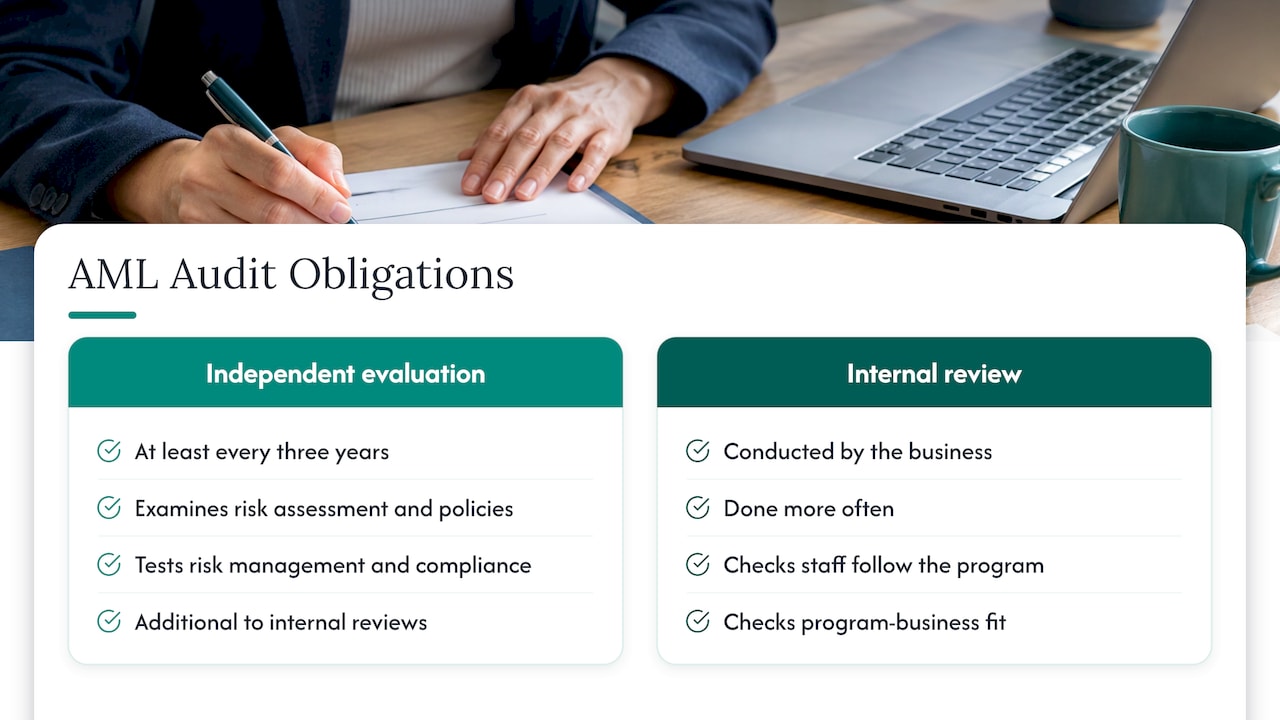
The first is the independent evaluation. AUSTRAC’s Step 5 guidance says it must examine how you undertook or reviewed your money laundering and terrorism financing (ML/TF) risk assessment, evaluate the design of your AML/CTF policies, and test whether you identified, assessed, mitigated and managed ML/TF risks appropriately and complied with your own policies. It must happen at least once every three years, and it is in addition to your own internal reviews of the program.
The second is the internal review: the checking you do yourself, more often, to confirm that staff follow the program and that the program still fits the business. The AUSTRAC program overview states that the steps for the risk assessment, policies, internal reviews and the frequency and conduct of independent evaluations must all be appropriate to the nature, size and complexity of the business.
The distinction matters because a file check by your compliance officer is valuable but does not satisfy the evaluation requirement. Equally, a three-yearly evaluation does not replace the day-to-day assurance a supervisor expects you to have.
Who can carry out the evaluation
AUSTRAC’s Step 5 page says the evaluator can be internal or external. An internal evaluator can sit, for example, in an internal audit team, provided they are sufficiently independent. In practice AUSTRAC expects the evaluator to be:
- free from bias, influence and conflicts of interest, with authority to exercise independent judgement;
- empowered to conduct the evaluation as they see fit;
- not responsible for implementing or maintaining the program;
- not involved in developing the program or in assessing the ML/TF risks; and
- independent of the work areas being evaluated.
The last point rules out the AML/CTF compliance officer and every member of the compliance team. They design, run or oversee the controls, so they cannot assess them independently.
For a larger group with a genuine internal audit team that does not touch the AML/CTF program, an internal evaluation is a workable path. For a typical agency with a principal, a handful of agents and a part-time compliance officer, there is rarely anyone who meets all of those tests. Where no impartial internal reviewer can be found, an external evaluator is the route, and the results go to the governing body and senior management.
Before you appoint anyone, write down why they meet each independence test. That note is the first document a supervisor will want to see.
What the evaluation must cover
The evaluation looks at the matters set out in Rules 5-10 of the AML/CTF Rules 2025. In plain terms, the evaluator works through three questions:
- Was the risk assessment done properly? Did the agency assess the risks of its services, customers, delivery channels and the places its customers come from, and has it reviewed that assessment when things changed?
- Are the policies well designed? Do they meet the Act, the regulations and the Rules, and do they match the risks you identified?
- Did the agency follow them, and did the controls work? Were customers identified and verified, was enhanced due diligence applied where risk was high, and were reports and records handled as the policies say?
There is no one-size-fits-all way to choose which parts of the program to test. A sound approach combines your current high-risk areas with changes in the wider regulatory environment. For an agency, that usually means weighting the evaluation toward the transactions and customer types your own risk assessment rates highest.
This is why a risk assessment, policies and training material that line up are so useful. An evaluator who finds a policy that contradicts the risk assessment has an adverse finding before testing a single file. Our guides on the AML/CTF risk assessment for real estate agencies and on what an AML/CTF program contains set out what the evaluator will be reading.
How often, and what triggers an earlier review
The evaluation must take place at least once every three years, and the frequency written in your policies has to suit your agency’s nature, size and complexity. For a newly captured agency, the Transitional Rules 2026 set staggered deadlines for the first evaluation, so confirm your own date on the official AUSTRAC page rather than assuming it.
Your internal reviews should be more frequent and event-driven. AUSTRAC’s real estate program starter kit lists the triggers for reviewing a real estate program:
- significant changes to services, delivery channels or customers;
- changes to ML/TF risk;
- regulatory or legislative updates;
- adverse findings from an independent evaluation;
- internal incidents or control failures; and
- scheduled periodic reviews.
The starter kit says adverse evaluation findings are to be addressed as soon as practicable. Build that into your process: every finding gets an owner, an action and a completion date, and the governing body sees the outcome.
In-house assurance between evaluations
If you have no audit team and no one independent enough to evaluate, you still need assurance that the program works. Call it what it is: an internal review. It supports the compliance officer’s reporting to the governing body, which the Rules expect (Rules 5-7), and it makes the independent evaluation cheaper and smoother when it arrives.
A practical routine for a small agency looks like this.
1. Sample files against the policies
Each quarter, pull a sample of completed customer files. Include some from each risk rating, every enhanced due diligence file, and any file where staff raised a concern. For each, check that the steps in your policy happened in the order the policy says, before the designated service began or within any delay the Rules allow. In real estate, that means before you broker the purchase, sale or transfer of the property.
For each file, ask:
- Was identity verified, and does the evidence match the person?
- For a company, was the beneficial owner determined, and who approved it?
- Were sanctions and politically exposed person (PEP) screening results recorded and acted on?
- Does the risk rating have recorded reasoning, and does it match the risk assessment?
2. Check approvals and records
Test whether the right people approved the right things. A senior manager’s approval of the risk assessment and policies, officer sign-off of determinations, and escalation of high-risk customers should each leave a dated record. Then check retention: AUSTRAC’s tranche 2 factsheet says records for most obligations must be kept for 7 years, including the program, customer due diligence, transaction records and staff training sessions.
3. Check training and reporting
Confirm every person who deals with customers has completed training and that the completion is recorded. Look at any suspicious matter or threshold transaction reports lodged, and at the internal escalations that did not result in a report, to see whether the reasoning was written down.
4. Report findings to the governing body
Summarise results in a short written report: what was sampled, what was found, what is being fixed and by when. The factsheet explains that senior management approves the program, the governing body oversees it and takes reasonable steps to ensure compliance, and the compliance officer handles day-to-day compliance and communication with AUSTRAC. In a small agency one person can hold all three roles, which is exactly why this review cannot count as independent.
5. Close the loop
Record each corrective action, who did it and when. Update the risk assessment, policies or training where the finding exposes a gap, so the documents stay consistent.
A simple review calendar for a small agency
| Activity | Suggested rhythm | Who does it | What it produces |
|---|---|---|---|
| File sampling against policies | Quarterly | Compliance officer or a nominated senior agent | Sampling note with findings |
| Approvals and records check | Quarterly | Compliance officer | Exceptions list |
| Training completion check | Twice a year | Compliance officer | Completion report |
| Report to governing body | At least annually, and after any incident | Compliance officer | Written report and actions |
| Program review after a trigger event | As triggers occur | Compliance officer, approved by senior management | Updated documents |
| Independent evaluation | At least every 3 years | Sufficiently independent evaluator | Evaluation report |
The rhythm is a suggestion, not a rule: AUSTRAC requires it to be appropriate to your nature, size and complexity, so set it in your policies and then keep to it.
What a reviewer wants to see in your records
Whoever evaluates your program, internal or external, starts with evidence. The most common practical weakness is that evidence is scattered: identity documents in one folder, screening results in an email, the officer’s decision in a conversation, the risk rating in a spreadsheet. Each fragment is individually fine, but reconstructing the story for one customer takes hours, and gaps look like control failures.
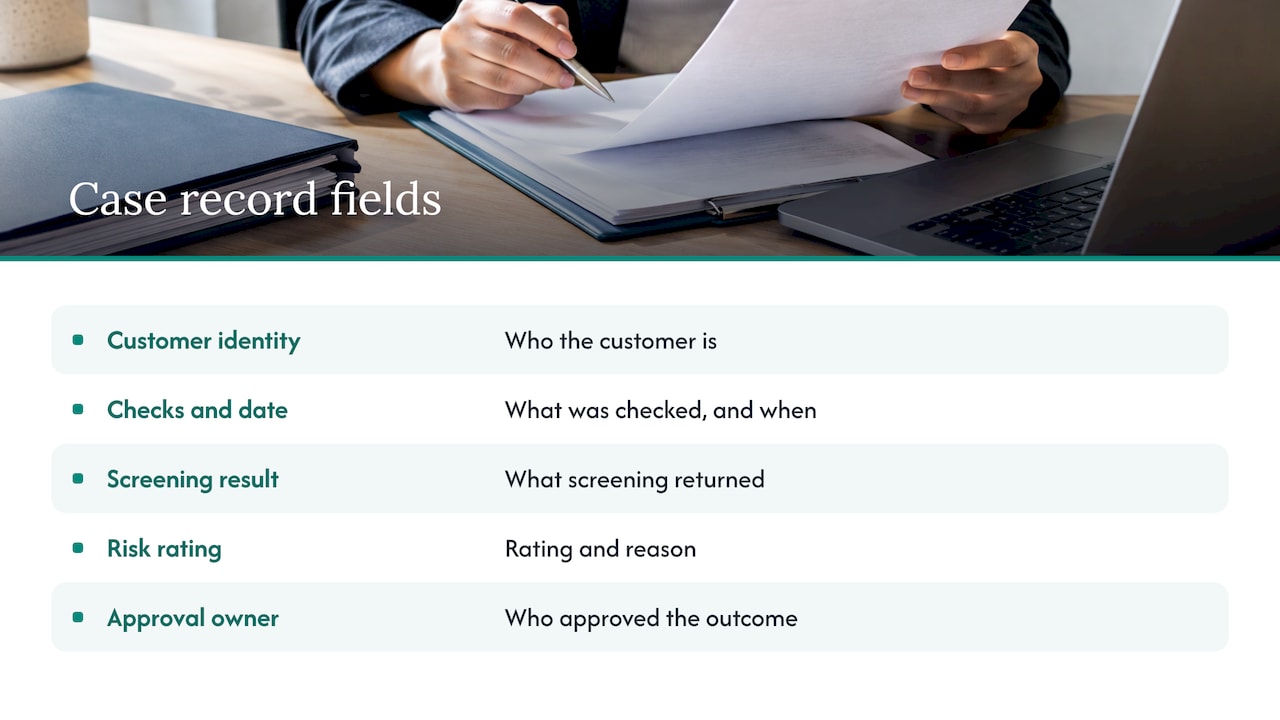
A good case record answers five questions on one page: who the customer is, what was checked and when, what the screening returned, what risk rating was given and why, and who approved the outcome. With one record per customer, sampling takes minutes instead of days, and the evaluator can test your controls rather than hunt for your paperwork.
What is at stake
AUSTRAC’s page on consequences of not complying says it can seek civil penalty orders and injunctions from the Federal Court, accept enforceable undertakings, issue infringement notices and issue remedial directions. Civil penalties can reach 100,000 penalty units for a body corporate. AUSTRAC can also require an external auditor to review compliance, with the report provided to AUSTRAC.
That last power is the one to keep in mind. An agency that already reviews itself, documents its findings and fixes them is in a very different position from one that is told to bring in an auditor.
The larger penalties have so far been imposed on big reporting entities. In the SkyCity Adelaide case, the Federal Court ordered a $67 million civil penalty after finding the AML/CTF programs failed to meet the Act’s requirements and that appropriate ongoing customer due diligence was not carried out. The lesson for an agency is about the pattern, not the scale: a program on paper that is not followed in practice is the failure that supervisors look for.
Our perspective
We built AML Guard around one idea: the evidence an auditor or evaluator needs should be created while the work is done, not assembled afterwards.
Our guided wizards produce the risk assessment, the AML/CTF program, a customer acceptance policy and the training manual, and can pre-fill from your risk assessment, so the documents start from the risks you assessed. Documents that agree with each other are the first thing an evaluator tests.
Each check and each officer decision is recorded in one case record. Each identity check, screening result and officer decision sits together, and a company’s beneficial ownership determination starts from its ACN, with an officer approving each one. The platform automates the lookups and the record keeping, not the judgement.
For a small agency, that means the quarterly review described above becomes a matter of opening records, not chasing them. And when an independent evaluator arrives, the work is theirs to test and ours to have made easy to find.
AML Guard
See the case record in practice
AML Guard is an AML/CTF compliance platform built for Australian Tranche 2 reporting entities, including real estate agencies, buyers agents and property developers. Its guided wizards produce the risk assessment, the AML/CTF program, a customer acceptance policy and the training manual, and each customer’s identity checks, screening results and officer decisions sit in one case record. AML Guard is not self-service; every firm starts with a demo. You can see the subscription and per-check fees on the pricing page, or book a demo to walk through a case record from intake to officer approval.
If you are still building your foundations, our AML/CTF compliance checklist for real estate agents lists what the program needs in place before the first review.
FAQ
Does my agency need an internal audit function?
No. The Act does not require an internal audit function. It requires an independent evaluation at least every three years, plus your own internal reviews. If you have an internal audit team that is sufficiently independent of the AML/CTF program, it can carry out the evaluation, but you do not need to create one.
Can our AML/CTF compliance officer do the independent evaluation?
No. AUSTRAC expects the evaluator to be independent of the areas being evaluated and not to implement, maintain or develop the program or assess the ML/TF risks. The compliance officer and the compliance team do those things, so their own checks count as internal review, not independent evaluation.
How often must the independent evaluation happen?
At least once every three years, with the frequency in your policies suited to your agency’s nature, size and complexity. The Transitional Rules 2026 set staggered deadlines for the first evaluation, so check the current position on AUSTRAC’s Step 5 page. Internal reviews should run more often and after trigger events such as a significant change in services or a control failure.
What should I report to the governing body after an in-house review?
Report what you sampled, what you found, what actions are under way and who owns each one. Include any incidents, training completion and reports lodged. In a small agency the governing body may be the same person as the compliance officer, which is another reason to label the work an internal review.
How long must I keep the records an auditor will ask for?
AUSTRAC’s tranche 2 factsheet says records for most obligations must be kept for 7 years, including the AML/CTF program, customer due diligence records, transaction records and training sessions. Keep review reports and corrective action records with them so the full history is available.
Sources
- Step 5: Conduct an independent evaluation | AUSTRAC
- Your AML/CTF program overview | AUSTRAC
- Step 3: Maintain and review your real estate program | AUSTRAC
- AML/CTF obligations factsheet for tranche 2 reporting entities | AUSTRAC
- Consequences of not complying | AUSTRAC
- Federal Court makes ruling in SkyCity case | AUSTRAC
Recommended
- AML/CTF Compliance Checklist for Real Estate Agents
- AML Training Requirements for Real Estate
- AML Compliance Officer Duties in Real Estate
- AML risk assessment for real estate agencies
See How AML Guard Works
Tranche 2 obligations are now in force.
Book a 20-minute demo to see how AML Guard supports your compliance from the moment your designated service begins.