
The AML/CTF compliance officer is the person your agency designates to oversee and coordinate day-to-day compliance with the Anti-Money Laundering and Counter-Terrorism Financing Act 2006 (Cth), the AML/CTF Rules and the agency’s AML/CTF policies, to communicate with AUSTRAC, and to report to the governing body at least every 12 months. Since Tranche 2 obligations commenced on 1 July 2026, that role is a legal requirement for real estate agents, buyers agents and property developers who provide designated services. The officer coordinates the work. They do not have to perform every customer check themselves, which is why the quality of the officer’s records and decisions matters more than the volume of tasks they personally handle.
TL;DR
- Every reporting entity must designate one individual as its AML/CTF compliance officer under section 26J, at management level, with real authority, independence and access to resources.
- The officer oversees and coordinates compliance, oversees how the policies operate, communicates with AUSTRAC and reports to the governing body at least every 12 months.
- Designate within 28 days of starting a designated service and notify AUSTRAC within 14 days of the designation.
- The officer keeps the program current: risk assessment, policies, training, independent evaluation and seven years of records.
- The governing body stays accountable for oversight. Appointing an officer does not hand the agency’s obligations to one person.
Table of Contents
- Who needs a compliance officer in a real estate agency
- Who can hold the role: the section 26J test
- When to designate and notify
- The core duties under section 26L
- Overseeing customer due diligence and monitoring
- Overseeing reports to AUSTRAC
- Maintaining the program, training and records
- What stays with the principals and governing body
- Covering absences
- A working week for the officer
- How AML Guard supports the officer
- Perspective: the officer’s job is decisions, not data entry
- FAQ
- Sources
Who needs a compliance officer in a real estate agency
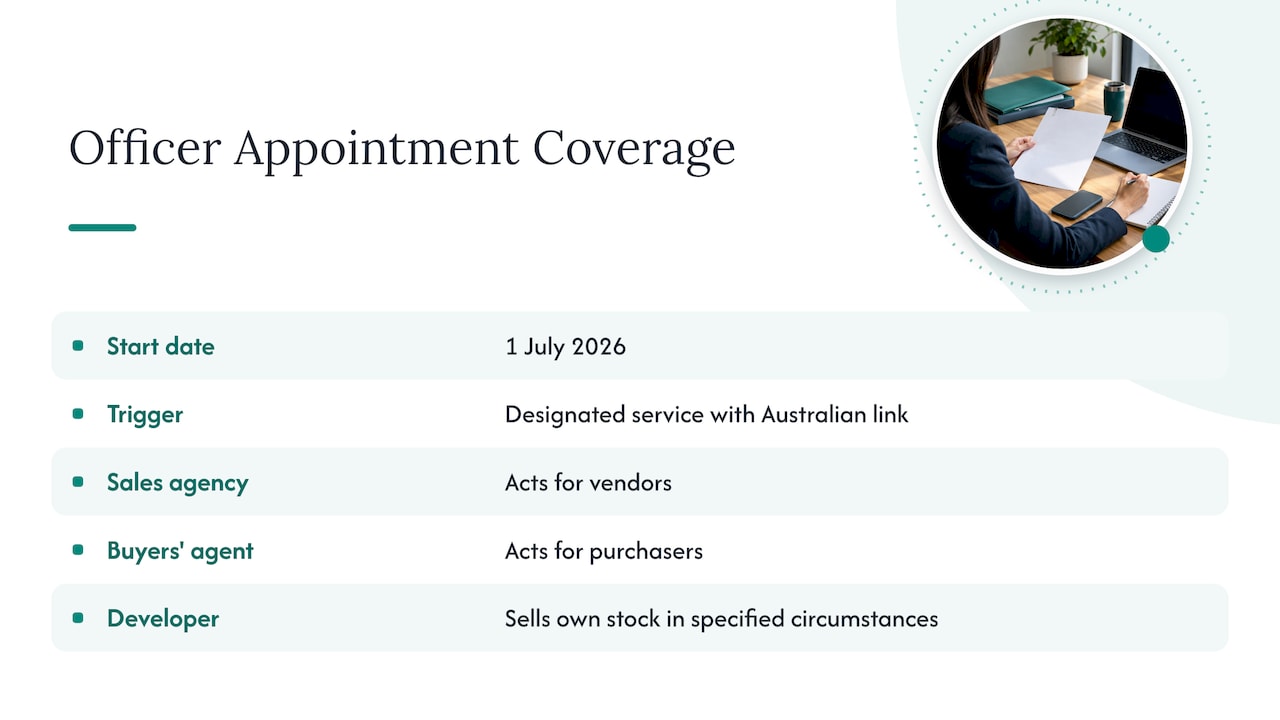
AUSTRAC’s factsheet for Tranche 2 entities says that from 1 July 2026, AML/CTF obligations apply to certain services provided by real estate businesses, including agents, buyers’ agents and property developers, and that these businesses must appoint a compliance officer. The trigger is providing a designated service with an Australian geographical link. AUSTRAC lists these services as including brokering the sale, purchase or transfer of real estate, and selling property directly in specified circumstances.
In practice that covers a sales agency acting for vendors, a buyers agent acting for purchasers (including those handling buying property through an SMSF), and a developer selling its own stock in the circumstances AUSTRAC describes. Each reporting entity designates its own officer. Two agencies under common ownership are still separate decisions if they are separate reporting entities.
Who can hold the role: the section 26J test
Section 26J of the Act sets out five requirements. Read them as a checklist you can evidence, not as a formality.
- Management level. The person must be employed or engaged at management level.
- Sufficient authority. They must be able to require action from agents and property managers, not merely recommend it.
- Independence. They need enough independence to raise problems, including about the agency’s most productive agents.
- Resources and information. They need access to the budget, systems, people and information to do the job.
- Australian residency and fit and proper status. Where designated services are provided through a permanent establishment in Australia, the officer must be an Australian resident, and they must be a fit and proper person. Under the Rules, that assessment weighs a defined set of matters (Rules 5-14), including conflicts of interest.
The conflict-of-interest point deserves attention in an agency. A principal who earns commission on every sale and also decides whether a doubtful customer proceeds has an obvious tension. It is not automatically disqualifying, but you should record how you weighed it and how the officer’s independence is protected.
AUSTRAC states that in a smaller business the officer may be an owner, director or operations or risk manager, and that the officer need not be an employee if an external appointee has the required authority, resources and expertise. The same page confirms that an external officer must still be able to perform every part of the role.
When to designate and notify
Two clocks run under the Act. Section 26K requires you to designate the officer within 28 days of starting to provide a designated service. Section 26M then requires you to notify AUSTRAC within 14 days of the designation. Both sit in the Act.
AUSTRAC’s transitional arrangements gave newly regulated entities until the later of 29 July 2026 and 14 days after enrolling to notify AUSTRAC of their officer. If your agency began providing designated services and you have not yet recorded who your officer is and when you notified AUSTRAC, resolve that first. Keep the designation record, the date, the evidence behind the eligibility assessment and the AUSTRAC notification together so a supervisor can see them in one place.
The core duties under section 26L
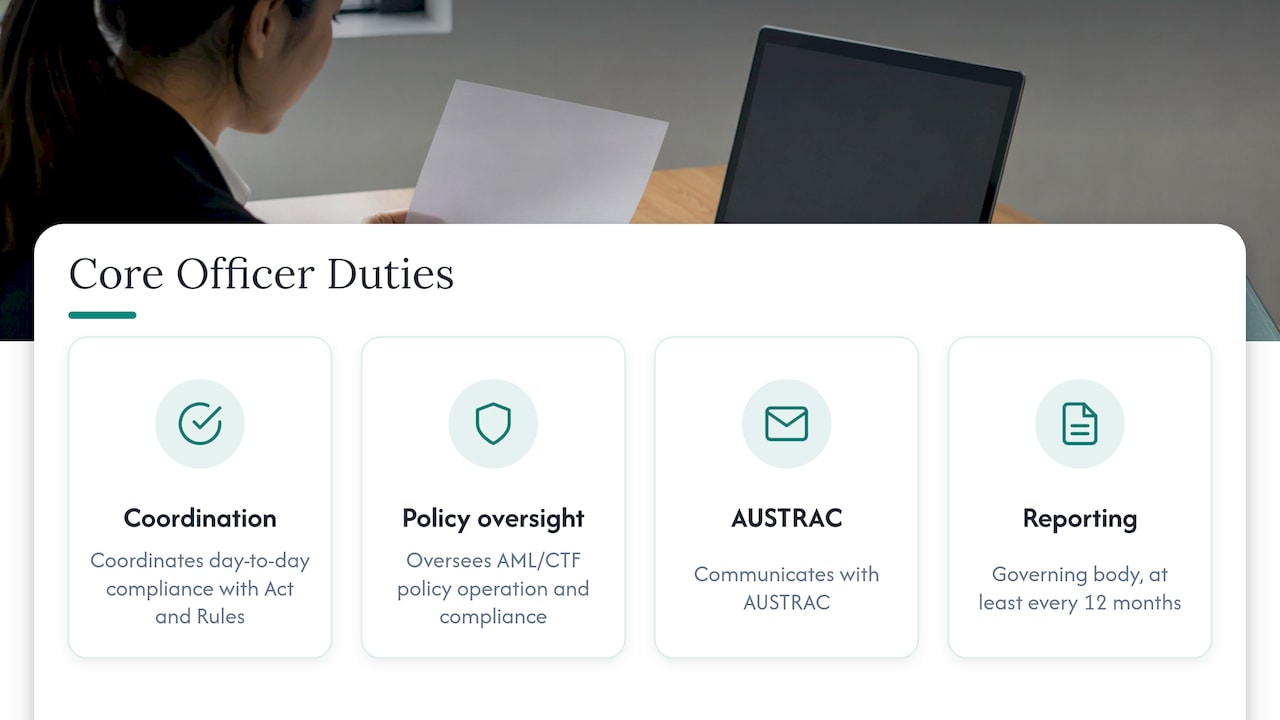
AUSTRAC’s guidance describes the officer’s responsibilities as overseeing and coordinating day-to-day compliance with the Act, Rules and regulations, overseeing the effective operation of and compliance with the AML/CTF policies, communicating with AUSTRAC, and reporting to the governing body at least every 12 months. Here is what each looks like in an agency.
Oversee and coordinate day-to-day compliance
This means knowing, on any given day, whether the agency’s frontline is doing what the policies say. Does every vendor and purchaser have initial customer due diligence (CDD) completed before the designated service begins? Are property managers and sales agents escalating unusual behaviour? Are open files waiting on documents, and who owns the follow-up? AUSTRAC explains that the officer coordinates rather than personally performing every customer check or operational obligation, so delegation is expected. What cannot be delegated is the accountability for knowing it is done.
Oversee the operation of the policies
Policies on paper are not enough. The officer checks that the policies work in the agency’s real transactions: that the high-risk customer approval step is actually used, that the risk rating reflects the reasoning, and that exceptions are recorded. When a policy cannot be followed in practice, the officer’s task is to change the policy or the process, not to tolerate the gap.
Communicate with AUSTRAC
The officer is the agency’s point of contact with the regulator. That includes the designation notification, enrolment-related contact and responding to requests. Keep a log of every communication and who approved what was said.
Report to the governing body at least every 12 months
The governing body is the agency’s top decision-making group, such as the board or the principals. The officer must report at least every 12 months and retains control over the content of that report. That control matters: the principals cannot edit out an uncomfortable finding. A useful report covers the current risk assessment, exceptions and high-risk approvals, reporting activity, training completion, program changes and the status of any evaluation findings. AUSTRAC’s starter-kit document library includes a form for annual governing-body reporting, along with forms for onboarding, periodic and trigger-event reviews and program maintenance.
Overseeing customer due diligence and monitoring
The officer’s oversight of CDD follows the structure in AUSTRAC’s factsheet: initial CDD is generally required before a designated service begins, ongoing CDD applies throughout the relationship, and enhanced measures apply where risk is high. Ongoing CDD includes monitoring transactions and behaviour, updating risk profiles when triggers arise, and reviewing, updating and re-verifying information as needed.
For an agency, three oversight points come up repeatedly.
- Beneficial owners and sanctions. DFAT’s guidance note for real estate professionals says reporting entities must check their customers, any beneficial owners, persons acting on behalf of customers and customers receiving services on behalf of another person against the Consolidated List. Where a purchaser is a company or a trust, the officer needs a consistent way to see who ultimately owns and controls it.
- Monitoring that fits property. Real estate businesses generally deal with each customer in a small number of large transactions, so monitoring should focus on unusual patterns and behaviour rather than frequency. In an agency that means agents reporting a purchaser who is evasive about the source of funds, not a dashboard of transaction counts.
- Reliance on other entities. If the agency relies on another reporting entity’s CDD under a CDD arrangement, AUSTRAC’s reliance guidance says the arrangement must be assessed at least every 2 years, or more often as the risk requires, and after a significant change, with a written record within 10 business days of each assessment.
Overseeing reports to AUSTRAC
The officer does not necessarily lodge every report, but they must know the deadlines are met. Per AUSTRAC’s factsheet, suspicious matter reports (SMRs) are due within 24 hours where the suspicion relates to terrorism financing and within three business days for other matters. Threshold transaction reports (TTRs) are due within 10 business days for physical-currency transactions of A$10,000 or more.
The short SMR clock is the reason escalation has to be easy. An agent who senses something is wrong at an open inspection or a settlement needs a clear path to the officer the same day. The officer’s job is to make that path obvious, make it blame-free, and record what was decided and why.
Maintaining the program, training and records
AUSTRAC’s compliance officer quick guide (December 2025) says the officer should oversee maintenance and updates to the AML/CTF policies and the ML/TF risk assessment, make sure records of senior manager approvals are kept, and oversee the independent evaluation of the program at least once every 3 years.
Training
AUSTRAC’s real estate training material concentrates on sector-specific risks and indicators, completing CDD, managing client conversations and escalating through the correct reporting pathways. Those are the topics your own training should cover, with completion records for every person, including part-time and new staff.
Records
Accurate and complete records must generally be retained for seven years, including the program, CDD, transaction and staff-training records. The quick guide lists the records to keep: the risk assessment and policies with version control, records of approvals and decisions, evidence of completed staff training, reports submitted to AUSTRAC and communications with AUSTRAC.
| Duty | What the officer ensures | Evidence to keep |
|---|---|---|
| Designation | Eligibility met; AUSTRAC notified | Assessment, designation date, notification |
| Day-to-day compliance | CDD done before service starts | File checklists, exceptions log |
| Policy operation | Policies work in real transactions | Review notes, policy versions |
| AUSTRAC liaison | Reports on time, contact logged | SMRs, TTRs, correspondence |
| Governing body | Report at least every 12 months | Report, minutes, approvals |
| Program upkeep | Risk assessment current, evaluation at least every three years | Approvals, evaluation responses |
| Training | Everyone trained and recorded | Completion records |
What stays with the principals and governing body
Appointing an officer does not move responsibility. The Act gives the governing body ongoing oversight of ML/TF risk identification and assessment and of compliance with the AML/CTF policies, the Act, regulations and Rules, plus an obligation to take reasonable steps to ensure risks are managed and mitigated. The practical consequence is that principals should resource the officer properly, read the annual report, and act on what it says.
Covering absences
AUSTRAC addresses what happens when the officer is away, and the agency should plan for it in advance. A nominated deputy, written into the policies, with the same access to files and the AUSTRAC portal, keeps the 24-hour and three-business-day SMR clocks achievable during leave. Record who covers, for what period, and the date handover occurred.
A working week for the officer
The duties above can look abstract, so here is how they tend to fit into a routine in an agency of modest size.
- Daily: review new matters awaiting CDD, anything escalated by agents, and any screening alerts. Decide, record the reasoning, and release or hold the file.
- Weekly: check open exceptions, outstanding documents and any high-risk customers awaiting approval. Confirm that nothing is approaching a reporting deadline.
- Monthly: review training completion, new starters and any changes in the agency’s services, channels or customer base that should flow into the risk assessment.
- Annually or on a trigger: update the risk assessment and policies, obtain approval, and prepare the governing-body report.
- At least every three years: arrange the independent evaluation and track the response to each finding.
A routine of this kind is easy to describe and hard to maintain from a shared inbox and a folder of PDFs, which is where a purpose-built system earns its place.
How AML Guard supports the officer
AML Guard is an AML/CTF compliance platform built for Australian Tranche 2 reporting entities, including real estate agencies, buyers agents and property developers. AML Guard’s guided wizards produce the risk assessment, the AML/CTF program, a customer acceptance policy and the training manual, and can pre-fill from your risk assessment. On each matter, one case record holds each identity check, screening result and officer decision, and beneficial ownership determination runs from a company’s ACN, with an officer approving each one. The platform automates the lookups and the record keeping, not the judgement.
For the officer, that means decisions sit in one case record rather than across an inbox and a spreadsheet. AML Guard is not self-service; every firm starts with a demo. Book a demo, or see the pricing page for the subscription and per-check fees.
If you are still working out the wider obligations, our guides on Tranche 2 obligations and AML training for real estate cover the ground around the officer’s role.
Perspective: the officer’s job is decisions, not data entry
We built AML Guard around a simple view of the compliance officer’s role: the officer is accountable for judgement, so the system should carry the lookups and the paperwork.
AUSTRAC describes an officer who coordinates others and need not do every task. In an agency, that only works if the officer can see what everyone else has done. AML Guard keeps one case record holding each identity check, screening result and officer decision. When a supervisor asks why a customer was accepted, the answer is in one place rather than across an inbox, a CRM note and a spreadsheet.
The same applies to the program. The guided wizards produce the risk assessment, the AML/CTF program, a customer acceptance policy and the training manual, and can pre-fill from the risk assessment, so the officer reports to the governing body on documents that start from the risks the agency assessed.
AML Guard
FAQ
Can a principal or partner be the compliance officer?
Yes, provided they meet section 26J: management level, sufficient authority, independence and resources, Australian residency where relevant, and fit and proper status. AUSTRAC says that in a smaller business an owner or director can hold the role. Naming a principal on paper is not enough, so the person must actually oversee the program and be able to show it.
Does the compliance officer have to complete every customer check?
No. AUSTRAC explains that the officer oversees and coordinates compliance rather than personally performing every customer check or operational task. Agents and staff can carry out checks under the policies, while the officer remains responsible for overseeing that they are done properly and on time.
How often must the officer report to the governing body?
At least every 12 months, and the officer keeps control over the content of the report. Many agencies also brief principals more often when high-risk matters, reports to AUSTRAC or program changes arise.
Can the compliance officer be an external appointee?
Yes. AUSTRAC states that the officer need not be an employee if an external appointee has the required authority, resources and expertise. The agency still designates them under section 26J and notifies AUSTRAC, and the governing body remains accountable for oversight.
Sources
- AML/CTF obligations factsheet for Tranche 2 reporting entities, AUSTRAC
- Real estate designated services, AUSTRAC
- Anti-Money Laundering and Counter-Terrorism Financing Act 2006, Federal Register of Legislation
- AML/CTF compliance officer, AUSTRAC
- Compliance officer quick guide: meeting your AML/CTF obligations, AUSTRAC
- Real estate program starter kit: Document library, AUSTRAC
- Smart real estate agent’s guide to AML/CTF, AUSTRAC
- Guidance Note: Sanctions Compliance for Real Estate Professionals, DFAT
Recommended
- AML/CTF Compliance Checklist for Real Estate Agents
- AML training real estate: what agencies must do
- AML risk assessment for real estate agencies
- When Does AML Compliance Actually Start?
See How AML Guard Works
Tranche 2 obligations are now in force.
Book a 20-minute demo to see how AML Guard supports your compliance from the moment your designated service begins.