
An AML governance framework is not a document that sits in a folder. Under the AML/CTF regime that now binds real estate agencies, it is a set of information flows that must move through the business on a schedule: the compliance officer reports to the governing body at least once every 12 months, the governing body is told each time the risk assessment changes, and an independent evaluation feeds back into both the risk assessment and the policies. An agency that maps those flows to a yearly calendar, and records each one, can show AUSTRAC that oversight is real. AML Guard’s guided wizard produces the AML/CTF program that those flows rest on.
TL;DR
- The governing body must exercise appropriate ongoing oversight and take reasonable steps to make sure risks are managed and the policies and law are followed (section 26H of the Act).
- Four flows keep that oversight alive: the compliance officer’s report at least every 12 months, written notice of each risk assessment update, policies on what information reaches the governing body, and the independent evaluation report.
- AUSTRAC expects the officer’s significant findings to reach the governing body unaltered, and expects minutes that show the body questioned them.
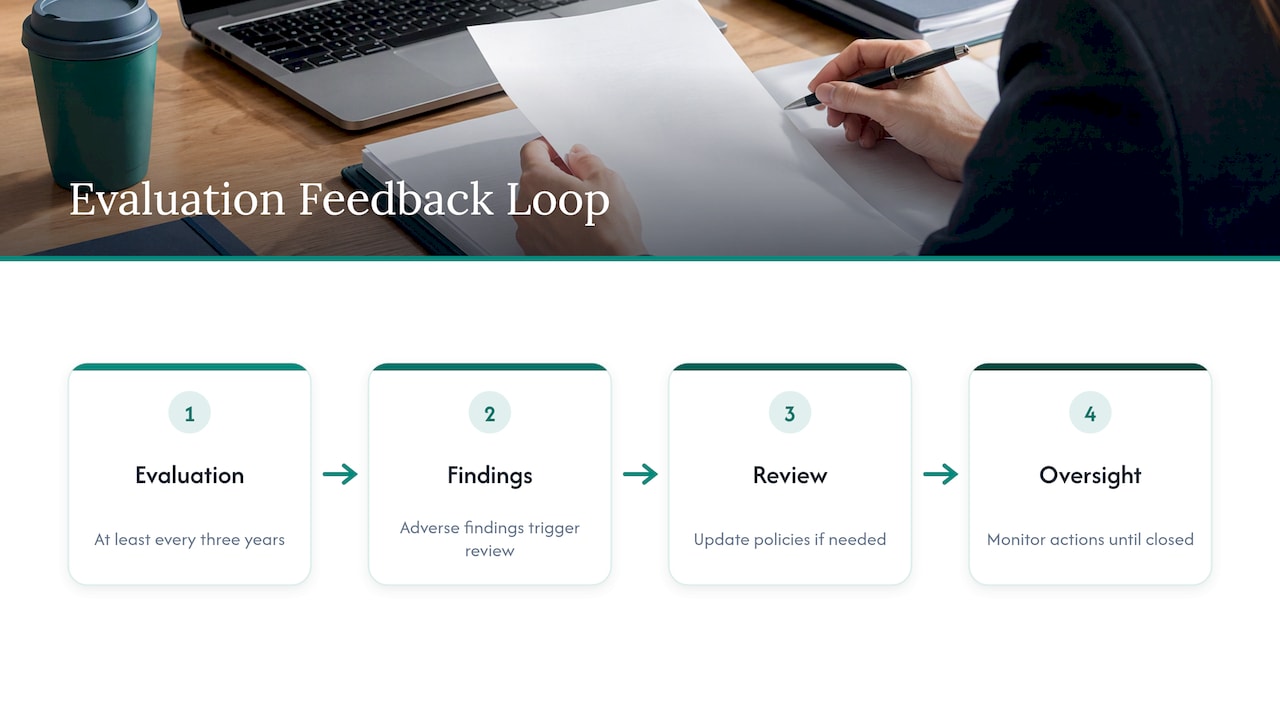
- Adverse findings in an independent evaluation trigger a review of the risk assessment and, where relevant, the policies.
- Tranche 2 obligations for real estate commenced on 1 July 2026, so these flows are already running for every agency.
Table of Contents
- What the law means by a governance framework
- What the governing body is actually required to do
- The four flows the law sets
- What good oversight looks like to AUSTRAC
What the law means by a governance framework
Section 26B of the Anti-Money Laundering and Counter-Terrorism Financing Act 2006 (Cth) treats the framework as two components: the ML/TF risk assessment and the AML/CTF policies, meaning the procedures, systems and controls that manage and mitigate the risks identified. Real estate agencies come under Table 5 of the Act, which covers brokering the sale, purchase or transfer of real estate and selling or transferring real estate that is not brokered by an independent agent. Tranche 2 obligations for the sector commenced on 1 July 2026.
AUSTRAC’s AML/CTF program quick guide says the governance part of the program must set out the governance roles and their responsibilities, the compliance officer’s eligibility requirements, how the governing body or senior manager is kept informed of program performance and risks, the process for the governing body to receive officer reports at least once every 12 months, the process for notifying AUSTRAC within 14 days of appointing a compliance officer, and how the senior manager documents approval of the policies and the risk assessment.
Who holds each role is a separate question, and this article does not repeat it. The question here is what moves between those roles, and when.
What the governing body is actually required to do
AUSTRAC’s page on the governing body defines it as the person or group primarily responsible for the governance and executive decisions of the business. In a large business that may be a board. In a small agency it may be the owner. The obligations sit in sections 26H and 26P(2) of the Act and in Rules 5-7.
There are two duties. The first is appropriate ongoing oversight of how the business identifies and assesses ML/TF risk, and of its compliance with its AML/CTF policies, the Act, the Rules and the regulations. The second is taking reasonable steps to make sure the business is identifying, assessing, managing and mitigating its risks, and complying with its policies and obligations.
The practical reading is that the governing body cannot approve a program once and leave it. It has to receive information, test it and act on it, repeatedly, with evidence. The rest of this article follows that information through a year.
The four flows the law sets
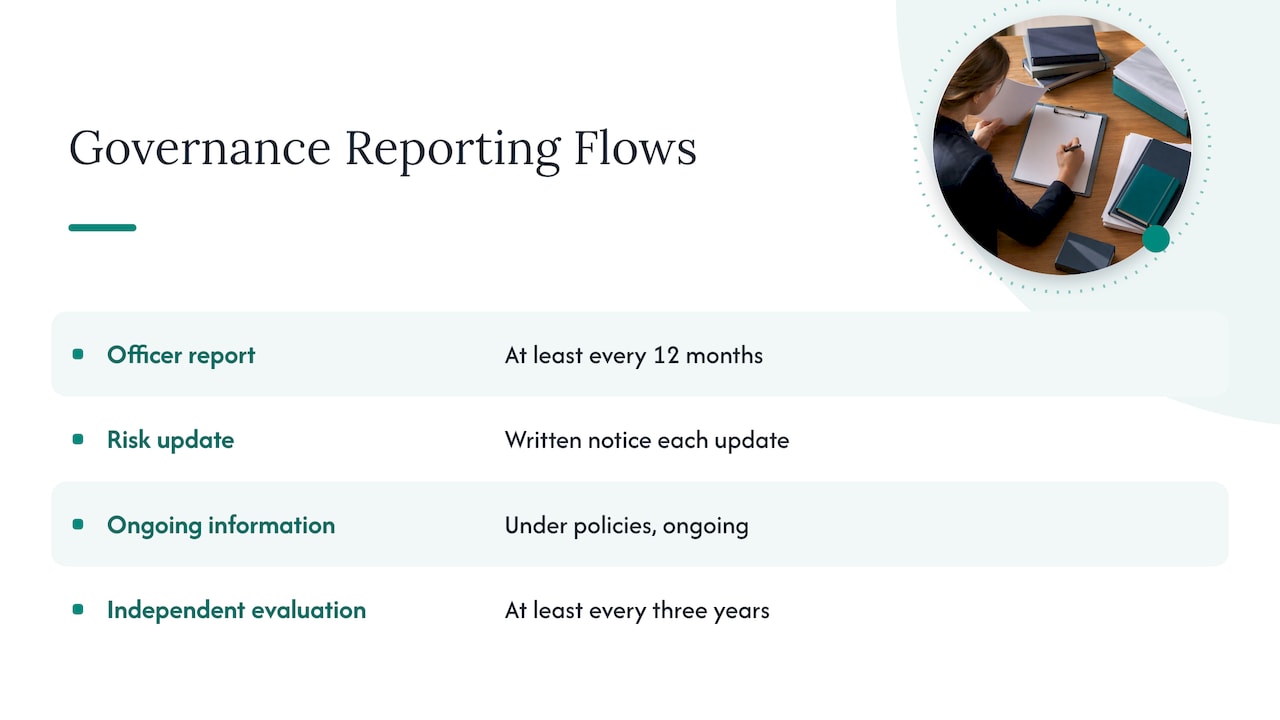
1. The compliance officer’s report, at least every 12 months
The governing body must receive a report from the AML/CTF compliance officer at least once every 12 months. It must cover two things: compliance with the AML/CTF policies and obligations, and how ML/TF risk is being mitigated and managed. The policies must set out how this reporting happens (Rules 5-7). The rule does not apply where the business is an individual, or where the compliance officer is the same person as the governing body. The officer’s report is the main evidence that the policies are being tested against what the agency actually does.
A useful report goes beyond a statement that all is well. It should cover, at a minimum:
- customer due diligence completed, including enhanced due diligence cases and how they were approved;
- suspicious matter reports lodged and any matters considered but not lodged, with reasons;
- staff training completed against the plan;
- changes in services, customers, channels or countries that affect the risk assessment;
- breaches, near misses and the actions taken.
The agency’s own policies decide the format, and the law sets the minimum frequency, not the maximum. A smaller agency with a high volume of transactions has good reason to report more often than yearly.
2. Written notice of each risk assessment update, section 26P(2)
The second flow is triggered by events, not the calendar. Each time the risk assessment is updated, the governing body must be given written notice of the update. This matters because the risk assessment is the foundation for the policies: if it changes and the governing body does not know, its oversight is working from an outdated picture.
AUSTRAC’s step on identifying and assessing risks expects the assessment to cover the inherent risks a business may reasonably face before controls are applied. AUSTRAC’s risk assessment quick guide for real estate professionals lists the four categories to consider: services provided, customers dealt with, channels used to deliver services, and countries dealt with, along with information AUSTRAC communicates about ML/TF risk.
AUSTRAC’s step on reviewing and updating the program says the risk assessment must be reviewed at least once every three years, and also on a significant change: when AUSTRAC communicates information that identifies or assesses risks for the designated services, or when an independent evaluation report has adverse findings about the risk assessment. Every one of those reviews that results in an update produces a written notice to the governing body. For more on building the assessment itself, see our guide to the AML risk assessment for real estate agencies.
3. Policies on giving the governing body the information it needs
The third flow is a standing design requirement rather than a dated event. The AML/CTF policies must set out how the governing body, or the senior manager, is kept informed of program performance and risks (Rules 5-6). Written down, this answers practical questions: who sends what to the governing body, in what form, how often between formal reports, and how an urgent matter is escalated.
AUSTRAC’s guidance on reasonable steps adds the protections that make the flow trustworthy. The compliance officer should have a direct line of communication to the governing body and the authority to escalate issues. AUSTRAC also lists, as an example of reasonable steps, making sure that no other person amends or removes significant findings or recommendations in the officer’s reports before they reach the governing body. In a small agency where the officer and the owner are different people, this is the safeguard that protects an unwelcome finding from being softened on its way up.
The officer must also have sufficient authority, independence from internal and external influence, and access to resources and information. AUSTRAC points to staff, funding, technology and access to information as the evidence of that.
4. The independent evaluation report
The fourth flow tests everything else. The AML/CTF obligations factsheet for Tranche 2 entities states that an independent evaluation of the program is required at least once every three years. AUSTRAC’s step on independent evaluations describes what the evaluator examines: how the risk assessment was undertaken or reviewed, the design of the policies against the Act and Rules, and whether the business appropriately identified, assessed, mitigated and managed its risks and complied with its own policies. The policies must set the frequency, which must suit the nature, size and complexity of the business.
The scope depends on what the agency does. A residential agency, a buyers agent and a developer face different exposures, and developers in particular see risk vary with the types of residential development projects they run, which the evaluator should see reflected in the risk assessment.
The feedback loop is where governance becomes visible. An evaluation report with adverse findings about the risk assessment requires a review of that assessment. Adverse findings about the policies require the policies to be reviewed and, if needed, updated. The governing body is expected to read the report, question how the business will address any adverse findings, and monitor the actions until they close.
What good oversight looks like to AUSTRAC
AUSTRAC’s governing body guidance gives examples of behaviour that may show appropriate oversight. They include having AML/CTF compliance and ML/TF risk as a regular standing agenda item, reviewing the matters raised in compliance officer and independent evaluation reports, questioning how the business will address adverse findings and the root causes of ongoing breaches, understanding the risk assessment and how its methodology was designed, keeping meeting minutes that show how the governing body engaged with these matters, and monitoring the actions taken to fix non-compliance.
AUSTRAC also gives the opposite picture. Limiting the officer’s ability to give candid and regular updates, not considering the officer’s reports, not questioning the root cause of ongoing breaches, not understanding the risk assessment, and having no standing agenda item for ML/TF risk and compliance are its examples of inappropriate oversight.
For a small agency, the practical test is the calendar. Put the four flows on it: the officer’s report on a fixed date at least every 12 months, a written notice to the governing body whenever the risk assessment is updated, the information the policies say the governing body receives between reports, and the independent evaluation at least every 3 years. Then keep the minutes, notices and responses together, so the oversight can be shown and not only asserted.
AML Guard’s guided wizards produce the risk assessment, the AML/CTF program, a customer acceptance policy and the training manual, and can pre-fill from your risk assessment. On each matter, one case record holds each identity check, screening result and officer decision, and beneficial ownership determination runs from a company’s ACN, with an officer approving each one. The platform automates the lookups and the record keeping, not the judgement. AML Guard is not self-service; every firm starts with a demo. Book a demo, or see the pricing page for the subscription and per-check fees.
Recommended
- AML governance dashboards: what a board needs
- AML compliance calendar: the dates the law sets
- Ongoing AML monitoring for Tranche 2 firms
- AML risk scoring that stands up to AUSTRAC
See How AML Guard Works
Tranche 2 obligations are now in force.
Book a 20-minute demo to see how AML Guard supports your compliance from the moment your designated service begins.