
A governance dashboard for AML pulls the state of your compliance program into one evidence-backed view for the governing body, not a compliance certificate. It should surface overdue re-verifications, screening matches waiting on an officer decision, training completion, policy version currency, and the date the risk assessment was last reviewed. Every item on it needs a named owner. It has no legal standing on its own, but it’s how boards see whether the real obligations are being met.
TL;DR:
- Dashboards must prioritize obligations and responsibilities over generic reporting, focusing on overdue items, decision timelines, and responsible owners.
- Effective KPIs include overdue re-verifications beyond 45 days, percentage of high-risk customers reviewed on time, and staff training completion rates.
- Mapping ownership clearly with RACI and role-based views ensures accountability and streamlined reporting for board and management oversight.
- Reliable data depends on having a single source, traceable lineage, and regular reconciliation to prevent drift and maintain trustworthiness.
- Linking dashboards to program artefacts like risk assessments and policies creates an audit trail that proves compliance during inspections or evaluations.
Table of Contents
- What should a governance dashboard include?
- Which KPIs actually map to governance obligations?
- How should RACI and role-based views shape the dashboard?
- How do you keep dashboard data trustworthy for governance?
- How does AML Guard turn records into board evidence?
- What actually breaks first-time governance dashboards?
- Get an audit-ready dashboard without building one from scratch
- Sources
What should a governance dashboard include?
Most dashboards fail for a boring reason: they were built as a general-purpose reporting tool and then bent to fit AML/CTF governance, rather than designed around the specific duties a governing body actually holds. A governance dashboard AML teams can trust starts with the obligations themselves and works backwards to the metrics.
Think of it in four layers, from board-level summary down to operational detail.
Executive summary widgets sit at the top. These should answer three questions at a glance: is the program healthy, where are the top risks concentrated, and are the controls actually working. A red/amber/green control-effectiveness indicator belongs here, alongside a one-line risk appetite statement and any material change since the last board cycle.
Operational trackers come next, and this is where most of the day-to-day compliance monitoring dashboard work happens:
- Suspicious matter report pipeline, aged by days open, with SLA breach flags
- Screening-match queue, showing who owns each unresolved match and how long it’s been sitting
- Threshold transaction reporting status against lodgement deadlines
- CDD verification backlog, split by risk tier
CDD and beneficial ownership items need their own lane rather than being buried inside the general operational tracker. Unresolved beneficial ownership determinations, particularly ones running through a corporate trustee structure for a trust or SMSF, tend to sit open longer than standard identity checks and deserve visibility precisely because they’re easy to lose track of.
Governance artefacts status is the layer that most spreadsheet-based dashboards get wrong or skip entirely:
- Current version number and review date for each AML/CTF policy
- Date the business-wide ML/TF risk assessment was last reviewed
- Training attestation completion rate by team and by individual
- Outstanding remediation actions from the last independent evaluation, each with an owner and a due date
Controls and remediation tracking ties it together. Every open finding should link to evidence: a document, a screenshot, a system log, something a supervisor could actually inspect rather than a status the compliance officer typed in from memory.
Pro Tip: Build the governance artefacts layer first, even if it feels less urgent than the SAR pipeline. It’s the layer AUSTRAC examiners and external evaluators ask about first, and it’s the one most firms have the weakest visibility over.
Which KPIs actually map to governance obligations?
Not every number worth tracking is worth putting in front of the governing body. The KPIs that earn a place on a governance dashboard AML compliance officers rely on are the ones that answer a specific oversight question, not the ones that are simply easy to pull from a system.
Useful KPIs for board-level reporting include:
- Percentage of high-risk customers reviewed within the internal guidelines
- Percentage of customers with current customer due diligence documentation
- Staff training completion status, broken down by employee category
- Typical time-to-decision on a screening match, from alert to officer sign-off
- Number of overdue re-verifications, categorized by ageing bands
That last point matters more than a single percentage. A screening match sitting open for three days is routine. One sitting open for 45 days without an officer decision is a governance failure waiting to be found by an evaluator. Pipeline ageing bands turn a flat backlog number into something the board can actually act on.
Each of these should trace back to a named duty. Percentage of high-risk cases reviewed on time evidences the governing body’s ongoing oversight of risk appetite. Training completion evidences that senior managers are meeting their accountability for staff competency. Risk assessment review date evidences the AML/CTF Act 2006 (Cth) requirement that the program stays current as the business changes.
On reporting cadence: operational trackers should be updated regularly, the governance pack presented periodically, and escalations reported promptly when thresholds are exceeded, such as a high-risk case unresolved beyond a pre-agreed duration.
Set the escalation threshold before you need it, not after a bad quarter. A board that only sees KPIs when something has already gone wrong isn’t exercising oversight, it’s doing damage control.
How should RACI and role-based views shape the dashboard?
A governing body can’t exercise oversight over a number with no name attached to it. Every overdue item needs an accountable owner, and the dashboard should show that ownership explicitly rather than leaving the board to infer it from a job title.
Map the dashboard to RACI in a straightforward sequence:
- Identify who is Responsible for actioning each item (the analyst working the screening queue)
- Identify who is Accountable for the outcome (the AML/CTF compliance officer, by name, not by role title alone)
- Identify who needs to be Consulted before an escalation (senior management for a high-risk approval)
- Identify who is simply Informed (the governing body, via the summary view)
Once that mapping exists, role-based views follow naturally:
- The board view shows program health, trend lines, and anything that’s breached an escalation threshold, nothing more
- The senior management view adds operational detail: pipeline volumes, SLA performance, remediation progress
- The frontline view shows only the individual’s own open items and due dates
The payoff shows up at board meetings. A one-click export that turns the current dashboard state into a board pack, complete with the date range and the names attached to each open item, saves the compliance officer hours of manual report assembly and gives the board something with an audit trail attached to it: who approved what, and when.
Escalation paths should live inside the dashboard too, not in a separate email chain. A screening match that crosses the 60-day threshold should visibly route to senior management, and an approval on a high-risk customer should show the officer’s name and the date of sign-off directly on the tile.
How do you keep dashboard data trustworthy for governance?
A dashboard is only as reliable as its weakest data feed. Practitioner experience across compliance platforms consistently points to the same failure mode: a system that pulled live data at launch and then quietly drifted out of sync with the systems it was meant to reflect, because nobody set up reconciliation.
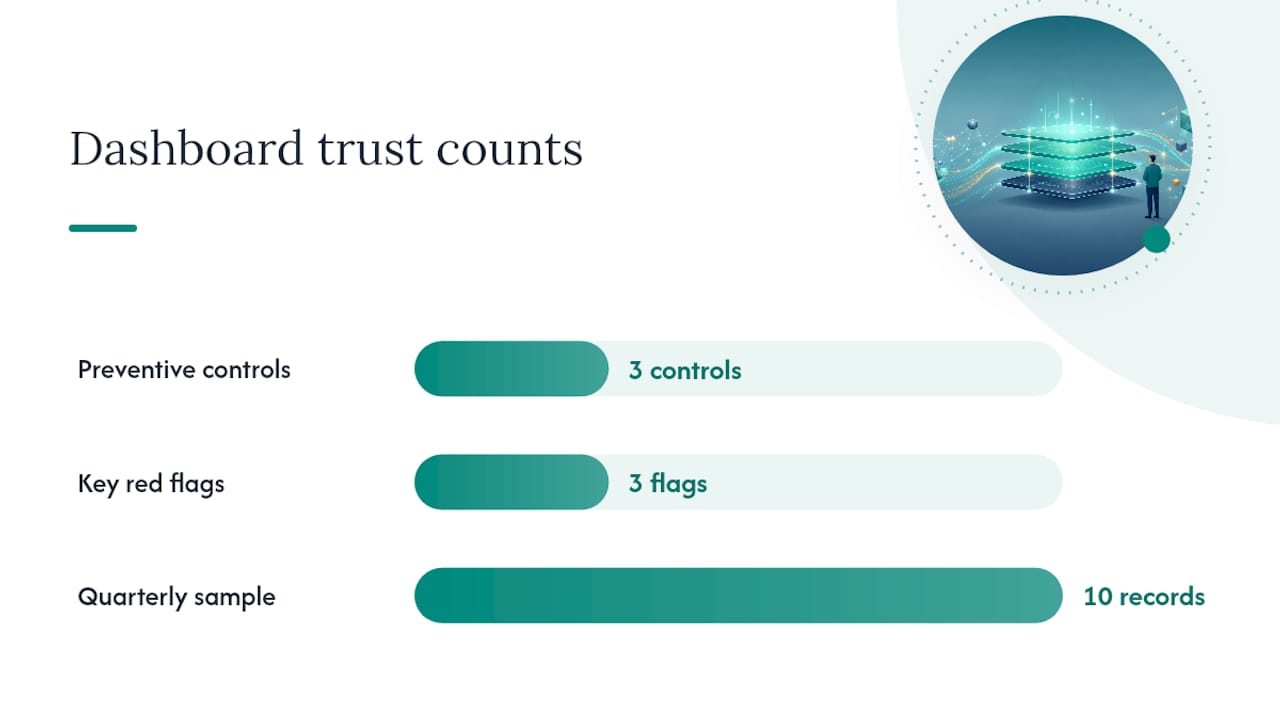
Three controls prevent that drift:
- Canonical data sources, meaning every metric has exactly one system it’s sourced from, never a manual reconciliation between two systems that might disagree
- Data lineage, so any number on the board pack can be traced back to the specific record that produced it
- Periodic reconciliation, spot-checking a sample of dashboard entries against the underlying case file to confirm the numbers still match
A tamper-evident audit trail underneath the dashboard matters just as much as the reconciliation process. If an officer overrides a risk score or closes a screening match, that action needs to be logged with a timestamp and a name attached, not silently overwritten. That’s the difference between a dashboard an evaluator can trust and one they have to independently verify from scratch, which defeats the purpose of having a dashboard at all.
Watch for three red flags in particular:
- An integration that hasn’t synced in weeks, quietly showing stale figures as current
- Manual overrides on risk scores or match decisions with no record of who made the change or why
- Dashboard tiles with no clear owner, meaning nobody is accountable when the number goes wrong
Pro Tip: Run a quarterly sample reconciliation, even a small one, ten records checked against source. It costs an afternoon and it’s the single fastest way to catch a stale integration before an evaluator or examiner finds it for you.
How does AML Guard turn records into board evidence?
A dashboard is only as good as what feeds it, and that’s where most governance dashboards quietly fall short. They display numbers someone typed in rather than numbers pulled live from the underlying record. A governance dashboard can draw from linked records such as the business-wide risk assessment, AML/CTF policies, CDD and beneficial ownership determinations, training attestations, and suspicious matter and threshold transaction logs.
Because those four program artefacts come from one linked set of guided answers, a change to the risk assessment shows up as a review flag on the dashboard automatically, rather than depending on someone remembering to update a separate tracker.
| Governance need | How it shows up on the dashboard |
|---|---|
| Compliance officer accountability | Named owner attached to every overdue item |
| Governing body oversight | Executive summary with program health and trend view |
| Audit readiness | 8-year tamper-evident audit trail behind every tile |
| CRM visibility without data exposure | Status indicators pushed to REX CRM, never CDD data |
That audit trail matters at inspection time. An AUSTRAC examiner or an independent evaluator asking why a high-risk case took 40 days to close can be shown the exact record, the exact decision, and the exact date, rather than a compliance officer’s best recollection.
A dashboard built this way is still not a substitute for the program itself. It’s a window onto whether the real obligations, the officer’s role, the governing body’s approvals, senior management’s accountability, are being met in practice.
What actually breaks first-time governance dashboards?
Every dashboard I’ve seen fail traces back to the same three habits: someone builds it in a spreadsheet, nobody names an owner for the overdue items, and the exports going to the board are summaries someone wrote rather than evidence pulled from source.
Start smaller than you think you need to. A live verification status feed, a training completion count, and a list of overdue actions with names attached will do more for board confidence than a polished dashboard with twelve widgets and no data lineage behind any of them. Bring the governing body one clean export, not a full platform demo, and let the evidence make the case for itself.
Get an audit-ready dashboard without building one from scratch
Building the integrations, the audit trail, and the RACI mapping described above from scratch is a genuine engineering project, one most reporting entities don’t have the resources to run alongside their actual compliance workload. Some compliance platforms provide a governance dashboard fed by linked program artefacts, CDD and beneficial ownership determinations, and training attestations, delivering one view with a tamper-evident audit trail.
If you’re evaluating options, ask any demo to show you three things: a board-ready summary export, the evidence trail behind a single overdue item, and how status indicators pass to your REX CRM without exposing CDD data. That’s the real test of whether a dashboard gives you evidence or just another summary to double-check. Book a demo to see how AML Guard maps your program artefacts, from the risk assessment through to CDD records, into one governance view your board can actually rely on.
Sources
Recommended
- AML risk scoring that stands up to AUSTRAC
- AML risk assessment template for Tranche 2 firms
- AML/CTF policy template for Tranche 2 firms
- Three CRM AML Compliance Architectures Emerging Ahead of Tranche 2
See How AML Guard Works
Tranche 2 obligations are now in force.
Book a 20-minute demo to see how AML Guard supports your compliance from the moment your designated service begins.