
In an Australian AML/CTF program, “risk appetite” is your business’s own decision about which money laundering and terrorism financing (ML/TF) risks you will accept, which you will not, and which need a senior decision first. The phrase does not appear in the Act. The decision does its work through your ML/TF risk assessment (section 26C) and your AML/CTF policies (section 26F), so a risk appetite statement is only worth writing if your policies and your day-to-day customer decisions follow it. Since Tranche 2 obligations commenced on 1 July 2026, real estate agencies, conveyancers, law firms, accountants and trust and company service providers are all expected to be able to show that decision on paper.
TL;DR
- Risk appetite is your choice of which ML/TF risks you accept, written into your risk assessment and policies. It is not a defined term in the Act.
- A usable statement names the customers, services, channels and countries you accept, decline or escalate, and says what happens when a customer falls outside it.
- Appetite never switches off an obligation: an accepted foreign PEP still needs enhanced CDD and senior manager approval, and declining a customer does not cancel a suspicious matter report.
- When you end a relationship, give a genuine reason that does not tip the customer off.
- A senior manager must approve the assessment and policies in writing, and the assessment must be reviewed at least every three years.
Table of Contents
- What risk appetite means under the AML/CTF Act
- Why the regulator’s wording matters
- What a workable statement contains
- From statement to controls: a worked example
- Appetite cannot switch off an obligation
- Ending a relationship without tipping off
- Who approves it and how often you review it
- Making it audit-ready
- Common mistakes
- How AML Guard supports this
- Our view on risk appetite
- FAQ
- Sources
What risk appetite means under the AML/CTF Act
The Act asks two things of you. First, an ML/TF risk assessment that identifies and assesses the money laundering, terrorism financing and proliferation financing risks you may reasonably face in providing designated services, with steps appropriate to the nature, size and complexity of your business (section 26C). Second, AML/CTF policies that manage and mitigate those risks. Together, the assessment and the policies make up your AML/CTF program under section 26B.
Risk appetite sits between the two. The assessment tells you what risks exist. Your appetite is the answer to “which of these are we prepared to carry, and on what conditions?” The policies then turn that answer into rules staff can follow. A simple way to hold the idea: the assessment describes exposure, the appetite sets the limit, and the policies enforce it.
A risk appetite statement is simply the written form of that decision. It can be a short section at the front of your policies or a one-page document the principal signs. Either way, what matters is that it is specific enough to change what a salesperson, property manager or paralegal does on a Tuesday afternoon.
Why the regulator’s wording matters
AUSTRAC’s guidance on AML/CTF policies expects them to be targeted to the specific vulnerabilities in your risk assessment, proportionate to the level of risk, and effective in practice. Its examples of meeting that expectation are practical rather than theoretical. One is service terms that allow you to stop acting if a customer withholds KYC (know your customer) information or otherwise falls outside your ML/TF risk appetite. Another is a business rule not to serve specified kinds of high-risk customers.
Those examples show how AUSTRAC reads the idea: appetite is something you can act on. If your statement says you will not accept customers whose beneficial ownership you cannot establish, your engagement or appointment terms need to let you walk away when that happens. A statement that the business “has a low tolerance for risk” gives staff nothing to apply and gives a supervisor nothing to test.
What a workable statement contains
For a real estate agency, buyers agent, conveyancing practice or small firm, a statement that does its job usually covers five things.
1. The risks you accept
Name them plainly. For an agency this might be Australian-resident individuals buying or selling an owner-occupied home through standard channels, where identity is verified face to face or electronically and funds come through the conveyancing process.
2. The risks you accept only with conditions
This is where most of your real decisions sit. A company or trust buyer, a purchaser relying on an agent overseas, or a customer connected to a higher-risk country might be acceptable only after enhanced CDD, more onboarding information and sign-off by a named senior manager. Write down who signs and what they must see first.
3. The risks you do not accept
Be concrete. Examples might include customers who will not provide or allow verification of beneficial ownership, structures where the real owner cannot be identified, or customers you cannot meet or verify through any channel you operate. The Law Society of NSW’s implementation guide for small practices gives a worked example of this: a practice that will not accept the risk of effective anonymity records that it will avoid it by requiring collection and verification of beneficial ownership information, and will not proceed with onboarding if the client does not comply.
4. Limits by customer, service, channel and country
The four risk factors you assess are the natural axes for limits. The same guide asks practices to go through a risk factor table for each designated service, client type and delivery channel and mark each one “Yes” (accepted) or “No” (not accepted, with the steps taken to avoid the risk). For countries, it asks practices to record each country they deal with, note its Basel AML Index rating, check it against the FATF high-risk jurisdictions list and the DFAT Consolidated List, assign a final rating and decide whether the country is within appetite, with controls documented for any marked “No”. You do not need to be a law firm to borrow the structure.
5. What happens at the edge
Say what staff do when a customer, service or transaction lands outside the statement: who they tell, who decides, what gets recorded, and how the relationship is ended if it comes to that.
From statement to controls: a worked example
Suppose a suburban agency sells a property for a company vendor and the buyer is a trust acting through a corporate trustee. The agency’s statement says it accepts company and trust customers only where beneficial ownership is established and verified, and that anything involving a high-risk jurisdiction goes to the principal.
The statement then drives the rest:
- The risk rating for the customer is higher than for a resident individual, because the structure adds a layer between the person and the asset.
- A higher rating triggers enhanced CDD, more onboarding information and closer monitoring. The Law Society’s risk assessment template ties ratings to controls in just this way: high-rated clients get enhanced CDD and annual reviews, medium-rated clients get reviews every two years, and low-rated clients can use simplified CDD with reviews every three years.
- If the trustee will not disclose who controls the trust, the statement says the agency does not proceed. The service terms already allow it to stop acting, so the decision is straightforward and consistent.
- The reasoning, the approver and the outcome are recorded in the file.
The point of the exercise is that the principal does not decide from scratch each time. The statement has already decided, and the file shows it.
Appetite cannot switch off an obligation
This is where businesses most often misuse the concept. Accepting a risk does not reduce what the law requires you to do about it.
- A foreign PEP you accept still needs enhanced CDD and senior manager approval (section 32 and Rules 5-5). Appetite decides whether you will take on the customer. It does not remove the extra steps.
- Declining a customer does not cancel a suspicious matter report. If you have formed the relevant suspicion, section 41 still requires the report, whether or not you proceed with the customer.
- Ongoing CDD is not optional for accepted customers. Section 30 requires you to monitor customers to identify, assess, manage and mitigate ML/TF risk, to watch for unusual transactions and behaviour that may give rise to a suspicious matter reporting obligation, and to review and reverify KYC information at a frequency appropriate to the customer’s ML/TF risk.
A well-drafted statement says this expressly: “Acceptance of a risk does not reduce the CDD, escalation or reporting steps required for it.” It stops a busy team reading “we accept this customer” as “we can skip the extra checks”.
Ending a relationship without tipping off
When a customer falls outside your appetite, the practical question is how to say no. Section 123 of the Act makes tipping off an offence: you must not disclose information about a suspicious matter report, or about a related notice under section 49 or 49B, where the disclosure would or could reasonably be expected to prejudice an investigation.
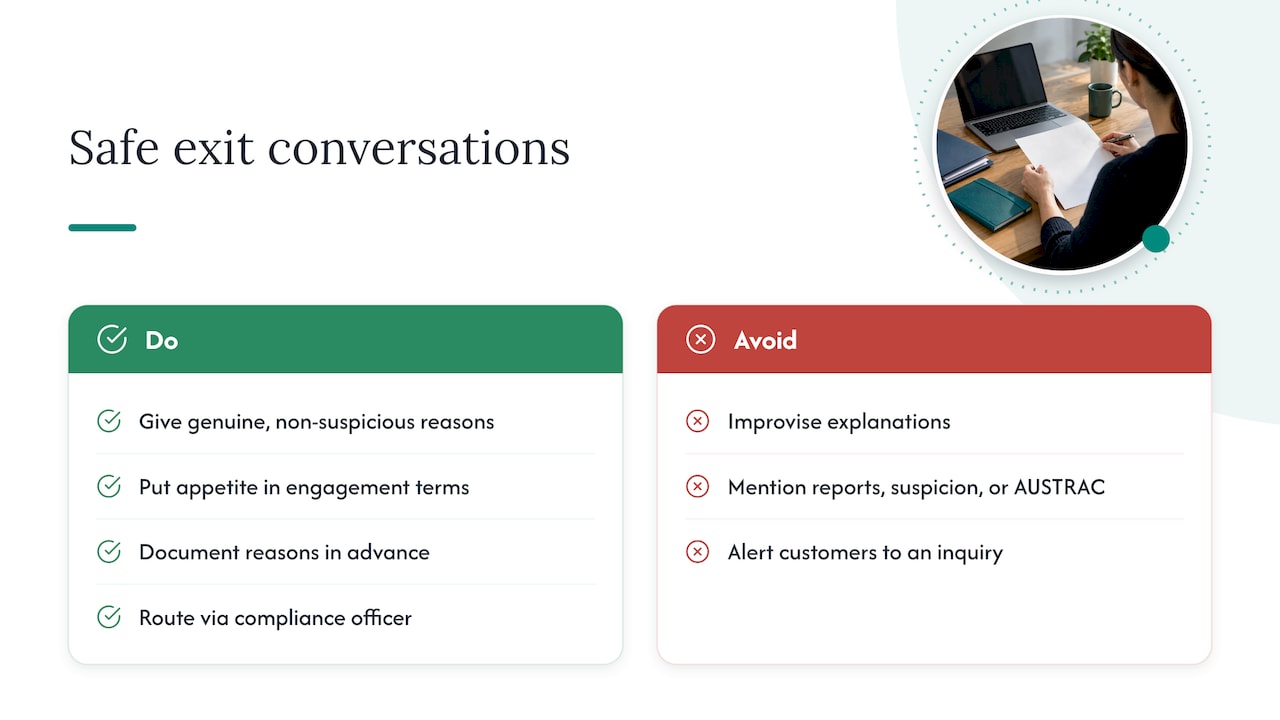
AUSTRAC’s tipping off guidance says that where possible you should give genuine reasons for ending a relationship that do not indicate you are suspicious of the customer’s conduct. It lists examples, including that the general nature of the customer’s activities falls outside your business’s risk appetite, or that the customer has not responded to requests for further information within a reasonable timeframe or in a satisfactory way.
This is a good reason to put appetite into your terms of engagement. If the reason you give is true, documented in advance and applied to every customer in the same position, it is both honest and safe. Staff should be told not to improvise explanations and not to mention reports, suspicion or AUSTRAC. Route the conversation through the compliance officer or principal.
Who approves it and how often you review it
Approval is a legal requirement, not a courtesy. Section 26P requires your ML/TF risk assessment and AML/CTF policies, including every update, to be approved by a senior manager. Any update to the assessment must also be notified in writing to the governing body as soon as practicable, and non-compliance is a civil penalty provision. AUSTRAC’s Step 3 guidance adds that the program must be documented before you start providing a designated service, updates must be documented within 14 days, and the written approval should show the senior manager’s name, role and date.
Because the statement shapes both documents, treat it as part of what the senior manager approves. If the statement lives in a separate file nobody signs, it will drift away from the policies.
On timing, section 26D requires you to review your risk assessment when there is a significant change to relevant matters, when AUSTRAC communicates risk information, in circumstances set out in the Rules, and in any event at least once every three years. Where the change is within your control, such as adding property management, taking on a new class of client or opening an office, the review must happen before the change. In practice, revisit the statement whenever you revisit the assessment.
Making it audit-ready
A supervisor or independent evaluator will not ask whether you own a risk appetite statement. They will ask whether your actual decisions match it. The Law Society guide notes that you must be able to demonstrate the steps taken in your risk assessment, and that those steps are evaluated in your independent evaluation under Rules 5-10(2).
To be able to show that, keep:
- the approved statement, with the approver’s name, role and approval date;
- the link from each accepted, conditional and declined category back to your business-wide risk assessment;
- for each customer, the risk rating, the reasoning and the control applied;
- records of every escalation and every decision not to proceed, with the genuine reason given;
- training records showing staff were taught the statement, which matters because staff training is where a statement either becomes practice or stays on the page.
Common mistakes
- Copying a bank’s statement. Large institutions publish enterprise-wide statements built around capital and board risk committees. A small agency needs a few pages about customers, channels and countries it actually deals with.
- Writing a statement the business cannot apply. “No high-risk customers” is not a rule unless staff know what makes a customer high risk.
- Declining without a record. A refusal with no file note looks arbitrary, and it leaves the reasoning for the next person to reconstruct.
- Mixing up appetite and the risk rating. The rating describes one customer. The appetite decides which ratings you will take on and what you require when you do.
- Forgetting the paper trail for the ‘no’. Declined customers still matter if a suspicious matter report is due.
How AML Guard supports this
If your policies, assessment and training are written separately, the statement is the first thing to drift. AML Guard’s guided wizards produce the customer acceptance policy and can pre-fill it from your risk assessment, so what you decide to accept, escalate or decline in the assessment carries through to the policy. The same wizards produce the risk assessment, the AML/CTF program and the training manual. On each matter, one case record holds each identity check, screening result and officer decision, and an officer approves each beneficial ownership determination. The platform automates lookups and record keeping. The judgement stays with your people.
See the platform subscription and check options to find the setup that fits your agency or practice.
For the wider context on how CDD obligations begin in a property transaction, see our guide to when CDD starts for real estate.
Our view on risk appetite
We think the most useful test of a risk appetite statement is whether a new team member could apply it on their first week without asking someone. If they cannot, it is an aspiration, not a control.
The Act does not define risk appetite, and that is a strength for a small business. It leaves you free to say, in your own terms, which customers, services, channels and countries you will take on and on what conditions. What it does not leave you free to do is let that choice quietly override a duty. Enhanced CDD, senior manager approval for a foreign PEP and suspicious matter reporting apply whatever you decide about acceptance.
That is why the customer acceptance policy in AML Guard is pre-filled from the risk assessment. The statement stops being a separate document that someone has to remember to update, and a supervisor looking for consistency can follow it from the assessment to the policy.
We also keep the officer in the loop. The platform handles the lookups and the record keeping, and a person approves each beneficial ownership determination. Appetite is a judgement, and judgement belongs to your principal and compliance officer. AML Guard is not self-service; every firm starts with a demo. Book a demo, or see the pricing page for the subscription and per-check fees.
AML Guard
FAQ
Is a risk appetite statement legally required?
The Act does not use the term or require a document with that title. It does require an ML/TF risk assessment (section 26C) and AML/CTF policies (section 26F), approved by a senior manager. A written statement of what you accept and decline is the clearest way to show those two documents reflect a deliberate decision.
Where should the statement sit in my program?
Put it with your policies and make it consistent with your risk assessment, so one senior manager approval covers both. Staff should be able to find it from the customer acceptance and escalation steps they already use. Keep the approval name, role and date alongside it.
Can I accept a high-risk customer?
Yes, if your statement allows it and you meet the obligations that come with that customer. A foreign PEP, for example, needs enhanced CDD and senior manager approval. The decision to accept never replaces those steps, and any suspicion still has to be reported under section 41.
What do I tell a customer I decline?
Give a genuine reason that does not suggest suspicion, such as the customer falling outside your risk appetite or not providing information you requested in a reasonable timeframe. Do not mention any report or inquiry, because section 123 makes tipping off an offence. Have the compliance officer or principal handle the conversation and record it.
How often should I update the statement?
Review it whenever you review your risk assessment: after a significant change, when AUSTRAC communicates risk information, and at least every three years under section 26D. Changes within your control, such as a new service or channel, need the review before the change goes live.
Sources
- Anti-Money Laundering and Counter-Terrorism Financing Act 2006, Federal Register of Legislation
- AUSTRAC: Step 3, Manage and mitigate your risks, AML/CTF policies
- AUSTRAC: Tipping off
- Law Society of NSW: AML/CTF Implementation Guide for sole practitioners and small practices
- Law Society of NSW: Risk assessment template
Recommended
- Risk-Based AML/CTF: How the Act Builds It
- AML/CTF Policies in Australia: What the Law Asks
- AML risk scoring that stands up to AUSTRAC
- Which AML/CTF program template should you use in 2026?
See How AML Guard Works
Tranche 2 obligations are now in force.
Book a 20-minute demo to see how AML Guard supports your compliance from the moment your designated service begins.